

Selecting an enterprise ABM platform is a high-stakes investment that shapes pipeline quality, marketing efficiency, and sales alignment long after the contract is signed. And most evaluation processes aren’t designed to predict whether a platform will actually deliver in production.
If your team is at this stage, you’ve probably already reviewed comparison sites and sat through vendor demos. What you need now is a structured way to test vendor claims against your actual GTM motion, align stakeholders who are evaluating different things, and justify a decision that will affect how your revenue teams operate for years.
This guide provides a performance-focused evaluation framework that goes beyond feature lists and assesses real business impact. You’ll learn how to define platform requirements, evaluate vendor fit across four pillars, run a proof of concept that tests production performance, and recognize when a broader data intelligence platform may serve your needs better than a dedicated ABM tool.
|
In This Guide:
|
Most enterprise ABM platform evaluations focus on the wrong things
Many evaluations focus too heavily on feature breadth and demo quality, which leads to disappointment after the platform deploys. Demos are designed to highlight ideal workflows. They rarely reflect the complexity of your CRM data model, your sales motion, or the way your teams actually coordinate across functions.
The second problem is stakeholder misalignment. Without shared evaluation criteria, every group assesses something different. Marketing focuses on campaign tools. RevOps looks at integration depth. Sales leadership prioritizes usability. That disconnect slows decisions, increases risk, and often produces a compromise selection that fully satisfies no one.
The framework in this guide addresses both problems by giving every stakeholder a common structure for evaluation and a practical method for testing vendor claims against real conditions.
Define your ABM motion before you evaluate any platform
Before choosing the right ABM software,your team needs a clear understanding of how your ABM programs operate today: how accounts are selected, how campaigns are executed, and how sales and marketing coordinate around target accounts.
Skipping this step leads to evaluating platforms against an ideal future state rather than current capabilities. The result is often a platform that checks the right boxes in a demo but becomes difficult to use, scale, or rely on once real execution begins.
Enterprise teams typically support multiple use cases simultaneously, including ABM optimization, account scoring, signal-based selling, high-intent lead routing, competitive displacement, territory optimization, AI sales plays, and data enrichment. Your evaluation criteria should reflect which of these motions your team runs today and which ones you’re planning to build toward, because a platform that supports three of your eight use cases will create the same fragmentation it was supposed to eliminate.
HG Insights covers this full range, combining technographic intelligence, intent signals, and spend data in a single platform, which makes it a useful benchmark when evaluating how other solutions hold up against your actual use case requirements.
The four-pillar evaluation framework
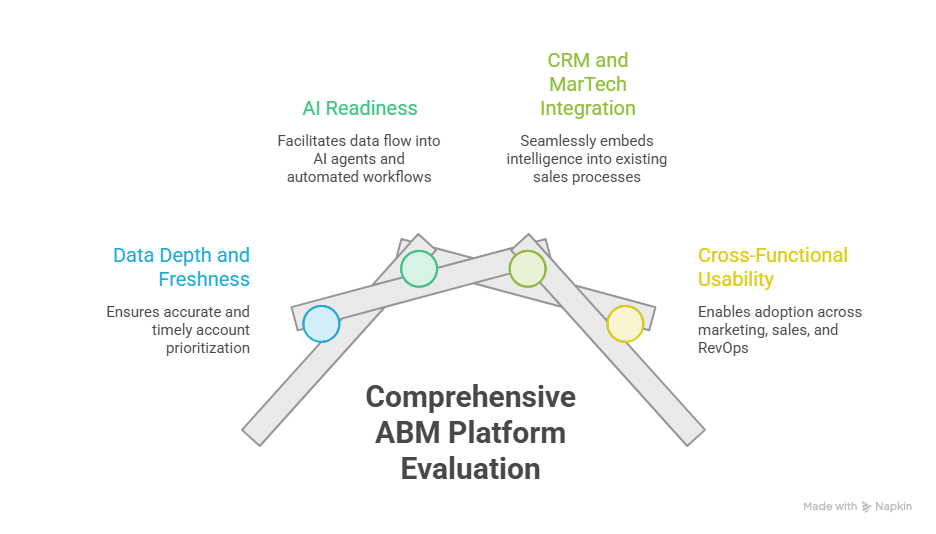
A useful ABM platform evaluation framework centers on four pillars that reveal how each solution holds up in real GTM environments, not just in a demo.
Data depth and signal freshness determine whether the platform can support real prioritization
Account prioritization depends on accurate, current signals. A platform with a large database that refreshes quarterly provides less value than one with tighter coverage that updates continuously within your target segments.
Strong platforms combine firmographic, technographic, intent, and spend data to support account scoring and prioritization from multiple angles. Buyers should request coverage tests using their own account lists, not the vendor’s sample data. A large record count may sound impressive, but it doesn’t prove that the data is fresh, complete, or reliable enough to support real GTM execution within your ICP.
Understanding what signal depth looks like in a data-driven ABM intelligence platform like HG Insights, helps your team test coverage, freshness, and context against real target accounts rather than accepting vendor claims at face value.
AI readiness goes beyond predictive scoring
AI has become a central factor in enterprise ABM platform selection, but predictive scoring alone isn’t enough. Your team needs platforms that allow enriched account data to flow into AI agents and automated workflows, not just produce a score that sits in a dashboard.
Evaluation should focus on how data is accessed (APIs, MCP server connectivity), how frequently it updates, and whether scoring logic is transparent and explainable. If your team is building toward autonomous GTM workflows, the platform’s ability to expose structured data to external AI systems matters as much as its internal AI capabilities.
CRM and MarTech integration quality determines whether intelligence gets used
Integration quality plays a major role in long-term ROI. Sales teams spend most of their working time inside the CRM, so intelligence that lives in a separate platform is far less likely to be used consistently.
Go beyond asking whether an integration exists. Test in a sandbox environment to confirm how account scores, intent signals, and technographic attributes appear within CRM workflows. Validate sync speed, data accuracy, and whether enriched fields map correctly to your existing CRM structure. A platform that requires manual data transfers or custom middleware to function within your tech stack will create adoption friction from day one.
Cross-functional usability determines whether the platform scales beyond one team
An ABM platform should be usable across marketing, sales, RevOps, and analytics without forcing every request through a single administrator or technical owner.
Marketing needs to build and launch campaigns independently. Sales needs clear account context and recommended next actions within CRM. RevOps needs to manage governance, scoring logic, and data quality efficiently. When any of these functions depends on another team to access or interpret the platform, adoption stalls and the investment underdelivers.
Tools that require ongoing manual supervision create operational drag that gets worse as your ABM program grows. Evaluate usability for each function separately during the selection process, not just for the team leading the purchase.
Competitive displacement capability requires account-level install visibility
Competitive displacement is a priority for many enterprise ABM strategies, and the evaluation should test this capability specifically rather than accepting a general “competitive intelligence” claim.
Your team should test whether the platform can show installed technologies, contract timing indicators, and relevant buyer signals for known competitive accounts within your target segments. The difference between a platform that tells you an account is in your competitive category and one that shows you the specific products installed, when contracts are likely to renew, and whether the account is actively researching alternatives is the difference between generic competitive positioning and targeted displacement campaigns.
Teams running displacement plays should evaluate this capability by providing the vendor with a list of accounts where you know the competitive landscape and testing whether the platform’s data matches reality. That test reveals data depth far more reliably than a demo built on the vendor’s chosen examples.
High-intent detection and signal-based selling capability vary widely across platforms
ABM platform capabilities around intent data can differ significantly. Some platforms track basic engagement like website visits and content downloads. Others capture deeper buying signals such as comparison research, pricing page activity, or active vendor evaluation behavior.
Evaluation should focus on three questions:
- How are signals generated? First-party behavioral data, third-party intent co-ops, and proprietary research networks each produce different signal quality and coverage.
- How quickly do signals reach sales teams? Intent data that arrives in a weekly batch report has less value than signals that update scoring and trigger notifications in real time.
- How much account context accompanies each signal? An intent spike without fit, spend, and technographic context is ambiguous. Signals paired with account-level intelligence allow reps to assess whether the intent represents a real opportunity worth acting on immediately.
Separating basic intent from sales-ready signals is one of the most consequential evaluation steps your team can take. The platforms that score highest on this criterion are the ones that pair intent with enriched account context to produce prioritization your reps will actually trust and act on.
A proof of concept should test production performance, not demo performance
A proof of concept should reflect real-world conditions. That means using your own account list, your CRM structure, and your actual ABM use cases rather than the vendor’s curated sample data.
Define success metrics upfront:
- Account coverage. What percentage of your target accounts does the platform have data on, and how complete is that data?
- Signal accuracy. Do the technographic installs, intent signals, and spend indicators match what you already know about accounts in your pipeline?
- CRM sync performance. How quickly does data flow into your CRM, and do enriched fields map correctly to your existing structure?
- Rep adoption. Can your sales team access and interpret account intelligence within their normal workflow without training or manual lookups?
A structured POC that tests these metrics against your real environment gives you an objective basis for vendor comparison that demo impressions alone can’t provide.
Align your buying committee around shared criteria, not individual preferences
When multiple groups are involved in selecting an enterprise ABM platform, a shared evaluation structure prevents the process from stalling in competing priorities.
Assigning specific evaluation pillars to each group keeps conversations focused and practical:
- Marketing evaluates segmentation capability, campaign execution, and audience building
- RevOps evaluates integration depth, data governance, and scoring model flexibility
- Sales evaluates usability, account context quality, and workflow integration within CRM
- Data and analytics evaluates signal accuracy, coverage depth, and reporting capability
When each group evaluates against defined criteria rather than general impressions, the final recommendation has a stronger basis and the buying committee reaches alignment faster because every perspective is accounted for within a common framework.
Sometimes the right answer isn’t a dedicated ABM tool at all
During evaluation, some teams discover that the real bottleneck isn’t campaign execution. It’s the data layer underneath their entire revenue operation. If your accounts are selected based on incomplete intelligence, your scoring model lacks the signals to predict conversion accurately, and your competitive visibility is limited to what reps discover during calls, a dedicated ABM campaign tool will optimize the execution of a flawed strategy.
A GTM intelligence platform addresses the upstream problem. It provides the account-level intelligence that powers precise targeting and scoring across ABM optimization, territory planning, competitive displacement, and AI sales plays while reducing reliance on disconnected point solutions.
The evaluation question worth asking is whether your ABM performance is limited by how campaigns are coordinated or by whether the right accounts are being selected and the right signals are being used in the first place. If it’s the latter, the solution may be a stronger data foundation rather than a better campaign tool.
HG Insights belongs in every enterprise ABM platform evaluation
HG Insights provides enterprise teams with technographic intelligence, IT spend data, buyer intent signals, and contract visibility through a unified Revenue Growth Intelligence platform. That signal depth supports every major ABM use case, from ranking target accounts and acting on buying signals to identifying displacement opportunities, balancing territories, and powering AI-driven execution.
For a detailed look at how data intelligence supports ABM strategy, the Data-Driven Approach for ABM Marketing product brief shows how these capabilities connect in practice.
Whether you’re comparing dedicated ABM tools or evaluating data-first GTM intelligence platforms, HG Insights gives your evaluation a benchmark for signal depth, refresh frequency, and operational integration that reveals how every other platform in your shortlist measures up.
Evaluate your next ABM platform against the intelligence standard your GTM motion requires. Book a demo with HG Insights.