

Competitive intelligence sits at the top of every B2B sales leader’s Wishlist and the bottom of most actual investment plans. Reps say they need it. Product marketers build it. Sales enablement distributes it. Yet the average B2B company still walks into deals with stale battlecards, surprise competitors, and reps who learn about the rival vendor halfway through the sales cycle.
The gap between intent and execution costs real revenue. Win rates suffer when sellers are reactive. Deal sizes shrink when reps can’t counter-position confidently. Whole categories of pipeline never get built because no one is hunting accounts running competitor products.
This article looks at how top-performing B2B companies operate competitive intelligence as a live, signal-driven system. We cover the framework, the signals that matter, the plays that turn intel into closed deals, and the operating model that holds it all together.
In this guide:
- The competitive intelligence gap holding most B2B sales teams back
- What competitive intelligence actually means today, beyond battlecards
- The five signals top B2B companies track to win competitive deals
- The plays that turn competitive intel into closed-won revenue
- The operating model behind every high-performing CI program
- Common competitive intelligence failures and how to avoid them
- How HG Insights powers competitive intelligence at scale
The competitive intelligence problem most B2B companies haven’t solved
Most B2B competitive intelligence programs follow the same broken pattern. Product marketing owns the function alone. Battlecards live in a wiki. Updates happen quarterly, if at all. Sales reps reference the content sporadically, usually after they’ve already lost deal control to a competitor they didn’t see coming.
The downstream effects are predictable. Reps discover competitors mid-cycle, when the rival has already shaped buying criteria. Battlecards lose accuracy within weeks of the latest competitor pricing change or product launch. Win/loss data, when collected at all, sits in a spreadsheet no one consults during active deals.
The cost appears in win rates, deal velocity, and pipeline composition. Sellers who walk into competitive deals blind close at lower rates than sellers armed with current intel. Cycles drag because reps spend time discovering competitor positioning rather than dismantling it. Displacement opportunities go untouched because no one is mapping competitor installs against the target account list.
Most companies under-invest in CI relative to its impact. A meaningful improvement in competitive win rate, even a few percentage points, drops directly to the bottom line. Yet CI budgets and headcount usually trail other GTM investments, even in categories defined by direct competition.
Symptoms of weak versus strong competitive intelligence programs
| Dimension | Weak CI Program | Strong CI Program |
| Ownership | Product marketing alone | Cross-functional with RevOps, sales, enablement |
| Refresh cadence | Quarterly or ad hoc | Continuous, signal-driven |
| Battlecard format | Static wiki pages | Embedded in seller workflows |
| Win/loss data | Captured occasionally | Captured on every deal, reviewed monthly |
| Competitor signals | Manually researched | Automated from installs, intent, contracts |
| AI readiness | Limited or none | Native, exposed to seller and operator agents |
What competitive intelligence really means when it’s done at scale
The companies winning competitive deals at scale operate CI very differently from the wiki-and-battlecard pattern. Their version is a live system, not a deliverable.
Three principles define it.
CI is signal-driven, not document-driven. The foundation is a continuous feed of competitor installs, contract data, intent signals, customer voice, and market movement. Documents like battlecards and one-pagers are outputs of that signal layer, not the layer itself.
CI is operationalized inside seller workflows. The intel surfaces where reps actually work: CRM, outreach platforms, and AI sales agents. Reps don’t navigate to a wiki to find competitor positioning. The positioning shows up automatically when they touch an account.
CI is cross-functional from day one. Product marketing, RevOps, sales enablement, and field reps all contribute. No single function owns the program in isolation because no single function has the full picture.
AI agents have raised the bar across all three principles. When sellers rely on AI assistants for account prep, deal coaching, and message drafting, the underlying CI data has to be fresh, deep, and structured. Companies that treat CI as a wiki can’t feed AI workflows usefully. Companies that treat it as live data infrastructure unlock entirely new categories of competitive plays. HG Insights customers building on live technographic and contract data see 25-30% improvement in competitive win rates. It’s a gap that compounds when the same data feeds AI seller workflows.
Components of a competitive intelligence program built for 2026
| Component | What It Includes | Why It Matters |
| Competitor install data | Real-time view of which accounts run which competitors | Foundation for displacement and counter-positioning plays |
| Contract intelligence | Renewal cycles, contract end dates, deal sizes | Times displacement plays to the right window |
| Intent signals | Research activity around competitor brands and categories | Identifies in-market accounts before they reach pipeline |
| Verified customer voice | Buyer reviews, switching reasons, product comparisons | Equips reps with proof points beyond marketing claims |
| Win/loss data | Structured capture from every deal | Sharpens positioning and informs strategy refinement |
| Workflow integration | CI surfaced inside CRM, outreach, AI agents | Drives adoption and translates intel into seller behavior |
A competitive displacement strategy that runs on this kind of signal layer beats one that runs on quarterly battlecard refreshes every time. For a deeper look at frameworks and applications, the Competitive Marketing Intelligence: A Complete Guide provides additional depth.
The five signals top B2B companies track
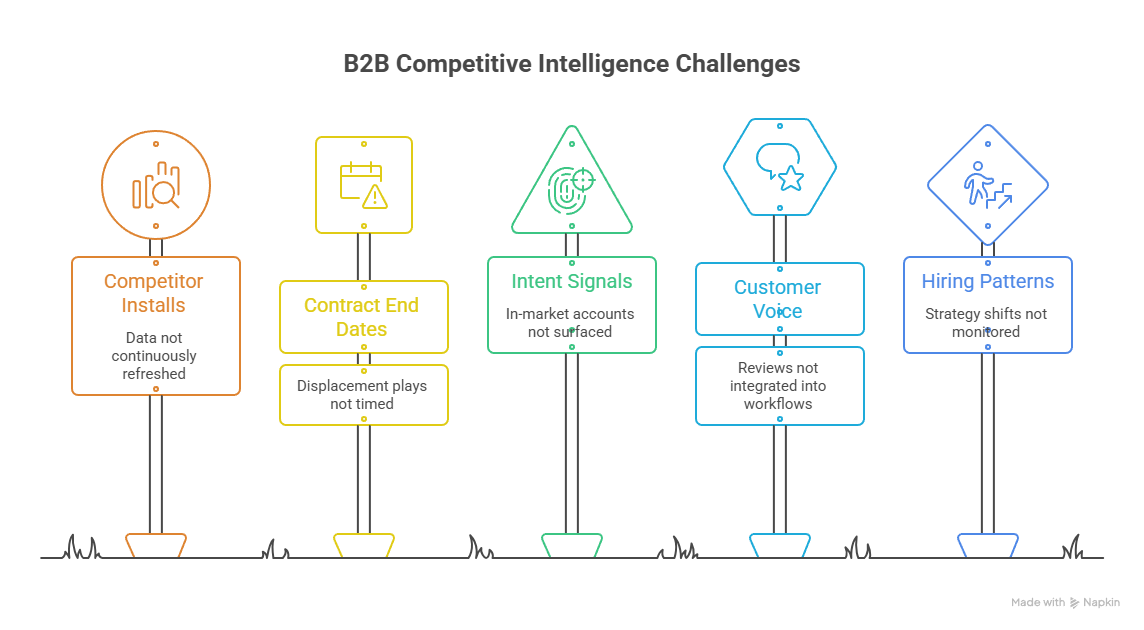
Top-performing B2B companies build their CI signal stack from five primary sources. Each one feeds a different play.
-
Competitor installs across the target account universe
This is the foundation. Top performers know exactly which accounts run which competitor products at any given moment. The data refreshes continuously, not annually. Reps use it to identify displacement targets, understand competitive density in territories, and prep for deals before the first call.
2. Contract end dates and renewal windows
Knowing a competitor is installed is useful. Knowing the contract expires in seven months is actionable. Top performers track contract data alongside install data and time their displacement plays to the renewal window. They start the conversation when the buyer is naturally evaluating alternatives, not when the rep happens to dial.
3. Intent signals around competitor brands and categories
Buyers researching alternatives leave a trail. Top performers monitor that trail through intent data, looking for accounts spiking on competitor brand searches, replacement keywords, or category research. The signal often surfaces in-market accounts weeks before they enter pipeline.
4. Verified customer voice and review intelligence
Buyer-side reviews of competitors carry weight that vendor-produced content can’t match. Top performers feed verified review data into seller workflows so reps can reference real customer experiences rather than marketing talking points. Switching reasons, common complaints, and feature comparisons all become live ammunition for the deal team.
5. Hiring patterns, financial signals, and product launches
Competitor strategy shifts leave fingerprints. New executive hires, layoffs, funding rounds, product launches, and partnership announcements all signal where competitors are investing or pulling back. Top performers monitor these patterns and adjust their own positioning before the market does.
The companies that win on CI don’t treat these signals as separate datasets. They stitch them together into a unified competitive view of every target account.
The plays that turn intel into deal wins
Signals matter only if they trigger action. Top B2B companies run a defined set of competitive plays, each tied to specific signals.
Pre-empting competitive deals
When competitor install data, intent signals, and contract end dates align, top performers run proactive outreach before the buyer formally enters an evaluation. The play takes the form of a tailored message acknowledging the competitor incumbency, framing the upcoming renewal as a natural decision point, and offering a specific reason to evaluate.
Displacement plays timed to renewal windows
When a competitor contract is approaching its end date, top performers run sequenced campaigns timed to the buyer’s natural decision rhythm. The plays combine email, executive outreach, content tied to switching costs, and reference customer introductions. Timing is the differentiator. A displacement play eight months before renewal lands. The same play one month before renewal often arrives too late.
Counter-positioning inside active deals
When a deal goes competitive in flight, top performers equip reps with verified customer voice, product comparisons, and switching cost frameworks in real time. The rep doesn’t improvise the counter-position. They execute a defined playbook informed by win/loss data and live customer review intelligence.
Whitespace plays where competitors have low adoption
Some accounts run a competitor product but don’t use it deeply. Install data combined with usage signals or customer review patterns surface these opportunities. The play frames the conversation as a stack consolidation or a real-value replacement, not a feature war.
AI seller workflows that surface competitor context in real time
The most advanced operators feed competitive data to AI sales agents. The agent prepares the rep before every meeting with the latest competitor installs at the account, recent intent activity, contract context, and recommended messaging. The rep walks in informed without spending an hour researching.
Common competitive plays and the signals that trigger them
| Play | Triggering Signal | Outcome |
| Pre-emptive outreach | Competitor install plus contract end date approaching | New pipeline before formal evaluation begins |
| Displacement campaign | Renewal window plus intent activity | Higher displacement win rate |
| Counter-positioning | Active competitive deal | Better win rate inside live deals |
| Whitespace replacement | Competitor install with low adoption | New revenue from underserved buyers |
| AI seller prep | Any competitor signal at the account | Faster, sharper deal preparation |
The right sales competitive intelligence tools make these plays repeatable across the entire sales org rather than dependent on individual rep effort.
The operating model that separates CI programs that produce results from those that produce documents
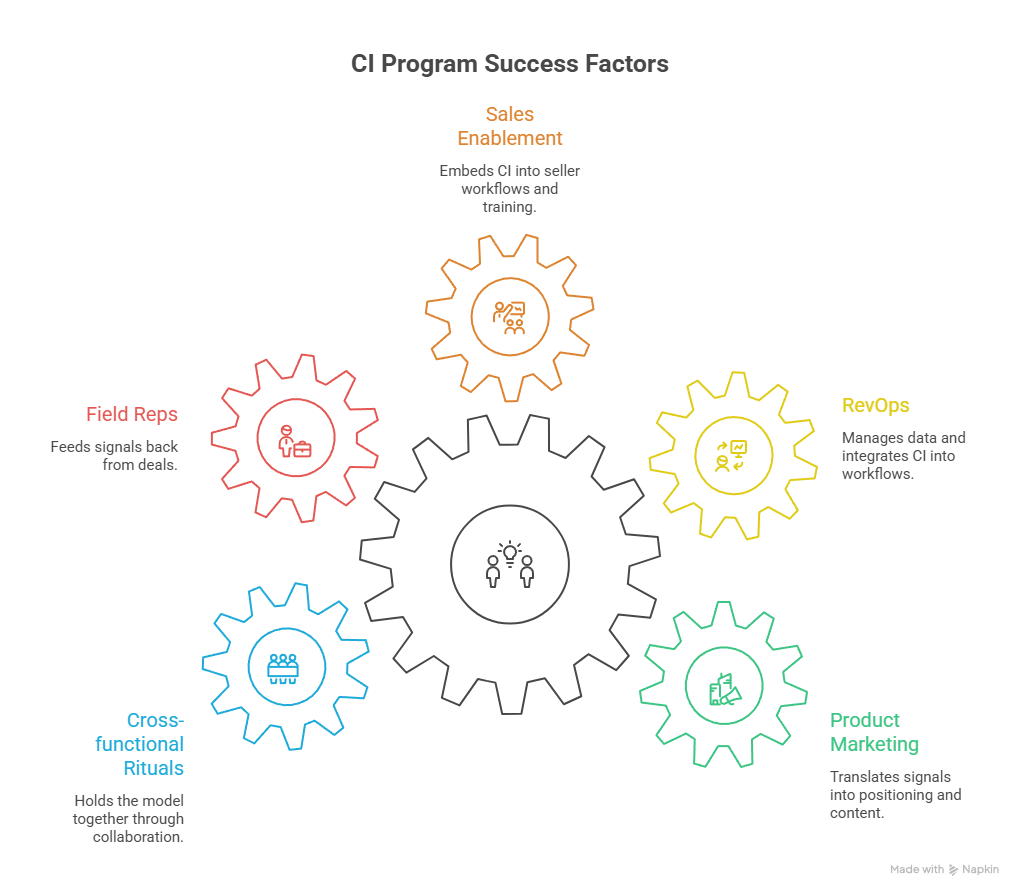
Tools and signals aren’t enough. The operating model is what separates companies that talk about CI from companies that close more competitive deals.
Product marketing owns CI strategy and content. This is the traditional home, and it remains important. Product marketers translate signals into positioning, narrative, and reusable content. They don’t, however, own the operational layer alone.
RevOps owns the data layer. Competitor data, intent signals, contract intelligence, and win/loss capture all live in systems that RevOps governs. RevOps connects CI signals to the CRM, surfaces them in seller workflows, and ensures data quality is maintained.
Sales enablement embeds CI in seller workflows. The function makes sure CI shows up in the right moments: deal prep, account research, competitive coaching, and call preparation. Enablement also runs the training rituals that turn raw intel into rep capability.
Field reps feed signals back from deals. Every deal generates signal. Why did we win? Why did we lose? What did the buyer say about the competitor? Top performers capture this systematically, not optionally. The data feeds the next iteration of positioning, plays, and content.
Cross-functional rituals hold the model together. Monthly competitive reviews bring product marketing, sales, RevOps, and enablement together to discuss recent wins, losses, and competitor moves. Quarterly win/loss reviews dig into patterns. Battlecard refreshes happen on a defined cadence informed by signals, not by guesses.
Competitive intelligence operating model components
| Component | Owner | Cadence |
| CI strategy and narrative | Product marketing | Quarterly with continuous updates |
| Data layer and signal feeds | RevOps | Continuous |
| Workflow integration | Sales enablement | Continuous |
| Win/loss capture | Sales reps with enablement support | Every deal |
| Competitive review meetings | Cross-functional | Monthly |
| AI agent integration | RevOps and IT | Continuous |
Common failure patterns to avoid
The companies that struggle with competitive intelligence tend to share the same failure patterns. Recognizing them is half the battle.
Treating CI as a static wiki. When CI lives only in documents, it ages out fast. The fix is to build CI on a live signal layer and treat documents as outputs, not the system itself.
Letting product marketing own CI in isolation. Product marketing produces excellent content but can’t operationalize CI alone. The function needs cross-functional partners in RevOps, enablement, and field sales for the program to land.
Failing to operationalize win/loss data. Many companies capture win/loss notes but never review them systematically. The data sits unused. Top performers run monthly reviews and tie patterns back to positioning and content updates.
Ignoring intent and customer voice as competitive inputs. CI programs that focus only on competitor product features miss significant sources of signal. Buyer-side intent and verified customer reviews carry credibility that internal analysis can’t match.
Skipping AI readiness. When competitive data isn’t structured for AI consumption, the seller agents and operator agents your reps use day to day can’t pull from it. The result is AI workflows that surface generic insights and reps who lose ground to competitors with stronger AI integration.
Underestimating the operating cadence. A great battlecard built once a year is worth less than a serviceable battlecard refreshed every month. Cadence beats polish in CI.
How HG Insights powers competitive intelligence at scale
HG Insights is built for the way top B2B companies actually operate competitive intelligence. The platform supports each layer of the framework.
Competitor installs and contract intelligence at scale
HG Insights tracks over 240 million verified technology installations across 25 million companies. Sales teams use that data to map competitor presence, time displacement plays to renewal windows, and prioritize accounts where the competitor footprint is deepest.
Verified customer voice through Customer Voice
HG surfaces buyer-side reviews of competitors, including switching reasons, product comparisons, and verified user feedback. Reps walk into deals with credible buyer voice rather than vendor-produced talking points.
CI delivered inside seller workflows through Sales Copilot
Sales Copilot puts competitor context, recommended plays, and real-time signals where reps already work. The integration removes the wiki-lookup step and embeds CI in daily selling motion.
Market intelligence through Market Analyzer
Strategy and product marketing teams use Market Analyzer for competitive market sizing, share-of-wallet analysis, and territory-level competitive intel. The same data layer that feeds rep workflows feeds executive strategy.
AI-native infrastructure through RGI Agent Builder and a native MCP server
Competitive data is exposed to AI agents in real time, which means seller agents, deal coaches, and operator agents all pull from the same source of truth. AI workflows become genuinely useful rather than generic.
Cross-functional support across the GTM stack
Product marketing gets the data they need to produce positioning. RevOps gets the data infrastructure to operationalize it. Sales enablement gets the workflow surfaces. Field reps get the daily intel.
For B2B sales leaders evaluating competitive intelligence platforms against the framework in this article, HG Insights is the benchmark to measure others against.
Final takeaways for B2B sales leaders
The best B2B companies don’t win competitive deals because they have better battlecards. They win because their competitive intelligence operates as a live system, fed by continuous signals, embedded in seller workflows, and supported by a cross-functional operating model.
A few principles guide the work:
- Build CI on a live signal layer, not a static document
- Connect competitor installs, contract data, intent signals, and customer voice into one unified view
- Operationalize CI inside seller workflows so it influences daily rep behavior
- Run a cross-functional operating model with shared rituals across product marketing, RevOps, enablement, and sales
- Treat AI readiness as a baseline so competitive data feeds the agents your reps now rely on
The cost of underinvesting in CI appears in lost deals, missed displacement opportunities, and slower pipeline. The return on investing in CI appears in higher competitive win rates and more predictable revenue.
Put competitive intelligence at the center of your sales motion. See how B2B organizations extend their stack with HG Insights for competitive displacement and contract-driven sales.