
Most B2B teams are not short on data. They are short on the right signals at the right time. Pipelines stall, deals slip to competitors, and forecasts wobble, not because teams lack effort, but because the intelligence guiding them is shallow or stale.
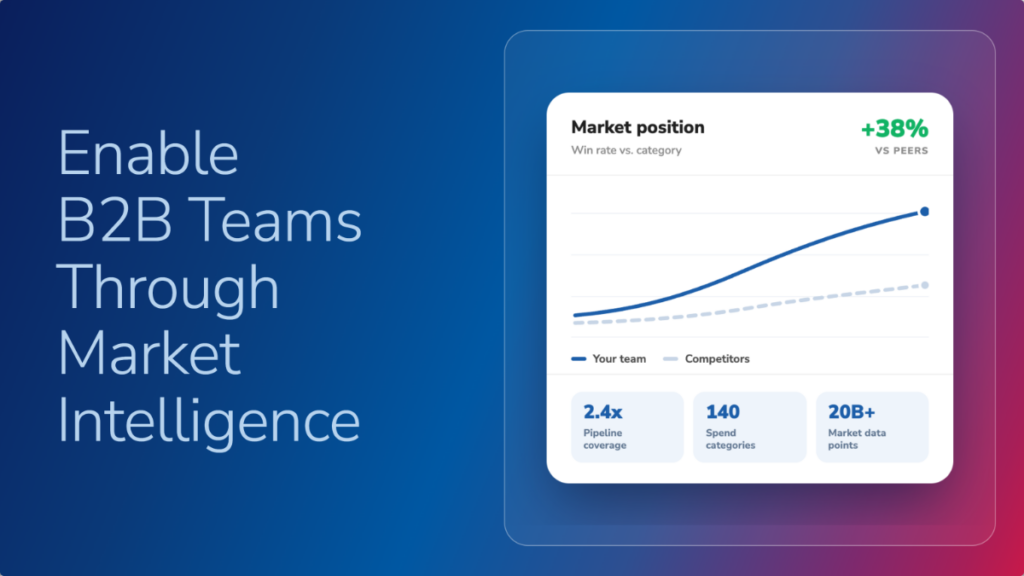
That is the gap the best market intelligence platforms close. They turn fragmented account data, buying signals, and competitive insight into one operational view that sales, marketing, and strategy teams can actually use. The platforms that help teams outperform competitors are the ones that go beyond reporting and start shaping daily decisions.
Below are the capabilities that separate the leaders from the rest, and how each one translates into a measurable edge.
1. The new bar for market intelligence in B2B
Buyer behavior has changed faster than most data providers. Research happens across channels, decisions involve larger committees, and budgets shift quarterly. Static lists of accounts and contacts no longer cut it.
HG Insights, for instance, blends firmographic, technographic, intent, and IT spend signals into one continuously refreshed account view. That combination is what makes intelligence actionable, because it tells teams not just who an account is, but what they use, what they are researching, and where they are spending.
2. Account-level market data that goes beyond surface firmographics
Industry, employee count, and revenue are table stakes. They describe an account but rarely predict whether it will buy.
Top platforms reveal install bases, tech stacks, and IT spend at the account level. That depth changes how teams qualify and segment, because reps can see exactly which technologies an account runs, which contracts are nearing renewal, and which spend categories are growing. With B2B data enrichment for GTM precision, marketing builds tighter segments, sales walks into discovery calls already informed, and strategy teams plan from a clearer picture of their addressable market.
3. Real competitive displacement intelligence, not guesswork
Knowing your competitors is one thing. Knowing exactly which accounts run their products, when those contracts expire, and which buying committees are quietly dissatisfied is another.
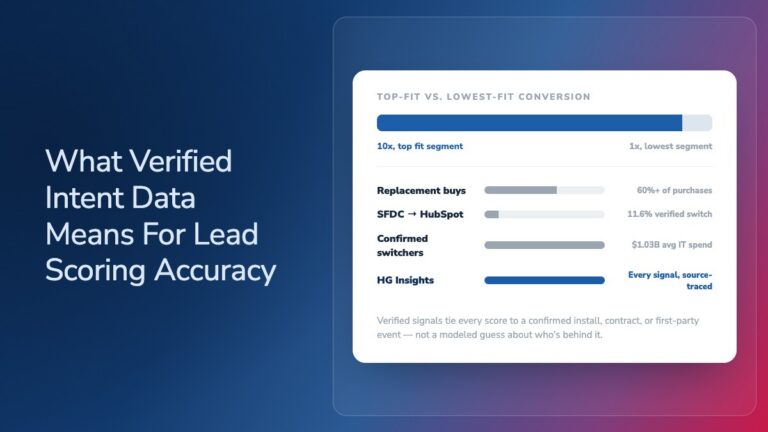
Leading platforms surface this level of detail. Teams use it to build a competitive analysis and takeout strategy grounded in real install data, time outreach around renewal windows, and protect their own customer base before a competitor slides in. HG Insights data identifies more than 12,700 companies with at least 100 employees running both Salesforce CRM and HubSpot CRM simultaneously — competing platforms that rarely coexist permanently, making each overlap a consolidation signal waiting to be acted on. This is where the difference between reactive and proactive selling shows up clearly.
4. Market sizing that reflects reality, not assumptions
TAM, SAM, and SOM numbers built on broad industry estimates rarely survive a board review. Strategy and finance teams need defensible figures, and HG Insights delivers them.
By quantifying the market with verified install and spend data, these tools give planning teams something firmer to work with. Forecasts become easier to defend, territory designs become more accurate, and investment decisions get tied to real opportunity rather than directional guesses.
5. Whitespace analysis that surfaces hidden revenue
Most B2B companies are sitting on more revenue inside their existing customer base than they realize. The challenge is seeing it.
Strong platforms map customer footprints against total opportunity, exposing untapped product lines, geographies, and divisions. Using whitespace analysis for revenue growth, customer success and account management teams get a roadmap for expansion, and revenue leaders unlock pipeline that does not require new logos to grow.
6. Signal-based prioritization that focuses sellers on the right accounts
Reps will always work the accounts in front of them. The question is whether those accounts are actually ready to buy.
Top platforms combine intent, install presence, and contextual signals to rank accounts by readiness. Instead of working through a static list, sellers focus on accounts already showing buying behavior. The result is shorter cycles, better connect rates, and a far healthier pipeline.
7. Account scoring models built on more than firmographics
A scoring model based only on company size and industry will tell you who looks like a customer. It will not tell you who is about to become one.
The strongest platforms weigh fit, install presence, spend levels, and intent inside one scoring framework. With predictive account targeting and scoring, models built this way actually predict conversion, which means RevOps stops fighting over lead quality and sales stops chasing accounts that look great on paper but never move.
8. Integrations that put intelligence inside daily workflows
Intelligence locked inside a separate tool gets ignored. The best platforms recognize this and meet teams where they already work.
Strong platforms push enriched data and signals into Salesforce, HubSpot, data warehouses, and increasingly into AI agents. Sellers see the right context inside their CRM, marketers activate segments without exporting CSVs, and analysts pull clean data straight into their warehouse for modeling. HG Insights data shows that 93% of enterprise Snowflake users also run Salesforce CRM, making the Salesforce-Snowflake stack the dominant data backbone of modern enterprise GTM and the integration layer that market intelligence platforms must plug into to be useful.
9. AI-ready data infrastructure for the next era of GTM
AI agents, copilots, and MCP servers are quickly becoming part of the GTM stack. They are only as useful as the data behind them.
Leading platforms are building unified data fabrics designed for this shift. Clean, structured, governed data flows into agents and copilots, which means revenue teams can scale insight-driven plays without rebuilding their stack every time a new AI capability lands.
10. Why HG Insights stands apart for B2B competitive advantage
HG Insights brings technographic, intent, spend, and contract data together inside one GTM-ready platform. Strategy teams get defensible market sizing. RevOps gets scoring models built on real conversion signals. Sales gets account-level context that actually shortens cycles. Marketing gets segments tied to in-market behavior.
The RGI Platform for B2B market intelligence supports market sizing, whitespace analysis, account scoring, signal-based selling, and AI-driven plays from a single source of truth. That is what it looks like when market intelligence stops being a report and starts being a competitive advantage.
The bottom line
The best market intelligence platforms do not just describe the market. They help teams act on it faster, with more precision, and with more confidence than the competition. The teams winning right now are the ones treating intelligence as infrastructure, not as a periodic research project.
If your current tools tell you what happened last quarter but not what to do next week, the gap between you and your competitors is going to keep widening. Picking a platform built for action is how that gap closes.
Request a demo today to see how the RGI Platform turns market intelligence into action.
Frequently asked questions
What is a market intelligence platform in B2B?
A B2B market intelligence platform aggregates and analyzes data about companies, their technology, their buying behavior, and their spending so revenue teams can make sharper go-to-market decisions. The strongest platforms combine firmographic, technographic, install, intent, and contract data into one view, turning scattered signals into account-level insight that informs targeting, scoring, market sizing, and competitive strategy.
How do market intelligence platforms help B2B teams outperform competitors?
They replace stale, fragmented data with current, account-level signals that show which companies are in-market, what they run, and where they are spending. That lets teams time outreach around real buying windows, build displacement plays grounded in competitor install data, and prioritize the accounts most likely to convert. The advantage comes from acting on signals earlier and more precisely than competitors working from static lists.
What features should the best market intelligence platforms include?
Look for account-level depth beyond firmographics, including install base, tech stack, and IT spend data; competitive install intelligence; verified market sizing for TAM, SAM, and SOM; whitespace analysis; signal-based account prioritization; scoring models that weigh fit, install, spend, and intent together; and integrations that push data into your CRM, warehouse, and AI tools. Coverage breadth, refresh frequency, and accuracy underpin all of it.
How is market intelligence different from competitive intelligence?
Competitive intelligence focuses specifically on rivals, including their positioning, install footprint, and where they are winning or losing. Market intelligence is broader, covering the full opportunity landscape: market size, buyer behavior, technology adoption, spend patterns, and account fit. Competitive intelligence is one component of market intelligence, and the strongest platforms deliver both from the same account-level data.
Why is account-level data important in market intelligence platforms?
Industry, headcount, and revenue describe what a company looks like, not whether it will buy. Account-level data shows what a company actually runs, which contracts are nearing renewal, and where spend is growing, which is what predicts buying readiness. That depth lets teams qualify, segment, and prioritize on real signals rather than surface attributes that two very different accounts can share.
How does HG Insights support B2B competitive advantage?
HG Insights combines technographic, intent, spend, and contract data in one GTM-ready platform, so teams work from a single source of truth rather than stitching vendors together. The RGI Platform supports market sizing, whitespace analysis, account scoring, signal-based selling, and AI-driven plays, giving strategy, RevOps, sales, and marketing the account-level depth to anticipate buying behavior and act on it before competitors do.