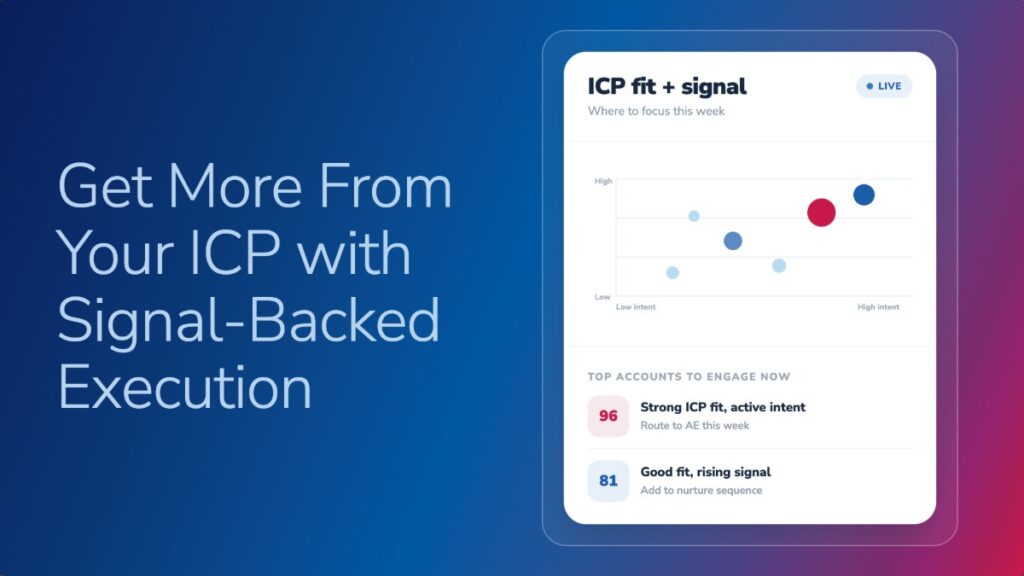
Most RevOps teams have done the ICP work correctly. The segment is defined. The criteria are documented. The personas are mapped. The problem is not the ICP — it is the data layer used to execute it. ICP activation doesn’t fail at the strategy level. It breaks down when a thoughtful set of criteria is translated into a CRM filter, where the only available fields are firmographic.
Quick Answer: Target account lists built from firmographic CRM filters underperform because firmographic data (employee count, revenue range, industry code) is the only data type that exists as a standard CRM field. Technology adoption, IT spend trajectory, and competitive install signals are often the strongest indicators of purchase fit. But because they don’t have standard CRM fields, they never make it into the list. The result is a list that looks right on paper and performs wrong in the field.
The Gap Between How ICPs Are Written and How Lists Are Built
When RevOps leaders document an ICP, the language is usually rich with signals. The target account “runs a mid-market ERP on NetSuite or Intacct,” “be in an active infrastructure modernization cycle,”or “have a competitive tool nearing the end of its contract.” That is the real ICP: technology-aware, timing-aware, signal-rich.
When that ICP gets turned into a target account list, the filter looks like this: 200–1,000 employees, SaaS or software industry, US-based. Sometimes a revenue range. Maybe a geography exclusion.
The technographic and spend signals that define the ICP have no standard CRM field. There is no “current ERP” column in Salesforce. There is no “IT spend trajectory” picklist. So those criteria simply disappear from the filter. The list that comes out reflects the firmographic shell of the ICP, not the actual ICP.
This is the ICP execution gap. It is not a strategy problem. It is a data layer problem.
Three Ways List Quality Gets Corrupted Before a Rep Ever Touches It
Stale firmographic snapshots
Firmographic data has a shelf life that most CRM systems don’t account for. Companies grow past the target headcount band. They get acquired. They change their tech stack. They buy a competitor product. The list that was accurate when it was built has moved by the time reps work it, and there is rarely a mechanism to refresh it. The list is a snapshot of a market that has already changed.
CRM noise that passes through every filter
Standard CRM exports carry records that should not be in any active target list: duplicate accounts, churned customers still tagged as prospects, contacts who left the company six months ago, accounts that already closed a deal with a competitor. Firmographic filters don’t remove this noise. They only add a size and industry constraint on top of it. Every rep who opens the list is working through contaminated data without knowing it.
Gut-check filters applied without validation
The criteria “50 to 500 employees, SaaS, US” did not come from analysis. It came from habit. It was the ICP three years ago and it stayed in the filter because no one had data to argue against it. Gut-check filters feel like precision. They are actually a guess that accumulates age and authority with each passing quarter. The accounts that actually convert may not look like the filter at all.
The CRM Field Problem No One Names Directly
The most under-discussed cause of list quality failure is structural: the CRM only surfaces what it can store, and it can only store what came in through a data source that mapped to a standard field.
Firmographic data maps cleanly. Employee count, revenue, industry, geography — these are stable, normalized, and available from dozens of providers. They have fields in every CRM.
Technographic data does not. There is no standard Salesforce field for “runs Workday,” “recently added a cloud security tool,” or “IT spend is accelerating in the data infrastructure category.” Spend trajectory data has the same problem. Competitive install data has the same problem. These signals sit outside the CRM field schema, which means they sit outside the filter, which means they sit outside the list.
The ICP was written to include them. The list was built without them. The gap between those two things is where the pipeline gets lost.
What This Looks Like on the Rep Side
The downstream effect of poor list quality becomes obvious when reps start working their accounts. They often receive large account lists with no stack ranking or prioritization signal.
Research into growth-stage B2B sales workflows found that reps routinely receive account lists with no signal-based prioritization. The default sort order, in the absence of anything better: alphabetical. That is the default sort when there are no signals to sort by.
When pipeline shortfalls follow, the diagnosis usually lands on rep effort or sequencing cadence. Those are visible and adjustable. List quality is invisible unless someone specifically audits it. So it stays broken while teams iterate on messaging and follow-up timing for accounts that were wrong from the start.
Why Target Account Lists Built on Firmographic Data Don’t Convert?
A target account list built from firmographic filters alone does not convert at the rate the ICP predicts because the list does not actually contain the ICP. It contains accounts that match the size and industry profile of the ICP, which is a much larger and far less precise population. Two companies with identical firmographic profiles can be running different technology stacks, have completely different buying timelines, and one may already be a customer of your direct competitor.
Firmographics define the eligible universe. Technology adoption, spend trajectory, and competitive velocity tell you who within that universe is worth calling this quarter. Without the second layer, the first layer is just a large list filtered down to a slightly smaller large list.
Airbase, a spend management platform, found this out directly. When they added technographic data to their targeting, their VP of Marketing, Michael Freeman, put it plainly: “Basically, our identified SAM in Salesforce grew by about 80% overnight.” The accounts had always been there. The firmographic filter had been hiding them.
How Signal-Backed ICP Execution Works in Practice
Teams that close the execution gap follow a different process. They start with the firmographic ICP as the outer boundary — the eligible universe. Then they apply a signal layer on top: which accounts in that universe run the technology stack that indicates fit, which are in an active spend cycle, which are running a product that puts them in a competitive displacement window.
Hyland Software ran this motion across five sales plays. Joe Hannum, Senior Manager of Customer Intelligence and Analytics at Hyland, described what changed: “The technographic data, competitive insights, and IT spend information all feed into our ICP scoring model. This allows us to prioritize accounts effectively for each play and ensure sales and marketing are aligned.” The ICP did not change. The data layer beneath it did.
NiCE ran the same process in channel marketing, using technographic and intent data to generate target account lists for partner campaigns. The result was a list precise enough that channel partners recognized the accounts immediately — because the accounts actually fit, not just on paper but on signal.
Storyblok, a headless CMS platform, came to this problem from a different starting point: no formalized ICP at all. Sales and marketing had no shared definition of what a good account looked like. They built one from scratch with HG Insights, scoring more than 4 million global accounts based on how closely they resembled their best customers across firmographic and technographic attributes. The resulting universe was segmented into four tiers and distributed across territories by normalized fit score. In the first quarter after implementation, pipeline grew roughly 50 percent over the prior quarter. The quarter after that, they generated more pipeline than in all of Q1.
Mark Wheeler, Chief Marketing Officer at Storyblok, summarized the outcome: “HG Insights has been a game-changer for Storyblok. By building a clear ICP and layering fit with intent data, we’ve aligned our entire go-to-market engine, from sales and BDRs to marketing and partners. We now operate with precision, clarity, and confidence. This is the backbone of our growth strategy.”
The common thread is that these teams stopped treating the CRM export as the list. They treated it as the starting point, then enriched it with the signals the CRM cannot store.
Build a Signal-Backed Account List with HG Insights
HG Insights gives RevOps teams the signal layer that firmographic data cannot provide. Real-time technology install data across 140-plus IT spend categories, spend trajectory signals at the account level, competitive velocity data, and corporate hierarchy mapping — all of which can be layered onto an existing ICP definition to produce a scored, prioritized account list rather than a firmographic snapshot.
The ICP definition stays the same. The data layer beneath it becomes one that actually contains the signals the ICP was written around.
If your target account list is not converting at the rate your ICP predicts, the problem is likely not the ICP. See how HG Insights builds a signal-backed account list from your existing ICP definition: hginsights.com/solutions-use-role/revops/
Frequently asked questions
Why is my target account list not converting?
Target account lists fail to convert when they are built from firmographic filters alone. Firmographic data — employee count, revenue, industry — defines who could fit your ICP, but it does not identify who fits right now. Technology adoption patterns, IT spend trajectory, and competitive install data are the signals that predict actual purchase readiness, and they have no standard CRM field, so they are typically excluded from the list-building process entirely.
What is the difference between an ICP and a target account list?
An ICP is a definition of the type of account most likely to buy and retain your product. A target account list is the set of specific companies that match that definition at a given point in time. The gap between them is a data quality problem: ICPs are written using signal-rich criteria (technology stack, spend behavior, competitive posture) that most list-building tools cannot filter on, because those signals do not exist as standard CRM fields.
How do firmographic data limitations affect ICP execution?
Firmographic data captures what a company looks like on the outside: its size, industry, and location. It does not capture how the company operates, what technology it runs, where it is spending, or whether it is in an active buying cycle. When ICP execution relies only on firmographic fields, the resulting list includes accounts that match the profile but not the signal — which is why the list looks right and performs wrong.
How can RevOps teams improve target account list quality?
RevOps teams improve list quality by treating the CRM export as a starting point rather than the list itself. The firmographic filter defines the eligible universe. A signal layer — technographic data, IT spend trajectory, competitive install data — then scores and ranks accounts within that universe by actual purchase fit. This produces a prioritized list rather than a sorted export, which gives reps a reason to work accounts in a specific order rather than alphabetically.
What signals actually predict ICP fit better than firmographics?
Technology adoption data shows which accounts run the software integrations, competing products, or platform dependencies that indicate fit. IT spend trajectory data identifies accounts that are actively investing in the category. Competitive velocity data surfaces accounts where a competing product is installed and potentially nearing end of contract. These signals sit outside the standard CRM field schema, which is why they require a dedicated data layer to bring them into the targeting workflow.
Author
-

Rajiv Dalal is a strategic business operations and finance executive with 20+ years of experience leading finance, revenue operations, and GTM strategy, with a proven track record of driving growth transformation, strengthening financial performance and improving margins, leading planning and forecasting, advancing systems and revenue intelligence, optimizing lead-to-cash processes, scaling ARR, and guiding organizations through acquisitions and recapitalizations.
Most recently, he served as the VP, Operations at Riverbed creating the WW Revenue Operations team (new sales, renewals, channel, and order management) and supporting the company through bankruptcy and buyout due diligence while driving SaaS transformation. Rajiv has also led revenue operations functions at Solarwinds and Ivanti and has proven deep experience at aligning sales, marketing, product, and finance teams to accelerate revenue growth, improve renewal rates, and drive operational excellence.
He holds an MBA from the University of Michigan Ross School of Business.