Eighty-seven percent of enterprises missed their revenue targets in 2025, and it happened during the biggest wave of AI investment in the history of B2B sales technology. That is not a coincidence worth ignoring. Account prioritization, the discipline of deciding which accounts a rep works first and why, is where most GTM teams are actually failing, not in the volume of data they collect. This post breaks down why more signal has not produced more accuracy, and what has to change to fix pipeline forecasting for good.
Quick Answer: Account prioritization is the process of ranking which accounts sales and marketing teams pursue first, based on fit and buying intent, rather than working leads in the order they arrive. Most B2B teams have the data to prioritize well but lack a system to reconcile competing signals, so reps default to gut instinct or outdated lists, which is why pipeline forecasts stay unreliable even as tech budgets grow.
The Gap Between AI Spend and Revenue Results
Sales and marketing teams did not sit still in 2025. Budgets for AI-powered sales tools, intent platforms, and enrichment services grew at a record pace, and most Growth-segment B2B companies added at least one new tool to the stack. Yet 87 percent of enterprises still missed their revenue number. The problem was not a lack of data. Reps had more signals available to them than ever before, pulled from CRM activity, marketing engagement, intent platforms, and enrichment tools running in parallel.
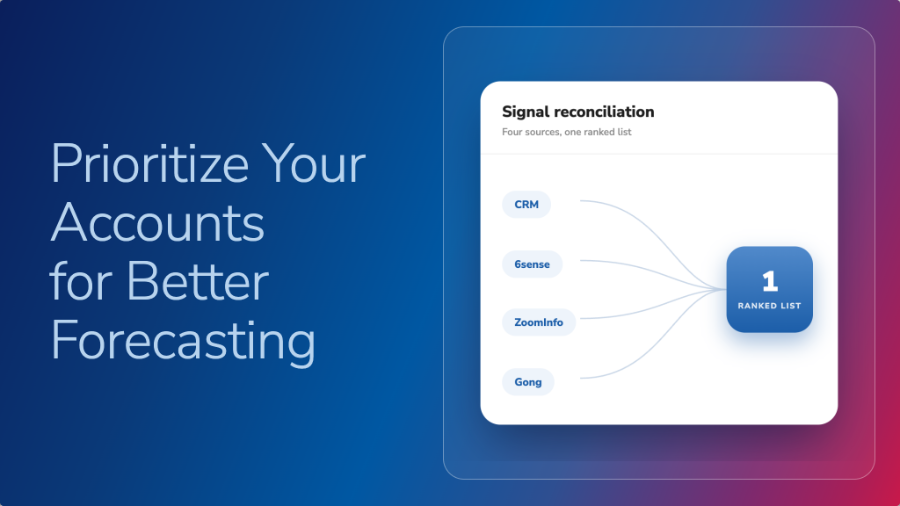
What broke down was the translation from signal to action. Reps acted on the wrong accounts at the wrong time, not because the accounts were invisible, but because no one had built a reliable way to decide which signal mattered most in a given week. A 6sense alert says one thing. A ZoomInfo score says another. Gong flags a call that went quiet three weeks ago. Someone has to reconcile all of that, and in most organizations, that someone is a rep guessing between calls.
This is the setup for a forecasting problem that looks like a data problem but is actually a decision problem. The next section shows how far this pattern extends across company size and industry.
The Tech Stack Paradox: More Tools, Same Miss Rate
The instinct after a missed number is to add another tool. Buy the intent platform. License another enrichment source. Turn on a new AI scoring feature inside the CRM. Each purchase makes sense in isolation, and each one adds one more voice to a conversation that already has too many voices.
Research into this pattern found that the pain is not tied to a specific industry or company size within B2B SaaS and IT-buyer accounts. It shows up wherever a company has accumulated more than one signal source and asked someone to reconcile them by hand. Every account profiled in that research independently owned a CRM, almost always Salesforce, plus at least one additional enrichment or intent tool: Clay, 6sense, ZoomInfo, Gong, or Outreach. Some owned three or four of these at once.
The Reconciliation Problem
Each tool generates its own version of “who matters right now.” A CRM shows deal stage and last-touch activity. An intent platform shows anonymous research behavior. An enrichment tool adds firmographic context. None of these systems talk to each other in a way that produces one ranked list. Someone, usually a rep or a manager, has to look at all three and decide what to believe. That reconciliation step is where signal quality erodes, because it happens inconsistently, differently by rep, and rarely on a fixed schedule.
Why More Data Sources Make the Problem Worse, Not Better
Adding a fifth signal source does not resolve conflicting priorities between the first four. It adds a fifth opinion to a debate that was already unresolved. Teams that stack tools without a prioritization layer on top end up with more noise per account, not more clarity. The fix is not fewer tools. It’s a layer that resolves what the tools are already telling you.
The Timing Failure Behind the Data Failure
Even when the right account gets flagged, timing determines whether that flag becomes revenue. An intent spike that surfaces two weeks after a rep last touched the account is functionally useless if no one is watching for it in real time. Growth-segment teams, typically 200 to 1,000 employees, feel this acutely because they don’t have dedicated data science headcount to build a reconciliation model in-house.
Tool sprawl explains why the problem is everywhere. The next question is why teams have not already solved it on their own, given how much time they’ve had.
What Teams Are Actually Doing Instead of Fixing It
The competing alternative to a real prioritization system is rarely another vendor. It’s a spreadsheet, or an internal formula, maintained by a rotating cast of reps and managers who inherited the process from whoever had the job before them.
Zachary Arbeitel, Senior Sales Ops Manager at Everpure Data, described his team’s approach directly: “we use, I believe it’s D&B for a lot of that and some kind of internal formulas that we just never seem to nail.” He was blunter about the outcome: “throwing a dart at a dartboard is not the most effective strategy.” That’s not a criticism of his team. It’s an honest description of what most Growth-segment companies are running today, dressed up as a scoring model.
Colleen McGough at Medallion described a similar pattern from the marketing and sales alignment side: “there’s some manual tiering that I think has fallen off a little bit, the AEs and BDRs work together, so they just have one book together and they meet every Monday and go through who’s going to work what.” A weekly meeting to manually re-sort a shared account list is a reasonable stopgap. It is not a system, and it does not scale past a handful of reps before priorities start slipping through the cracks between Mondays.
Both examples point to the same root cause. The tools exist. The discipline to reconcile them into one ranked, repeatable process does not. That gap is what shows up downstream as missed forecasts and pipeline that looked healthy in the CRM but never closed.
How Account Prioritization Actually Fixes Pipeline Forecasting Accuracy
What Account Prioritization Requires
Real account prioritization requires three things working together: a fit signal that confirms an account matches the ideal customer profile, an intent signal that confirms active buying behavior, and a timing signal that tells a rep when to act. Most teams have fragments of all three scattered across different tools. Few have them combined into a single score that updates on a consistent cadence.
Why Pipeline Forecasting Accuracy Depends on This
A pipeline forecast is a prediction built on the accounts inside it. If those accounts were selected inconsistently, by whichever rep had time to check the spreadsheet that week, the forecast built on top of them inherits that inconsistency. Fewer than one in five sales leaders currently rate their pipeline forecast as predictable, and the gap traces back to the same root cause: accounts entering the pipeline without a consistent, defensible reason for being there. Fix the input, and the forecast built on top of it gets more reliable by definition, not by hope.
Why This Explains Leads That Never Convert to Pipeline
This is also the answer to a related question RevOps teams ask constantly: why leads aren’t converting to pipeline even when volume looks fine. A lead that enters the funnel without a fit and timing signal attached gets worked the same way as a lead with both. Reps spend equal time on unequal opportunities, and the good ones get diluted inside a queue that treats every lead as equally urgent. Prioritization is what separates a lead list from a working pipeline.
What Is Account Prioritization, Exactly
Account prioritization is the practice of ranking accounts by a combination of ICP fit and active buying signal, so that sales and marketing teams work the accounts most likely to close first, instead of working accounts in the order they were assigned or entered the CRM. It replaces manual, inconsistent triage with a repeatable scoring logic that updates as new signals arrive, giving reps a defensible answer to “why this account, why now” every time they open their queue.
Done well, this shows up in the forecast within a quarter or two: opportunity-to-close rates improve because the accounts entering the pipeline actually match the criteria that predict a close, not just the criteria that got them noticed.
Build Deterministic Account Prioritization with HG Insights
Most Growth-segment teams don’t need to rip out their CRM or their intent platform to fix this. They need a layer that sits on top of what they already own and resolves the conflicts between it. That’s the specific gap HG Insights’ RGI Platform is built to close.
RGI unifies CRM activity, marketing engagement, and existing intent signals, whatever combination of Clay, 6sense, ZoomInfo, Gong, or Outreach a team already runs, with HG Insights’ own install-level technographic data, IT spend signals, and TrustRadius first-party intent. The result is one prioritized, deterministic signal layer instead of four disconnected opinions about the same account. It is not a replacement for the tools already in the stack. It’s the reconciliation step those tools were never built to perform on their own. See how HG Insights supports account prioritization for RevOps and demand gen teams working to close the gap between signal volume and forecast accuracy.
Further Reading
Frequently asked questions
What is account prioritization in B2B sales?
Account prioritization is the process of ranking accounts by fit and buying intent so reps work the highest-probability accounts first. It replaces first-in, first-worked lead handling with a scoring system that reflects which accounts are actually ready to buy.
Why did so many enterprises miss revenue targets in 2025 despite record AI spend?
Enterprises added AI-powered sales and marketing tools at record rates in 2025, but 87 percent still missed their revenue targets. The tools increased signal volume without adding a way to reconcile conflicting signals, so reps kept acting on the wrong accounts at the wrong time.
Why isn't more sales and marketing data fixing pipeline forecasting accuracy?
More data sources add more competing opinions about which accounts matter, not more clarity. Without a system to reconcile a CRM, an intent platform, and an enrichment tool into one ranked list, forecasting accuracy stays low regardless of how much data feeds into it.
Why aren't leads converting to pipeline even when lead volume is strong?
Leads that enter the funnel without a fit and timing signal attached get worked with the same effort as leads that have both. High-value leads get diluted inside a queue that treats every lead as equally urgent, which suppresses the lead-to-pipeline conversion rate even when top-of-funnel volume looks healthy.
What's the difference between intent data and account prioritization?
Intent data is one input, a signal that an account is actively researching a category or product. Account prioritization combines intent with ICP fit and timing into a single ranked score, so reps know not just that an account is interested, but whether it’s worth working right now relative to every other account in their queue.
Author
-

Nik Koutsoukos brings over 25 years of product and marketing executive leadership to his role as VP of Product Marketing at HG Insights. He drives product GTM, customer and partner-marketing, and sales enablement to increase awareness, reach, adoption, and growth.
Prior to HG Insights, Nik held senior positions including VP of Product Marketing at SolarWinds, Chief Marketing Officer at Catchpoint, and VP of Product Marketing at Riverbed Technology, where he helped scale adoption of enterprise performance and observability solutions. Nik brings deep expertise in translating complex technology into compelling market value and partner-aligned growth. He holds a BSEE from Leeds Beckett University.