
Agentic GTM describes a new operating model for revenue teams: AI agents that research accounts, enrich records, prioritize outreach, and trigger next steps without a human queuing up every task. Marketing, sales, and RevOps leaders are evaluating agentic GTM platforms right now, but the term gets used loosely, sometimes for a chatbot, sometimes for a fully autonomous workflow. This post defines agentic GTM precisely, explains how it differs from automation and CRM workflows, and lays out what actually determines whether it works.
Quick answer: Agentic GTM is a go-to-market model where AI agents, not static workflows, research accounts, apply enrichment, and take or recommend next actions across marketing, sales, and RevOps with limited human intervention. Unlike marketing automation or CRM workflows, which execute pre-built rules on existing data, agentic GTM agents reason over live signals and adapt their own next step.
What is agentic GTM?
Agentic GTM is go-to-market execution carried out by AI agents instead of manually configured rules. A demand gen team running marketing automation still decides every trigger: if a lead fills out this form, send that email. An agentic GTM setup instead gives an agent a goal, such as “find accounts showing signs of budget for this category,” and lets it pull data, weigh signals, and decide what to do next inside guardrails a human sets. Gartner expects task-specific AI agents to appear in 40 percent of enterprise applications by the end of 2026, up from under 5 percent today, and much of that growth is concentrated in exactly this kind of GTM work: prospecting, enrichment, scoring, and outreach sequencing.
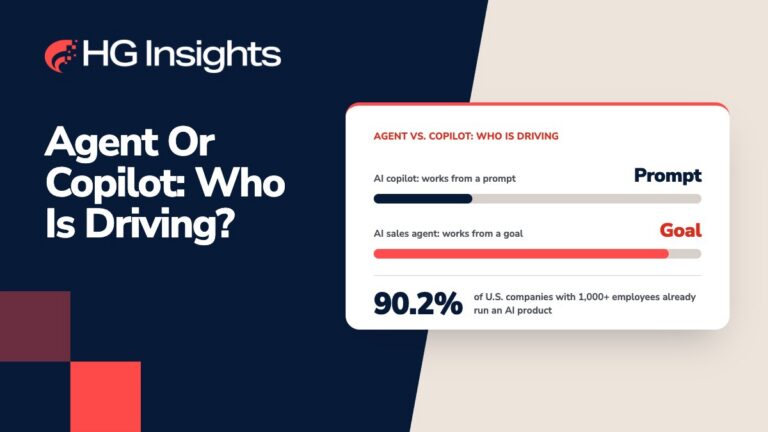
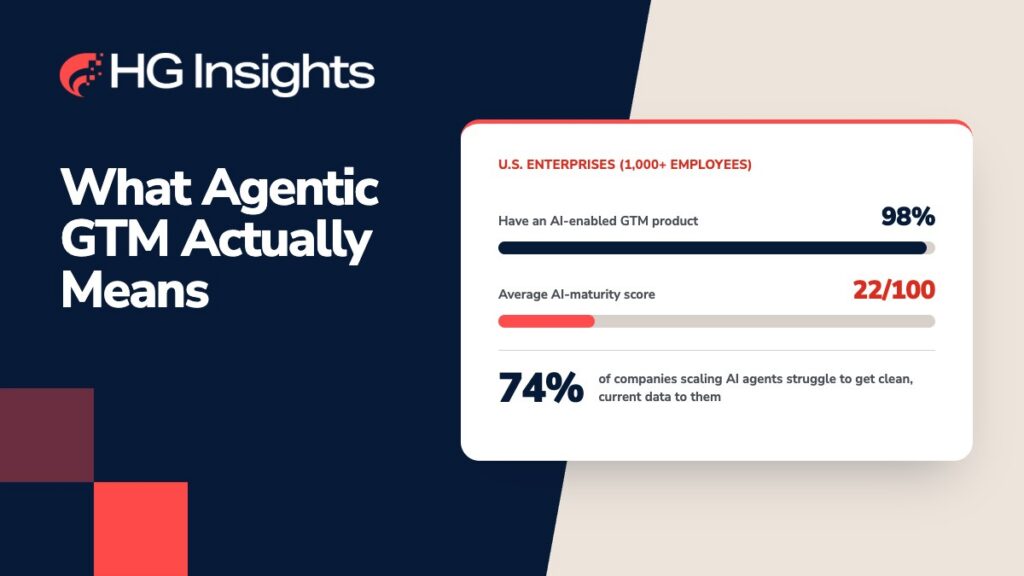
That shift is already underway. HG Insights data shows 98 percent of U.S. enterprise companies with 1,000 or more employees already have at least one AI-enabled product somewhere in their GTM stack, so the real question isn’t whether a GTM team has AI. It’s whether that AI is agentic, and whether it’s reasoning over data good enough to trust.
What “agentic” means in this context
“Agentic” describes software that acts with a degree of autonomy. It can plan a sequence of steps, pull from tools or data sources on its own, and adjust its approach based on what it finds, rather than following one fixed script. In GTM, an agentic system might independently research a company’s technology stack before recommending a specific angle for the outreach to a prospect based on what it finds. That’s different from a rules engine, which only moves to the next step if a specific condition is met. .
What GTM means in this context
GTM stands for go-to-market: the combined strategy and execution that gets a product in front of buyers and turns interest into revenue. It spans marketing (who to target and with what message), sales (who to call and in what order), and RevOps (which data and systems make that targeting accurate). Agentic GTM applies AI agents across all three functions rather than just one, which is why it gets discussed as a category rather than a single tool.
How agentic GTM differs from automation and traditional CRM workflows
Automation and agentic GTM both remove manual work, but they remove different kinds of it. Automation executes a workflow a person already designed. Agentic GTM builds and adjusts the workflow itself, responding to data the person never explicitly programmed for.
Agentic GTM vs. marketing and sales automation
Marketing automation platforms send a specific email when a specific trigger fires, because a marketer defined the path and trigger condition in advance. Sales automation platforms queue up a call or a sequence step because a rep or an admin set the cadence. Both are fast and reliable, but they’re also fixed: when the market shifts or the available data changes, someone has to go back in and rebuild the rule. An agentic GTM agent isn’t running a rule at all. It’s working toward a goal, so when the inputs change, its output can change without a rebuild.
Agentic GTM vs. traditional CRM workflows
A CRM workflow moves a record from one state to another when a condition is met: a stage changes, a field updates, a task gets created. That’s useful bookkeeping, but the CRM itself has no opinion about which accounts matter or why. Agentic GTM sits on top of, or alongside, the CRM, bringing in outside signals, like which companies are actively spending on a competing category, to make the prioritization call the CRM workflow can’t make on its own.
Why data quality determines whether agentic GTM actually works
Every vendor building agentic GTM tools is making roughly the same pitch: agents that research, prioritize, and act faster than a person could. That pitch is table stakes now. Boston Consulting Group research found that 74 percent of companies trying to scale AI agents run into trouble not because the models are weak, but because their systems can’t deliver clean, governed, current data to the agent when it needs it. An agent asked to prioritize accounts is only as useful as the account data it’s reasoning over. Feed it stale technographic data or the same generic third-party enrichment file every competitor is also buying, and it will make the same mediocre call a person would have made with the same weak inputs.
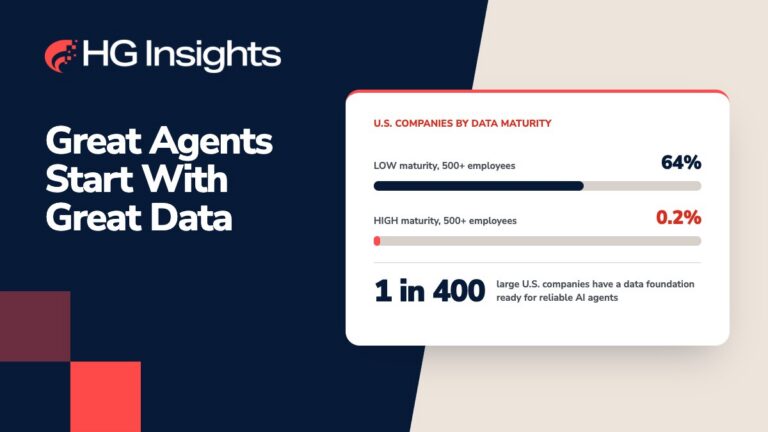
HG Insights data shows how wide that gap actually is. Across the same population of U.S. enterprise companies, the average AI-maturity score sits at just 22 out of 100, even though AI-enabled products are already present in nearly all of those tech stacks. Adoption came first. Readiness hasn’t caught up.
This is the argument HG Insights has made publicly since launching its Revenue Growth Agentic Ecosystem: agents built on proprietary, verified data outperform agents built on commodity enrichment, because an agent’s reasoning is only as sharp as the facts behind it. Read how HG Insights applies agentic GTM to competitive displacement for a look at what that means in a live GTM motion, prioritizing accounts by verified technology installs and spend rather than inferred intent alone.
The core components of an agentic GTM platform
Strip away the marketing language and most agentic GTM platforms are built from the same handful of parts. What varies, often a lot, is how deep and how proprietary each part actually is.
A proprietary, connected data foundation
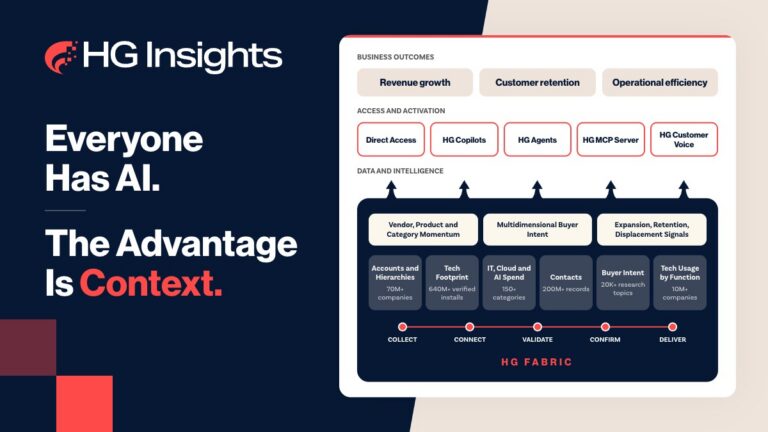
Every agent needs something to reason over: firmographic data with details on accounts and corporate hierarchy, technology installs with history of first and last verified, spend signals for IT, Cloud and AI technology, contract and renewal dates, buyer intent that gives an understand of what buyers are researching and how that interest relates to the products their companies already use or ideally a connected combination of these. Platforms that own this data outright, like HG Insights HG Fabric, can guarantee freshness and coverage. Platforms that aggregate data from third-party providers inherit whatever quality and refresh cadence those providers offer, and that’s largely out of the platform’s control.
Open, MCP-native architecture
The Model Context Protocol, or MCP, has become the standard way AI agents connect to outside data and tools, and Forrester expects 30 percent of enterprise application vendors to ship an MCP server in 2026. A platform built MCP-native from the start lets any agent, whether it’s built in-house or on another vendor’s tool, query its data directly. A platform that bolts MCP on as an add-on tends to expose less of its data and more friction.
Transparent, separated consumption pricing
Agent usage and data access are two different costs, and most vendors bundle them into one opaque credit system. A platform that separates how much AI reasoning an agent used from how much data it pulled gives a RevOps or finance team a much clearer way to forecast and control spend as agent usage scales.
Agentic GTM in action: marketing, sales, and RevOps use cases
The same underlying agent infrastructure supports different work depending on which team is pointing it.
Marketing
Marketing teams use agentic GTM to move past broad intent signals and target accounts by what they actually run: technology stack, spend level, and maturity. An agent can continuously re-score a segment as technographic and spend data changes, instead of a marketer re-pulling a list once a quarter.
Sales
Sales teams get the clearest, most immediate value from competitive displacement: an agent that identifies exactly which accounts run a competitor’s product, how much they’re spending on it, and when that spend is likely to come up for renewal. That turns a cold account into a qualified, context-rich competitive displacement opportunity before a rep ever picks up the phone.
RevOps
RevOps teams use agentic GTM to build and maintain propensity models, blending internal CRM data with external technographic and spend signals so scoring stays accurate as both data sets change. This is also where governance lives: RevOps typically owns the guardrails that keep every marketing and sales agent reasoning over the same trusted data foundation.
What to look for when evaluating an agentic GTM platform
Most vendor conversations sound similar, so a real evaluation has to focus on the questions that actually separate platforms. Where does the underlying data come from, and does the vendor own it or license it from the same third parties every competitor also uses? Is the platform MCP-native, so agents can query data directly and work alongside tools you already have, or is MCP a feature bolted onto a closed system? And can you see, in plain terms, what you’re actually paying for: AI reasoning, data access, or both blended into one number?
HG Insights built its HG MCP Server and HG Agents around these three questions directly, pairing an MCP-native architecture with a proprietary data fabric spanning firmographics, technographics, spend, contracts, and intent, so agents built on it reason over verified data instead of a shared third-party file. Marketing, sales, and RevOps teams can compose their own agents on top of that foundation instead of working within a fixed set of pre-built ones.
If your team is comparing agentic GTM platforms this quarter, the fastest way to see the difference proprietary data makes is to book a demo and run it against your own accounts.
Frequently Asked Questions
What does "agentic GTM" mean?
Agentic GTM means using AI agents, software that can plan, act, and adjust with limited human input, to carry out go-to-market work like account research, prioritization, and outreach. It differs from automation because the agent decides its own next step based on live data instead of following a pre-built rule.
What does "agentic" stand for?
“Agentic” isn’t an acronym. It describes software with agency: the ability to plan a sequence of actions, use tools or data on its own, and adapt based on results, rather than executing one fixed script.
How is agentic GTM different from automation?
Automation runs a workflow a person already built: if this trigger fires, do that action. Agentic GTM builds and adjusts its own workflow toward a goal, so it can change its output when the underlying data changes without anyone rebuilding a rule.
How do agents pick target accounts?
Agents pick target accounts by combining firmographic fit, technographic signals, IT spend capacity, and intent data into a single scored view, then weighting accounts where multiple signals align. An agent with access to fewer data types has fewer signals to combine, which means shallower, less accurate account prioritization.
How is agentic GTM different from a CRM?
A CRM stores records and moves them between stages when a condition is met, but it has no opinion on which accounts matter. Agentic GTM adds reasoning on top of or alongside the CRM, pulling in outside signals like technology spend to make prioritization decisions the CRM workflow can’t make alone.
What should an agentic GTM platform include?
At minimum, an agentic GTM platform needs a data foundation the vendor actually owns, MCP-native architecture for open agent connectivity, the ability to build custom agents rather than only using pre-built ones, and transparent pricing that separates AI usage from data access costs.