
AI agent infrastructure covers orchestration, model and runtime access, tool permissions, security, and observability, but none of that matters if the data foundation underneath is broken. Sales and RevOps teams are moving fast to deploy agents for account research, outbound personalization, and pipeline prioritization, but most of that effort assumes the data underneath is already solved. It usually isn’t. An agent built on stale, third-party, or partial data produces confident-sounding output that’s wrong in ways nobody catches until a deal falls through. Here’s what the data foundation layer of AI agent infrastructure actually requires, and how to check whether yours is real.
Quick answer: The data foundation layer of AI agent infrastructure is verified, unified B2B data (firmographic, technographic, spend, intent, contract, and contact signals resolved under one company ID) exposed to agents through an open protocol like MCP. It’s one piece of the broader infrastructure stack, alongside orchestration, model access, tool permissions, security, and observability, but without it, a GTM agent is reasoning on incomplete or unverifiable information, regardless of how capable the underlying model is.
What AI agent infrastructure actually means
AI agent infrastructure is the full stack an agent depends on: orchestration, model and runtime access, tool permissions, security, observability, and the data layer underneath all of it. This post focuses specifically on that data layer, the data and access an agent depends on to take a correct action, not the agent itself and not the language model doing the reasoning. It’s the piece most often assumed to already be solved and least often actually is: where the data comes from, how current it is, whether it’s proprietary or borrowed from someone else’s pipeline, and how an agent actually reaches it.
Most of what gets marketed as “AI agent infrastructure” right now is really the orchestration layer: the workflow builder, the prompt templates, the no-code automation on top. That layer matters, but it’s not what this post is about, and it’s rarely what breaks first. A workflow builder can be beautifully designed and still hand an agent bad information. The data layer is the part that decides whether the information was good in the first place.
That distinction is why GTM teams keep hitting a ceiling with agents that looked great in a demo. The demo ran on curated data. Production doesn’t.
Why AI agents fail without a real data foundation
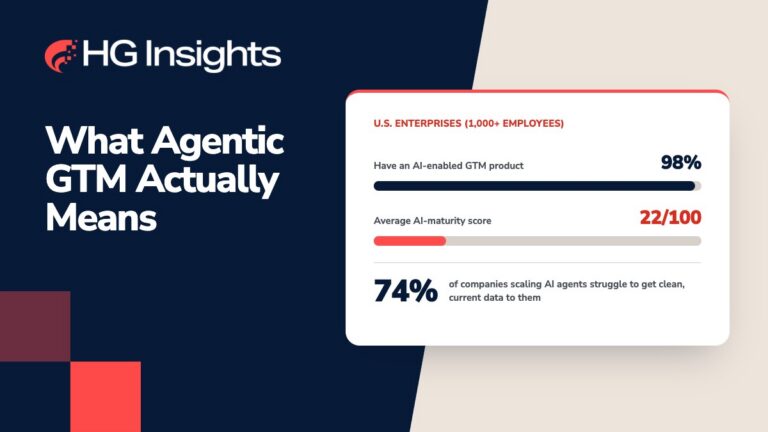
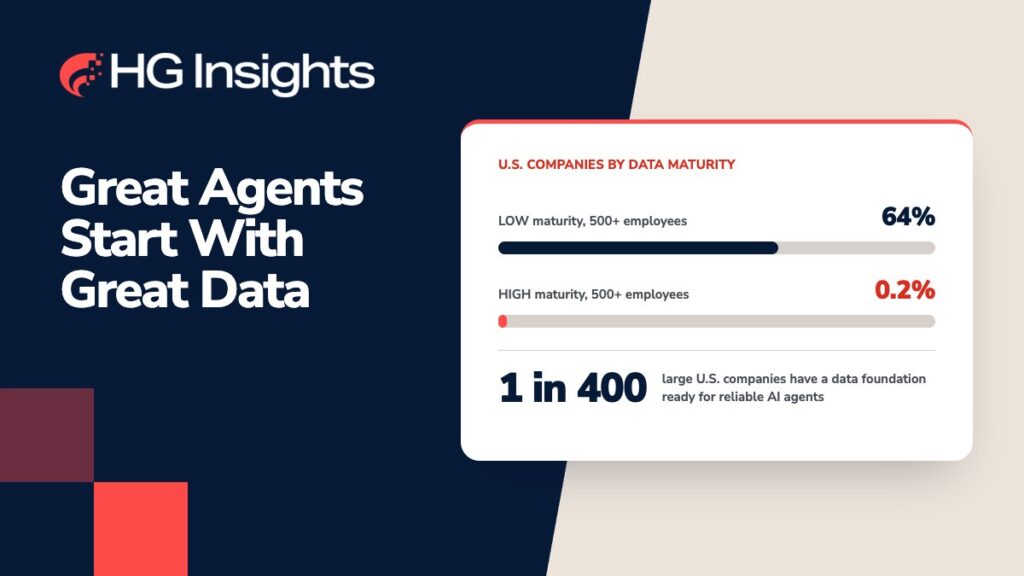
Fewer than 1 in 400 large U.S. companies has a data foundation mature enough to support reliable AI agents. Across more than 42,000 U.S. companies with 500 or more employees, HG Insights data shows just 0.2% rate as HIGH data maturity, while 64% rate as LOW, and most of those LOW-maturity companies are already running an AI product. An AI agent amplifies whatever it’s given. Point it at accurate, current, well-governed data and it produces useful output fast. Point it at fragmented or stale data and it produces the same confident tone, just aimed at the wrong account, the wrong contact, or a technology stack that changed eight months ago.
This is the exact failure mode RevOps teams already describe in their non-agentic tools: data fragmentation, manual enrichment overhead, duplicate records, and CRM data gone stale between refresh cycles. An agent doesn’t fix any of that. It just executes on it faster, with more apparent authority, which makes the mistake harder to catch.
A concrete version of this: an agent tasked with prioritizing accounts for a competitive displacement play pulls technographic data that’s a year old. It flags an account as running a competitor’s product when that account switched months ago. The agent isn’t wrong about its reasoning. It’s wrong about its inputs, and it has no way to know that.
This is why the shape of the underlying data matters as much as the sophistication of the agent reasoning over it. Not all data is equally useful to an agent, and most vendors selling “data for AI agents” are selling a narrower slice of it than they let on.
The seven data types a GTM agent needs to act on
A GTM agent that’s actually useful needs to reason across several distinct data types at once, not one enrichment source stretched to cover everything.
Firmographic and technographic depth
Firmographic data (company size, industry, location, structure) is table stakes. Almost every data provider has some version of it. Technographic data is where the real differentiation shows up: not just that an account uses Salesforce, but since when, how intensely, and whether that adoption is expanding or eroding. Time-series depth is what turns a static snapshot into a signal an agent can act on, like flagging a renewal window or a displacement opportunity before a human would notice it.
IT spend and contract intelligence
An agent recommending which accounts to prioritize needs budget context, not just interest. Account-level IT spend, segmented by category like AI, cloud, or enterprise software, tells an agent whether an account can actually act on an opportunity. Contract data, especially around systems integrator and infrastructure deals with real renewal dates, adds a layer almost nobody tracks at the GTM level: it tells an agent when a buying window is actually open.
Intent and buying signals
Raw intent data tells you a company is researching a topic. Contextual intent, the kind enriched with what that company’s technology stack already looks like, tells an agent whether that research represents an expansion, a competitive displacement, or a net-new opportunity. That distinction changes what the agent should recommend next, and most intent providers can’t make it because they don’t have the technographic layer to check against.
Contact and buying-group context
A flat list of contacts at a company isn’t enough for an agent trying to run a multithreaded outreach play. It needs structured buying-group intelligence: who holds which role, how those roles cluster around a specific account, and how that maps to the deal the agent is trying to move forward. Public financial signals, like SEC filings for larger accounts, round this out by giving an agent a read on company health before it commits outreach effort.
Every one of these data types needs to map to the same company under a single identifier. Otherwise, the agent is forced to reconcile conflicting records across multiple systems, increasing the risk that it combines mismatched or outdated information into the same account view.
How HG MCP Server exposes verified GTM data to any agent
Having the right data doesn’t help if an agent can’t actually query it. That’s the job of the Model Context Protocol (MCP), an open standard for connecting AI agents and large language models to external data sources without custom integration work for every tool. An agent built on Claude, GPT, or any MCP-compatible framework can call an MCP server the same way regardless of which vendor built it.
This matters most to CTOs and data engineering leaders, though security, governance, reliability, and permissions matter just as much. On data access specifically, most AI agent builder platforms for GTM still fall short. Of the eight direct competitors in this category, only three, Clay, D&B, and Demandbase, support MCP at all today. Even those three expose one slice of proprietary data rather than a unified foundation: D&B is deep on firmographics, Demandbase is strong on intent and technographic signals, but neither unifies all seven dimensions under one identifier. Several vendors describe MCP support when what they’re really offering is a protocol wrapper around third-party data they license from someone else, which reintroduces the same data-fragmentation problem agents need solved in the first place.
Built by HG Insights, HG MCP Server exposes the full HG Fabric data foundation: firmographic, technographic, spend, intent, contract, and contact data an agent can query directly, all under the same company identifier. It’s proprietary data, not resold third-party aggregation, available through an open protocol instead of a closed API a vendor controls. Teams evaluating this can see it firsthand in a technical walkthrough of HG MCP Server with HG Insights’ data architecture team.
Where HG Fabric fits in the stack
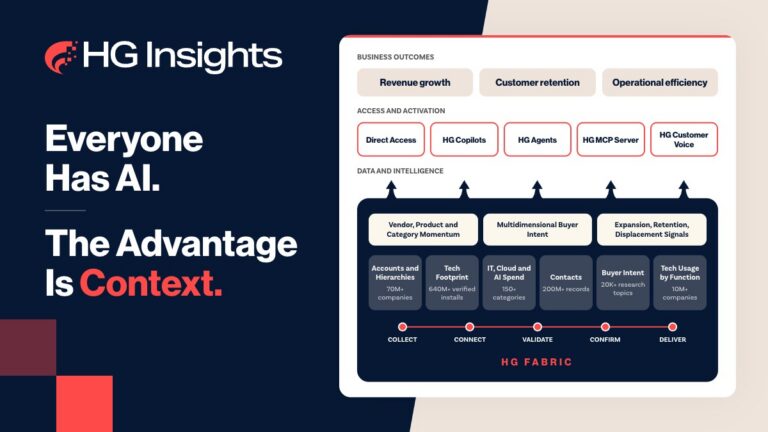
HG Fabric is the data foundation underneath all of this: the unified layer where firmographic, technographic, spend, contract, intent, and contact data resolve against a single company ID at every level of an org’s hierarchy. It’s not an application. It’s the layer applications and agents both sit on top of.
HG Agents is the layer above it, where GTM teams compose actual agents, whether pre-built for a specific use case or custom-assembled for something their business needs that nobody’s productized yet. HG MCP Server is what connects the two: it’s how an agent built in HG Agents, or built entirely outside HG’s platform, reaches into HG Fabric’s data without a custom integration. See the full seven-dimension data spec on the HG Fabric product page for the technical detail on how each data type is structured and delivered.
This post has focused specifically on what agent infrastructure’s data layer requires and why it’s the part that actually determines outcomes. For a broader look at how HG Fabric, HG Agents, and MCP fit together as part of a wider agentic GTM ecosystem, the earlier piece on HG Fabric’s role in the agentic GTM ecosystem covers that ground in more depth.
Open architecture versus closed data: what to check before you build
Every vendor in this category now claims some version of “open” and “AI-ready.” Most of those claims don’t survive three questions.
First, is MCP support actually in production, or is it still on a roadmap slide? Several platforms in this space list MCP as a capability that’s announced but not shipped. Second, is the data behind that MCP server something the vendor actually owns, or is it a protocol layer sitting in front of data licensed from somebody else? That second case means you’ve inherited a data-quality problem you didn’t know you were buying. Third, does pricing separate what you’re paying for AI inference from what you’re paying for data access, or is it bundled into a contract opaque enough that nobody on your team can tell you which line item is driving cost?
None of these questions are unfair to ask a vendor. If the answers are vague, that’s the answer. Talk to HG Insights’ data architecture team directly about what a real MCP implementation looks like under the hood.
Frequently Asked Questions
What data foundation powers GTM agents?
A GTM agent needs a data foundation that unifies firmographic, technographic, IT spend, intent, contract, and contact data under a single company identifier, exposed through an open protocol like MCP. Without that unification, an agent is reconciling conflicting data from disconnected sources instead of acting on a verified account view.
Why do GTM agents need technographics?
Technographic data tells a GTM agent which technologies an account already runs, since when, and how intensely, which is what separates a real opportunity signal from a guess. Without it, an agent can’t distinguish a genuine displacement opportunity from an account that already made a purchase decision months ago.
How do technographics improve GTM agents?
HG Technographics gives an agent time-series context most other technographic sources don’t track: adoption timing, intensity, and change over time, not just a static list of tools. That context lets an agent flag renewal windows, expansion signals, and displacement opportunities on its own, instead of requiring a rep to manually cross-reference install data before acting.
How do agents pick target accounts?
Agents pick target accounts by combining firmographic fit, technographic signals, IT spend capacity, and intent data into a single scored view, then weighting accounts where multiple signals align. An agent with access to fewer data types has fewer signals to combine, which means shallower, less accurate account prioritization.
How do agents build ideal customer profiles?
Agents build ideal customer profiles by pattern-matching firmographic and technographic traits across an existing customer base, then scoring net-new accounts against that pattern. The accuracy of that profile depends entirely on how much verified, unified data the agent had to learn the pattern from in the first place.
What is MCP, and why does it matter for AI agents?
MCP, the Model Context Protocol, is an open standard that lets an AI agent query external data sources without a custom integration for each one. It matters because it determines whether an agent can reach verified, current data directly, or whether it’s limited to whatever was manually piped into it ahead of time.