
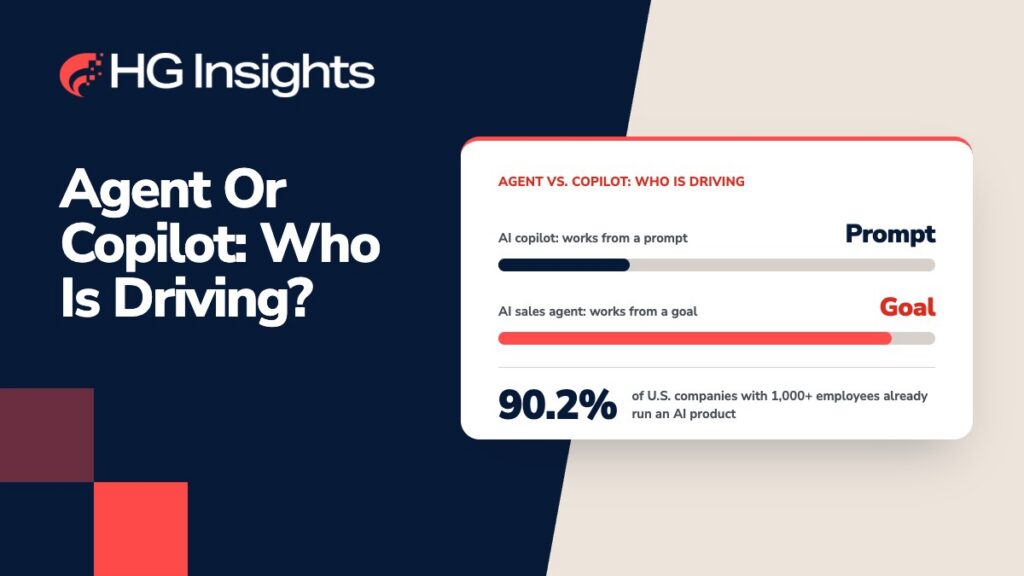
Most GTM teams evaluating AI tools right now are really asking one question: is this thing going to do the work, or help me do it faster? That’s the AI agent vs. AI copilot distinction in practice. An AI copilot sits alongside a rep or RevOps analyst, answering a prompt and handing control back. An AI sales agent takes a goal and runs the multi-step workflow itself, checking back in only when it needs a decision only a person can make. Neither one is replacing the other. Most agentic GTM stacks in 2026 run both.
Quick Answer: An AI copilot is a human-in-the-loop assistant that responds to a prompt, surfaces a recommendation, and waits for a person to act. An AI sales agent is a goal-driven system that plans and executes a multi-step GTM workflow on its own, looping in a human only for approval or exception handling. The difference is autonomy, not intelligence.
What is an AI sales agent?
An AI sales agent is a goal-driven system built to complete a defined GTM task end to end, without a person managing each step. You give it an objective, such as “build a target account list for this quarter’s displacement campaign,” and it plans the steps, pulls the data, makes the intermediate decisions, and reports back what it did.
That last part matters. A copilot returns a suggestion. An agent returns a finished piece of work. In practice, that means an AI sales agent can run account research, enrich a lead list against technographic and spend data, sequence outreach, and flag which accounts are worth a rep’s attention, all in one continuous run instead of five separate tool switches. HG Insights data puts this in context: 55.7% of U.S. companies with 100 or more employees already have at least one AI product live in their stack. Adoption isn’t the open question anymore. Which layer, agent or copilot, handles which job is.
What is an AI copilot?
An AI copilot is an assistant that works from a prompt inside a workflow you own, gives you an answer or a draft, and then steps back. It doesn’t decide what to do next; you do. That’s by design. A copilot is meant to sit inside a workflow a person still owns, whether that’s a rep prepping for a call or a RevOps leader sizing a territory.
HG Insights builds several of these: Sales Copilot surfaces account intelligence and buyer intent signals directly inside a rep’s CRM so they know who to call and why before they pick up the phone. Market Analyzer Copilot turns a market-sizing question into a bottom-up TAM/SAM/SOM model in minutes instead of days. Data Studio is the layer underneath both: it’s where ops configures the offerings, ICPs, and scoring models everything else runs on. In every case, a person reviews the output and decides what happens next. The copilot makes that decision faster and better informed. It doesn’t make it for you.
AI sales agent vs. AI copilot: the core difference
The core difference between an AI sales agent and an AI copilot is who’s driving. A copilot takes direction from a person one request at a time and hands control straight back. An agent takes a goal, plans the path to it, and executes across multiple steps before a person needs to weigh in again.
Dimension | AI copilot | AI sales agent |
|---|---|---|
Works from | A prompt, one request at a time | A goal, executed across multiple steps |
Human role | Reviews and acts on every output | Sets the objective, reviews the result |
Best fit | Relationship-driven, high-stakes selling moments | High-volume, repeatable GTM workflows |
Example | Sales Copilot surfacing account context in a CRM | An agent running a full prospecting workflow on HG Agents |
That’s not a hierarchy. It’s a division of labor. A rep working a six-figure enterprise deal wants a copilot whispering context in their ear, not an agent making judgment calls on their behalf. A RevOps team trying to enrich ten thousand accounts a week wants an agent running the pipeline, not a copilot they have to prompt one account at a time.
How AI agents and AI copilots work together in an agentic GTM workflow
Neither an agent nor a copilot works in isolation. Both need the same thing underneath them: current, accurate data about the accounts and buyers they’re acting on. Get that wrong, and it doesn’t matter whether a human or an agent is driving.
The data layer underneath both
An AI agent or copilot is only as reliable as the data it can reach. This is why the Model Context Protocol (MCP) has become the connective layer for agentic GTM in 2026, giving any agent or copilot a standard way to pull live data from a CRM, a spend database, or a firmographic source instead of requiring a custom integration for each one. For a deeper look at how that connection actually works, see What Is an MCP Server? A GTM Leader’s Guide.
Where a copilot hands off to an agent
A common pattern: a RevOps leader uses a copilot like Market Analyzer to identify a whitespace segment worth pursuing, meaning accounts actively researching a category they don’t currently run. Once that segment is defined, an agent takes over, building the account list, enriching it against technographic and spend data, and staging the first outreach sequence. The person made the strategic call. The agent did the repeatable execution that follows from it.
Where an agent hands back to a copilot
The reverse happens just as often. An agent runs a competitive displacement sweep across thousands of accounts and flags the twenty that show the strongest buying signal. A copilot then surfaces those twenty inside the rep’s CRM, with the account context needed to have a real conversation. The agent did the finding. The copilot made it usable by a person in the moment that matters.
When to use a copilot vs. when to use an agent
For RevOps leaders
For a VP or Director of RevOps, the decision usually comes down to volume and repeatability. Territory design, account scoring, and enrichment at scale are agent work: the inputs are structured, the steps are repeatable, and the value comes from doing it across thousands of accounts consistently. A copilot doesn’t scale to that volume because it needs a person prompting it account by account. An agent, once built, runs the same logic across the whole book. At the enterprise tier, this isn’t a hypothetical. HG Insights data shows 90.2% of U.S. companies with 1,000 or more employees already have an AI product live in their stack, well above the 55.7% adoption rate across the broader market. For enterprise RevOps teams, the question has already moved past whether to bring in AI and into which layer, agent or copilot, should own which workflow.
For sales leaders
For a VP or Director of Sales, the calculation is different. A complex enterprise deal involves stakeholder politics, timing, and judgment calls that no agent should be making unsupervised. That’s copilot territory: real-time account context, a suggested next best action, a drafted follow-up email the rep still reads before sending. The goal isn’t to remove the rep from the loop. It’s to make sure they walk into every call already knowing what an agent surfaced about that account overnight.
Choosing the right AI layer for your GTM stack
Most vendors selling into GTM teams right now will tell you their product is an “AI agent,” whether or not it actually plans and executes multi-step work on its own. Worth asking directly: does this system take a goal and run with it, or does it take a prompt and hand back a suggestion? Both are useful. Only one replaces the manual work of stitching five tools together yourself.
HG Insights runs both layers on the same data foundation, which the company laid out when it unified its Fabric and agentic ecosystem. Sales Copilot, Market Analyzer, and RevOps Data Studio handle the human-in-the-loop side. HG Agent Builder handles the autonomous side, giving RevOps and technical teams the MCP tools to build custom agents on top of HG’s proprietary technographic, firmographic, spend, and intent data instead of generic third-party enrichment. See how HG Agents help teams construct GTM agents grounded in data no other platform has.
Frequently Asked Questions
Is an AI copilot the same thing as an AI agent?
No. A copilot responds to a prompt and waits for a person to act on its output. An agent takes a goal and executes the steps to reach it on its own, checking back in only for approval or exceptions. The difference is autonomy, not capability.
Do AI sales agents replace human sales reps?
No. AI sales agents take over repeatable execution, like enrichment, list building, and initial outreach sequencing, so reps can spend their time on relationship-driven conversations. HG Insights and most GTM vendors position agents as handling volume work, not replacing the judgment reps bring to a deal.
Can AI agents and AI copilots work in the same GTM stack?
Yes, and most agentic GTM stacks in 2026 run both. A common pattern has an agent handling account research and enrichment at scale, then a copilot surfacing the results inside a rep’s CRM so they can act on it in the moment.
What is agentic GTM?
Agentic GTM refers to go-to-market operations where AI agents handle multi-step workflows such as account research, enrichment, and outreach sequencing autonomously, working alongside copilots and human reps rather than replacing the entire GTM motion.
What is MCP and why does it matter for AI agents?
MCP, or Model Context Protocol, is a standard that lets an AI agent or copilot pull live data from systems like a CRM or spend database through one shared connection instead of a custom integration for each source. It’s become the default way agents access enterprise data in 2026.