
AI visibility monitoring is how a brand tracks whether it actually shows up when buyers ask ChatGPT, Perplexity, or Google AI Overviews a question in its category. For years, that question didn’t need a dashboard: if you weren’t ranking, you checked your backlinks and your content and got back to work. AI answers don’t work like a results page, so the old troubleshooting checklist doesn’t fully apply anymore. This guide covers what AI visibility monitoring actually measures, what a GEO monitoring dashboard does with that data, and what to look for before committing budget to a tool.
Quick Answer: AI visibility monitoring is the ongoing tracking of how a brand appears in AI-generated answers from tools like ChatGPT, Perplexity, Google AI Overviews, and Copilot. It measures mentions, citations, sentiment, and Share of Voice against named competitors across a set of tracked buyer prompts, giving marketing and SEO teams a real baseline for a channel that used to be a black box.
What is AI visibility monitoring?
AI visibility monitoring is the practice of systematically tracking how, and how often, a brand is mentioned or cited in responses from generative AI tools. Instead of watching a keyword’s position on a results page, it watches a set of realistic buyer questions (a “prompt panel”) and records who gets named, who gets linked, and in what tone.
That distinction matters more than it sounds like it should. A brand can rank well on Google and still be absent from an AI Overview or a ChatGPT answer for the exact same query, because the model is drawing from a different mix of sources and weighting them differently. AI visibility monitoring is the only way to know that gap exists before a prospect tells you about it in a loss review.
Why AI visibility monitoring matters now
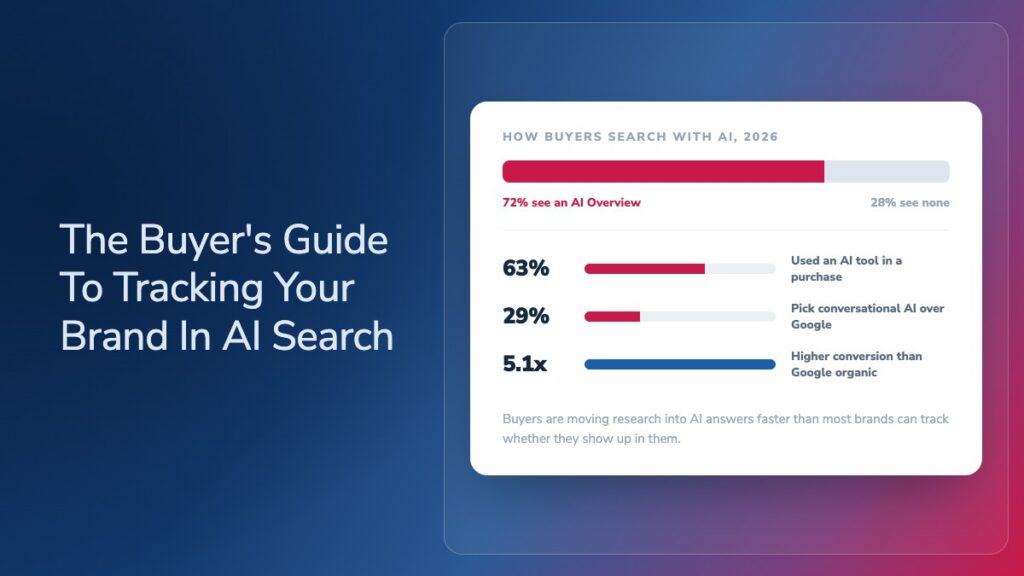
Search teams have spent years defending organic rankings against algorithm updates. This shift is different in kind, not just degree. Seventy-two percent of buyers now encounter an AI Overview during a routine Google search, and a documented share of B2B buyers, roughly 29% by some counts, are choosing a conversational AI tool over Google outright for early research.
The behavior underneath that shift is what makes monitoring necessary rather than optional. According to the 2026 B2B Buying Disconnect Report from TrustRadius, an HG Insights company, 63% of B2B buyers used an AI tool during a purchase decision in the past year, up from 46% the year before. Most of them don’t take the answer at face value: 72% say they always or very often verify what the AI tells them, typically against a third-party source like a review site or a vendor comparison, up from 58% a year earlier. That verification moment is where a brand either shows up or doesn’t.
For an SEO or organic search lead, the discomfort is specific and hard to explain upward. Rankings still matter, and traffic can still be tracked. But a growing share of the research that used to happen on a results page now happens inside an answer that a rank tracker was never built to see. Leadership wants to know where that traffic went. Without a visibility baseline for AI-generated answers, there’s no honest way to answer that question, only a guess.
How AI visibility monitoring works
AI visibility monitoring breaks down into a few measurable layers, and none of them map cleanly onto a keyword rank. That’s exactly why the SEO tooling most teams already own can’t answer the question by itself.
Brand mentions and Share of Voice
A mention is any instance where an AI tool names your brand or product in a response, whether or not it links back to a source. Tracked over a fixed set of prompts, mentions roll up into Share of Voice: your mentions as a percentage of total mentions across you and your named competitors for that prompt set. A brand with 15% Share of Voice on its category’s core prompts has a concrete, trackable problem. A brand with no visibility program has no way to know its number is 15% in the first place.
Citations and sentiment
A citation goes beyond a mention: the AI response actually attributes a claim to a specific source, sometimes with a link. Citation rate (the percentage of tracked prompts where a brand earns a citation, not just a mention) is a tighter measure of whether your content is doing the work, not just existing. Sentiment adds a second layer: whether the response frames the brand positively, neutrally, or negatively, which matters because a citation with negative framing can do more damage than no citation at all.
Prompt-level tracking
None of the above means anything without a defined, repeated set of prompts to test it against. Most monitoring approaches run a panel of realistic buyer questions, refreshed on a schedule, across the major engines: ChatGPT, Perplexity, Google AI Overviews, Copilot, and Claude, though exact engine coverage varies by tool and by contract. Prompt-level detail is what turns “our AI visibility is bad” into “we lose the comparison prompts against this specific competitor,” which is the difference between a data point and a plan.
Inside a GEO monitoring dashboard
A GEO monitoring dashboard is where the metrics above get operationalized: one place that pulls mentions, citations, sentiment, and Share of Voice into a live view instead of a spreadsheet somebody rebuilds by hand every month.
The GEO Monitoring Dashboard from HG Insights and TrustRadius is one example, and it’s built around three tabs:
- Product Monitoring. Tracks up to 100 real buyer prompts a month for a single product, showing brand mentions, TrustRadius citations, and sentiment benchmarked against named competitors.
- Category Monitoring. Runs the same tracking at the category level, useful for a VP of Marketing or CMO who needs to know how the whole space is being represented in AI answers, not just one SKU.
- Crawler Analytics. Goes a layer deeper than either, showing which AI engines are actually crawling a brand’s pages, how often, and whether that activity is grounding (answering a live buyer question in real time) or training (feeding a model’s next update).
For a hypothetical illustration, imagine a dashboard view for a fictional vendor, “Acme, Inc.” It might show a citation coverage rate of 34% against a leading named competitor’s 61%, with the gap concentrated almost entirely in comparison-style prompts like “Acme vs. [Competitor] for enterprise teams.” That’s a specific, fixable target. Compare that to knowing only that “our AI visibility feels weak,” and the case for a dashboard over a one-time audit gets a lot easier to make.
See what this looks like on a live account. The GEO Monitoring Dashboard from HG Insights and TrustRadius is available today for TrustRadius CVP customers, tracking Product Monitoring, Category Monitoring, and Crawler Analytics in one view.
AI visibility monitoring vs. traditional SEO tracking
Traditional rank tracking answers one question: where does this URL sit for this query on this search engine today? It’s a stable, repeatable measurement because the underlying mechanic, the ranked list of ten blue links, hasn’t changed much in twenty years.
AI visibility monitoring has to answer a messier question, because the underlying mechanic is messier. There’s no fixed “position one through ten.” The same prompt can generate a different answer for two different users, or for the same user an hour later, depending on how the model is sampling and which sources it pulls into that specific response. Citations, not backlinks, are the currency that matters, and a citation in an AI answer doesn’t behave like a link for SEO purposes: it can’t be crawled and counted the same way, and it doesn’t carry the same durable authority signal.
The two disciplines aren’t in competition, and framing them that way undersells both. GEO is best understood as an extension of SEO, not a replacement for it. The technical groundwork that makes a page rankable (crawlable markup, structured data, content that’s actually written to answer a real question) is largely the same groundwork that makes it citable by an AI model. One third-party analysis puts AI-referred traffic’s conversion rate at roughly 5.1 times the rate of Google organic (Averi Multi-Source Analysis, March 2026), which is a strong argument for building AI visibility monitoring on top of an existing SEO program rather than standing up a separate function from scratch.
How to choose an AI visibility monitoring tool
Most of what’s published on this topic right now is a listicle ranking ten or fifteen tools against each other, which is a reasonable starting point but not a decision framework. A few criteria matter more than the rest when you’re actually evaluating one:
- Engine coverage that matches where your buyers actually research, not just the two or three engines every vendor demos first.
- Prompt-level detail, not just an aggregate visibility score, so you can see which specific buyer questions you’re winning or losing.
- Competitive benchmarking against named competitors, because a Share of Voice number means nothing in isolation.
- Sentiment tracking, since a citation with the wrong framing can do real damage.
- A clear path to action: does the tool just report the gap, or does it connect to a way to close it?
That last point is where most tools stop and where the more useful ones don’t. A dashboard that tells you your citation rate on comparison prompts is 34% is informative. A program that also tells you which specific pages need work, and helps build the content that closes the gap, is the difference between a report card and a plan.
AI visibility monitoring only pays off as a habit, not a one-time report card. Teams that treat it like a quarterly check-in find out about a problem long after it’s already baked into how a model describes their category. The opportunity is also bigger than most vendors assume: of the 6,380 U.S. software companies with 100 or more employees, HG Insights data shows only 4.5% (289) are enterprise-scale companies with 1,000 or more employees. The other 95.5% are mid-market vendors, exactly the segment least likely to have any visibility tooling in place today. Get a Share of Voice baseline for your product by booking a demo of the GEO Monitoring Dashboard before your next planning cycle, while the gaps are still cheap to close.
Related read: Why AI engines cite some vendors and skip others.
Frequently Asked Questions
What is AI visibility monitoring?
AI visibility monitoring is the ongoing tracking of how often and how accurately a brand is mentioned or cited in AI-generated answers from tools like ChatGPT, Perplexity, and Google AI Overviews. It typically measures mentions, citations, sentiment, and Share of Voice against named competitors across a fixed set of buyer prompts.
How is AI visibility measured?
AI visibility is measured by running a defined panel of realistic buyer prompts against major AI engines on a regular schedule, then tracking four metrics from the responses: brand mentions, citation rate, sentiment, and Share of Voice relative to named competitors. Prompt-level detail shows which specific questions a brand wins or loses.
What are the best tools for tracking AI visibility?
The right tool depends on which AI engines your buyers actually use, whether you need prompt-level detail or just an aggregate score, and whether you want monitoring alone or monitoring paired with a way to close the gaps it finds. Compare tools against those criteria rather than a generic ranking, since coverage and depth vary widely.
What's the difference between AI visibility monitoring and GEO?
AI visibility monitoring is the measurement layer: tracking mentions, citations, and sentiment in AI-generated answers. GEO, or generative engine optimization, is the broader practice of structuring content so AI engines are more likely to cite it in the first place. Monitoring tells you where you stand. GEO is the work of improving that standing.
How often should a brand check its AI visibility?
Monthly tracking is the common baseline, since AI models update frequently and a competitor’s new content can shift citation share within weeks. Brands in a fast-moving or highly competitive category often monitor more frequently, particularly around product launches or major content pushes where visibility gaps are most likely to open up.
Do I need AI visibility monitoring if I already track SEO rankings?
Yes, because the two measure different things. A strong SEO ranking doesn’t guarantee an AI tool will mention or cite your brand for the same query, since generative engines weigh sources differently than a traditional results page. Rank tracking and AI visibility monitoring answer separate questions and work best when used together.