
Comparing 6sense vs HG Insights usually starts from the wrong question. Most buyers ask which platform to pick, when the more useful question is what each one is actually built to detect. 6sense reads intent: the research activity happening before a buyer raises their hand. HG Insights reads deployment: what’s actually installed, how deeply it’s used, and when the contract comes up for renewal. Teams that understand this difference stop treating it as a replacement decision and start treating it as a stack decision.
Quick Answer: 6sense and HG Insights solve different problems and are commonly run together. 6sense identifies accounts researching a category through predictive intent signals; HG Insights identifies which vendor is installed, how intensively, and when that contract renews. Most GTM teams keep 6sense for demand gen and ABM orchestration and HG Insights for competitive displacement, contract timing, and transparent account scoring.
6sense and HG Insights at a glance: what each platform does
6sense built its position on predictive intent: a single platform that combines third-party research signals, its own Signalverse data, and AI models to score accounts by buying stage, then activate that scoring across email, display, and LinkedIn campaigns. It’s a strong fit for teams running omnichannel ABM programs who need one system to identify, score, and advertise to in-market accounts.
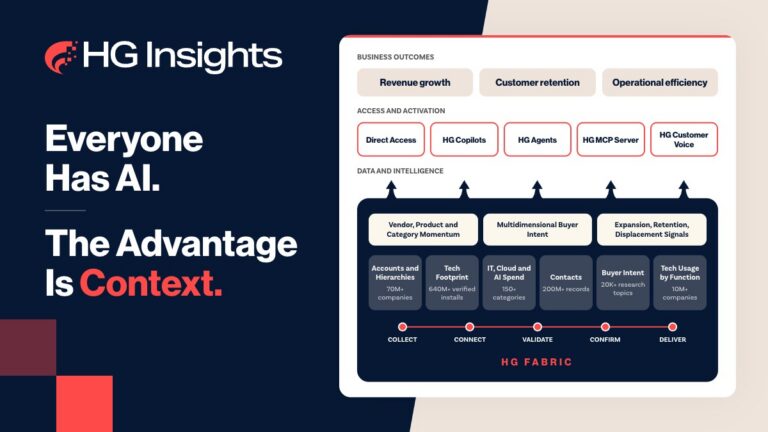
HG Insights approaches the same buyer with a different data foundation. HG Insights tracks what technology is actually installed at an account, how intensively it’s deployed, and when the contract is expected to renew, then layers that with its own contextual intent signals across four categories: whitespace, expansion, competitive displacement, and retention risk. Where 6sense answers “who’s shopping,” HG Insights answers “who’s running what, and when does it change.” That distinction, not a feature checklist, is what determines which platform a given use case needs.
Buyer-intent data: installation signals vs. predictive intent signals
The core difference between these platforms is what kind of signal they treat as ground truth. 6sense scores accounts using predictive intent: research activity, content consumption, and modeled buying-stage probability. HG Insights scores accounts using IT spend signals, buyer intent, and technology installation data: verified technographic data, deployment intensity, and confirmed contract dates.
Neither intent signals or install data replaces the other, and that’s the point missed by most “vs.” comparisons. Buyer intent data models are strong at surfacing accounts early in a buying cycle, before any technographic change has happened. Instal data is strongest once a displacement or renewal opportunity is real. It tells sellers what’s already deployed, at what intensity, and how soon that account’s contract comes up, which is exactly the information intent scoring alone can’t produce. A mature GTM motion uses intent to find the account and installation data to know how to sell into it.
6sense vs. HG Insights: feature-by-feature comparison
Dimension | 6sense | HG Insights |
|---|---|---|
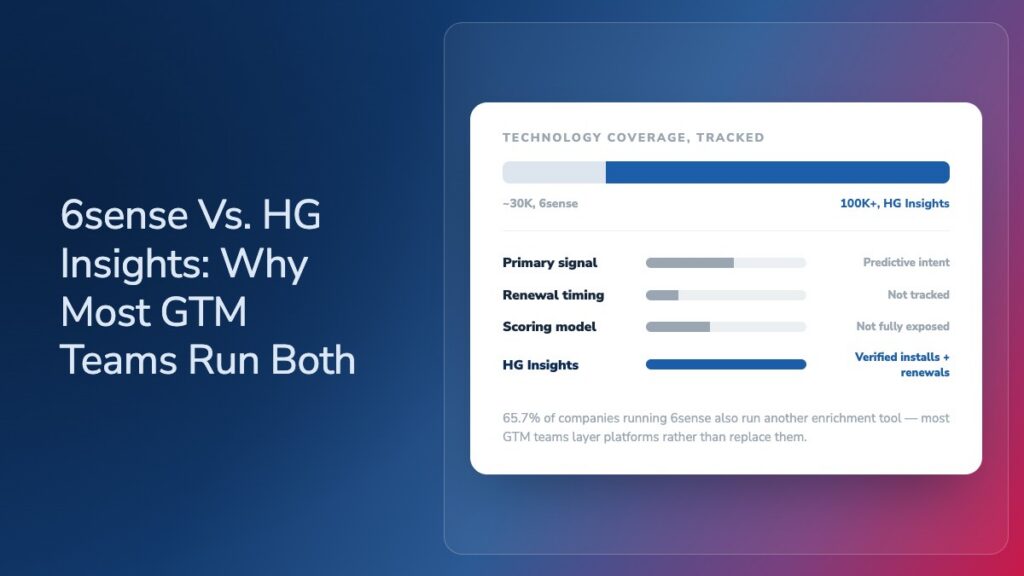
Primary signal | Buyer intent (research + behavioral) | Verified technographic installs + contract data + IT Spend data |
Technology coverage | ~30,000 technologies tracked, presence/absence only | 100,000+ technologies tracked, with deployment intensity and time-series depth |
Contract & renewal timing | Not natively tracked | Verified renewal dates and vendor-of-record status |
Contextual intent | Topic and keyword-based research signals | Topic and keyword-based research signals |
Scoring transparency | Predictive model, not fully exposed to the user | Transparent, explainable, predictive model, exposed to all users |
Campaign orchestration | Native email, display, and LinkedIn activation | Feeds data, scoring, and prioritization into existing CRM and sales workflows |
The technology-coverage gap here is real on both counts: HG tracks more than 3x the technologies 6sense does, and unlike 6sense’s presence-or-absence count, HG’s figure carries deployment intensity and time-series depth per technology. Breadth gets a team into the conversation; depth is what makes a displacement or renewal play specific enough to act on.
Where 6sense wins, where HG Insights wins
6sense’s real strength is native anonymous-visitor identification combined with mature omnichannel campaign orchestration. Its own Signalverse infrastructure processes intent signals at massive scale, and its advertising and email activation are more built-out than anything HG Insights offers today. For a team whose primary job is running coordinated ABM advertising across LinkedIn, display, and email off a single predictive score, 6sense is the more complete platform.
HG Insights wins on the questions 6sense wasn’t built to answer: what’s deployed, how deeply, and when the contract is up. Its transparent, explainable scoring means a RevOps team can see and adjust exactly what’s driving an account’s priority, instead of trusting a model they can’t inspect. That transparency, combined with verified renewal timing and IT spend modeling, is why competitive displacement and contract-driven motions consistently favor HG’s data over predictive intent alone. Sales teams built around signal-based selling and account scoring get a specific reason to call, not just a buying-stage label.
Can you run HG Insights and 6sense together?
Yes, and for most B2B GTM teams already invested in 6sense, this is the more realistic path than a rip-and-replace decision. HG Insights’ install data puts a number on how common that layering already is: 65.7% of companies running 6sense (4,294 of the 6,537 HG tracks globally) also have another data enrichment tool installed. Meaning most GTM teams are already comfortable stacking more than one data platform The two platforms answer different questions, which means layering them compounds rather than duplicates.
Smarter ABM tiers
6sense’s intent data identifies which accounts are actively researching; HG Insights’ fit and deployment data confirms whether that account is a genuine displacement target or already a customer of a compatible tool. Layering the two produces tighter, better-qualified ABM tiers than either signal alone. Storyblok’s team built exactly this kind of dual-axis model, scoring accounts on HG’s fit data and 6sense’s intent data together, and generated more pipeline in a single quarter than in the entire quarter before it, with April alone setting a new pipeline record and the average number of buying-group members engaging per target account rising from one to more than four.
Displacement campaigns that convert
6sense can tell a team an account is in-market. It can’t tell them which vendor that account currently runs or when the contract renews. HG Insights fills that gap with verified installs and renewal dates, turning a generic in-market signal into a timed, vendor-specific displacement play.
Filtering out the noise
Intent signals alone produce false positives: accounts researching a category for reasons unrelated to switching vendors. Cross-referencing 6sense’s intent score against HG Insights’ confirmed technographic and contract data filters out accounts that aren’t structurally ready to move, so reps spend time only on switches that are real.
One anonymous B2B infrastructure and security software company put this into practice directly: it kept 6sense for demand gen and ABM. Then they added HG Insights specifically for competitive displacement, contract-driven motions, and building custom predictive scoring that they weighted by contract age, install age, spend trajectory, and hiring signals. Within one quarter, the company saw a 3x improvement in target-account accuracy, a 40% reduction in wasted outreach, and $2.3 million in new pipeline sourced directly from HG-flagged accounts. See the full comparison and coexistence framework for how this plays out account by account.
Switching from 6sense to HG Insights: what changes
For teams evaluating a full switch rather than a layered stack, the change is less about losing a feature and more about trading one kind of visibility for another. Teams give up native anonymous-visitor identification and built-in ad orchestration, both of which stay stronger in 6sense today. In exchange, they gain verified renewal timing, transparent, explainable scoring, and technographic depth built specifically for displacement and expansion use cases rather than general demand-gen targeting.
In practice, most teams don’t fully switch. The evaluation that starts as “replace 6sense” more often ends as “keep 6sense for top-of-funnel ABM orchestration, add HG Insights for the account intelligence layer alongside it.” That’s the pattern in both the infrastructure company’s deployment and Storyblok’s dual-axis model, and it’s the more common outcome across HG’s competitive displacement customer base.
Which platform fits your GTM stack?
The right choice comes down to which question your team needs answered first. If the immediate gap is orchestrating multi-channel ABM campaigns off a buying-stage score, 6sense is built for that motion natively. If the gap is knowing what’s installed, how intensively, how invested, and when the contract renews so a rep has a specific, timed reason to call, that’s the question HG Insights was built to answer.
For RevOps and sales leaders running competitive displacement or contract-driven sales motions, combining HG Insights with an existing 6sense deployment is typically the higher-leverage move. Keep the orchestration you’ve already built, and add the verified installation and renewal data that turns a generic intent signal into an account-specific play. Talk to HG Insights about adding buyer intent and competitive displacement data to your existing 6sense stack.
Frequently Asked Questions
Can you use HG Insights and 6sense together?
Yes. HG Insights and 6sense are commonly run in parallel rather than as replacements for each other. Teams typically keep 6sense for intent signals and ABM campaign orchestration, then add HG Insights for verified technographic installs, IT spend, contract renewal timing, and competitive displacement targeting.
What's the difference between 6sense and HG Insights?
6sense scores accounts using intent signals, which is research and behavioral data suggesting a buyer is in-market. HG Insights scores accounts using firmographic data, buyer intent, and verified tech spend and installation signals, meaning confirmed technology deployment, usage intensity, and contract renewal dates. One predicts interest; the other confirms what’s already running.
What are the best 6sense alternatives for buyer-intent data?
Teams evaluating alternatives to 6sense for buyer-intent data typically fall into two camps: platforms that replace ABM orchestration outright, and platforms like HG Insights that add technographic, contract, and contextual intent data alongside an existing 6sense deployment rather than replacing it outright.
Should I switch from 6sense to HG Insights?
Most teams don’t need a full switch. 6sense is a strong choice for native anonymous-visitor identification and omnichannel ad orchestration. HG Insights is a winner when it comes to verified renewal timing, transparent, well rounded scoring, and technographic depth which is why most GTM teams layer the two rather than replacing one with the other.
How does HG Insights' technology coverage compare to 6sense's?
HG Insights tracks 100,000+ technologies with deployment intensity and time-series depth, more than 3x 6sense’s roughly 30,000, which is tracked on a presence-or-absence basis only. HG’s coverage captures how intensively each technology is deployed, not just whether it’s present. Making its coverage broader and deeper.
What is contextual intent, and how is it different from 6sense's intent data?
Contextual intent is HG Insights’ framework for mapping buyer-intent signals to one of four specific contexts: whitespace, expansion, competitive displacement, or retention risk. 6sense’s intent data identifies that an account is researching a topic.HG’s contextual intent goes a step further and classifies why that research matters for the account’s current relationship with your company.