Here’s the scenario. The pipeline projections look healthy at creation. The meetings are on the calendar. The SDR hit quota. Then the quarter closes and the numbers are short, and the post-mortem lands in the same place it always does: the sequence wasn’t tight enough, the pitch needs work, or the reps need coaching. None of that is why your pipeline collapsed. The meetings booked agreed to meet, but the accounts weren’t right.
Quick Answer: SDR meetings that don’t convert to pipeline are most often a list quality problem, not a sequencing problem. Reps prospect accounts and book meetings with accounts that clear every firmographic filter but are wrong on signal. For example, they are already running a competitor’s tech, not in an active buying cycle, invisible to every enrichment layer in the CRM, or a real fit for a different product in your portfolio than the one the rep led with. Fixing conversion means amending the account list — and the product angle attached to each account — based on factors that weren’t considered before, not the outreach.
The disconnect between a booked meeting and a real opportunity
When meeting-to-opportunity conversion rates fall, the natural response is to audit the process closest to the failure: the outreach. Sequence steps get tightened. Reps shadow top performers. New messaging frameworks roll out. Sometimes these interventions move the number. More often, they don’t, because the problem isn’t what the rep said on the call. It’s who the rep was calling.
The accounts that fill a typical SDR’s target list have one thing in common: they passed a firmographic filter. Right industry, headcount range, geography, and revenue band. That’s the output of a CRM export or a list purchase, and it’s the foundation most SDR programs run on.
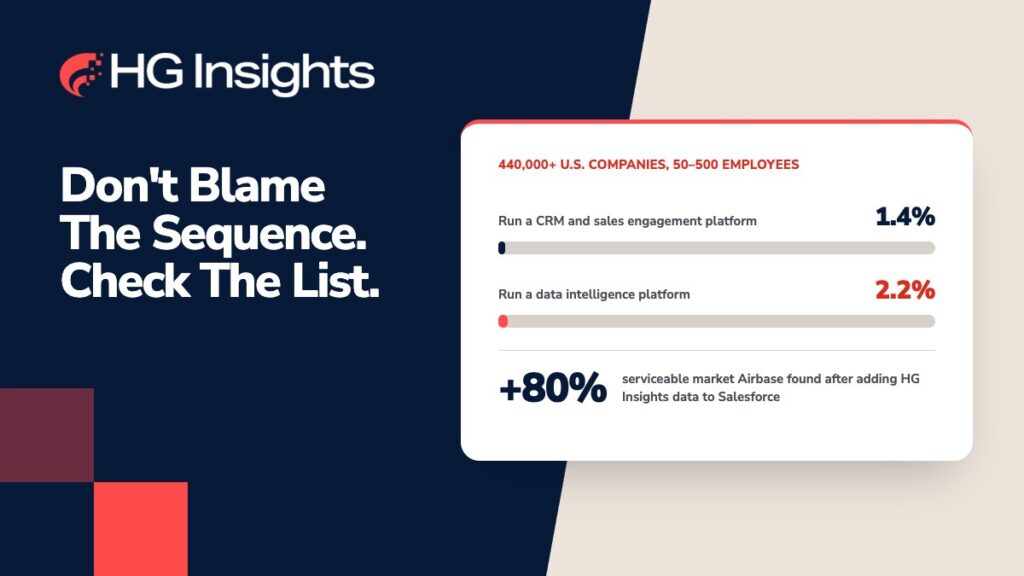
HG Insights tracks more than 440,000 US companies in the 50–500 employee range. Of those, only around 6,200 — roughly 1.4% — run both a CRM and a dedicated sales engagement platform. Most SDR programs are running without the full infrastructure stack, let alone a signal layer on top of it.
What those filters cannot tell you is whether the account is actually in a position to buy. They don’t know if the company signed a three-year deal with your top competitor six months ago. They don’t know if the technology you sell is already running in the account’s stack. They don’t show you which accounts are actively evaluating solutions right now versus which ones renewed last quarter and won’t look again for two years.
Why list quality fails before the SDR makes a single call
The accounts that end up on a target list are assembled from three compounding sources of noise.
The first is stale firmographic snapshots. Company size, industry code, and revenue range are point-in-time attributes. Over time, that data decays. A company that cleared your ICP threshold twelve months ago may have been acquired, restructured, or downgraded. The CRM doesn’t track those changes.
The second is CRM noise itself: duplicate records, churned accounts, contacts who left the company. Every list built from a CRM export carries this noise, and most teams have no systematic way to filter it out before it reaches the SDR queue.
The third source is gut-check logic. ICP criteria that someone documented two years ago and nobody has revisited. Filter rules applied because “that’s how we always built the list,” not because data validated them. RevOps resets the criteria when performance falls, but the problem isn’t the criteria. It’s the data layer underneath them.
The result is predictable. HG Insights data across more than 440,000 US companies in the 50–500 employee range shows that only 2.2% run a dedicated data intelligence platform. For the rest, pipeline numbers look reasonable at creation — the CRM shows enough accounts, the meetings get booked, and the quarter starts with coverage. Then the pipeline collapses at later stages when reps work accounts that fit on paper but are wrong on signal.
The default workflow at most Growth-stage accounts without a signal layer: reps receiving a large volume of leads with little-to-no stack ranking, working from whatever order the CRM serves — alphabetical, date-sorted, or by assignment date. That’s not a sequencing problem. That’s a list problem that shows up all the way down to how prospects get worked on a Monday morning.
Why do SDR meetings not convert to pipeline
The account either already runs a competitor’s technology, is not in an active buying cycle, was never a fit beyond the firmographic filter, or was a fit for a different product than the one the rep pitched. That last failure is the quietest one. The account was real and the timing was fine, but the rep led with the wrong use case, or brought the right one to a person who doesn’t own that problem. Fit isn’t binary at the account level — it’s a question of which product, framed which way, for which buyer.
These are real factors at the margin. But if SDR-sourced deals close at a significantly lower rate than marketing-sourced or inbound deals at your company, the cause is upstream: the list.
The technographic and spend context that would tell you whether an account is actually in a buying window has no standard field in a CRM. It doesn’t make it into the filter. So it doesn’t make it onto the list. Reps spend their effort on accounts that checked every box except the ones that actually predict conversion.
How signal-based list building changes the conversion equation
The fix is not a better sequence. It’s a list built from signals that predict whether an account is ready to engage, not just signals that confirm it resembles your existing customers.
Technographic data, the record of which technologies an account is currently running, tells you whether your product has a natural integration point or faces an entrenched incumbent. Spend trajectory data tells you whether an account is growing its investment in the category you sell into or contracting. Competitive install data tells you which accounts are locked in and which are evaluating alternatives.
Those signals get sharper when they’re joined together instead of, you should read one at a time. A company that just opened a second region, added headcount to an ops function, and started showing up in competitive comparison research is telling you something that none of those facts tells you alone. Staffing changes, geographic expansion, competitive movement, and market trends compound into timing — read separately, they’re trivia.
The same layering answers a question a fit score can’t: which product to lead with, and who to lead with it. Two accounts can score identically and still need completely different opening conversations — one because an entrenched incumbent renews in Q1, the other because a new team is standing up the function from scratch. The signals that put an account on the list should also set the angle and the persona. Otherwise you’ve fixed the targeting and left the messaging to chance.
The accounts that belong on the list but never appear in a firmographic export surface. Among Growth-stage US companies running both a CRM and a dedicated sales engagement platform, 40% have no external data intelligence layer installed — no technographic context, no competitive install data, no spend signals. Their reps work from lists built entirely from CRM fields. High-fit accounts go unworked under list-building logic that stays at the spreadsheet level, because there’s no signal to push them into the queue. With account-level technographic and spend data scoring every record, those accounts don’t stay invisible.
One data point illustrates what that looks like at scale: when Airbase added HG Insights data to its Salesforce CRM, its identified serviceable addressable market grew 80% overnight. The accounts were always there. The list just couldn’t see them.
Build a list that converts with HG Insights
HG Insights gives Sales Ops teams one place to layer the signals that actually predict conversion — company, person, market, and activity data, joined with the first-party signals already in your CRM and product. Technology adoption patterns, IT spend trajectory, competitive install data, and corporate hierarchy score every account, and the same layer decides which product and use case to bring, to which person, at which moment.
The result is an SDR queue where accounts have been screened for buying context before the first touch. Reps spend less time on accounts that went nowhere and more time on accounts that were genuinely ready.
Want to learn more? Book a meeting.
Frequently Asked Questions
Why do SDR meetings not convert to pipeline?
SDR meetings fail to convert when the account wasn’t a real opportunity at the time of booking. The most common cause is list quality failure: the account cleared firmographic filters but was already running a competitor’s tech, wasn’t in an active buying cycle, or had no real buying urgency. The sequence rarely explains late-stage pipeline collapse.
How do you improve SDR meeting-to-opportunity conversion?
Improving meeting-to-opportunity conversion starts upstream, with the account list. Layering technographic signals, competitive install data, and IT spend trajectory into account scoring before the list reaches SDRs removes accounts that look right on paper but are wrong on buying context, and tells you which product and buyer to lead with on the ones that stay.”
What causes pipeline collapse in B2B sales?
B2B pipeline most often collapses because accounts in the early stages of the pipeline were never qualified on the signals that predict late-stage conversion. Firmographic criteria capture company shape; they don’t capture technology fit, competitive lock-in, or buying cycle timing. Deals that look viable at creation fall apart when reps discover these factors mid-cycle.
How do I fix low SDR conversion rates?
Start by separating the sequencing problem from the list problem. If meetings are getting booked but not converting, the issue is usually the accounts on the list, not how the outreach was written. Audit whether your target accounts are being scored against technographic and spend signals, not just firmographic attributes. Rebuild the scoring logic before rebuilding the sequence.