At Context ‘26, the HG Insights virtual customer summit on October 6, CEO Rohini Kasturi launched the Contextual Intelligence Platform and laid out what Agentic GTM actually requires: AI agents are only as good as the context behind them, and connecting more data does not create context. Here’s what Rohini covered, and what it means for teams trying to win, expand and retain revenue with agents.
Quick Answer: Contextual Intelligence for Agentic GTM in B2B go-to-market is connected account data interpreted for a specific account, persona, and use case, so revenue teams and AI agents know which account to act on and how. It layers an ontology over Firmographics, Tech Installs, IT Spend, and buyer intent.
Key Takeaways
Key takeaways from this session include:
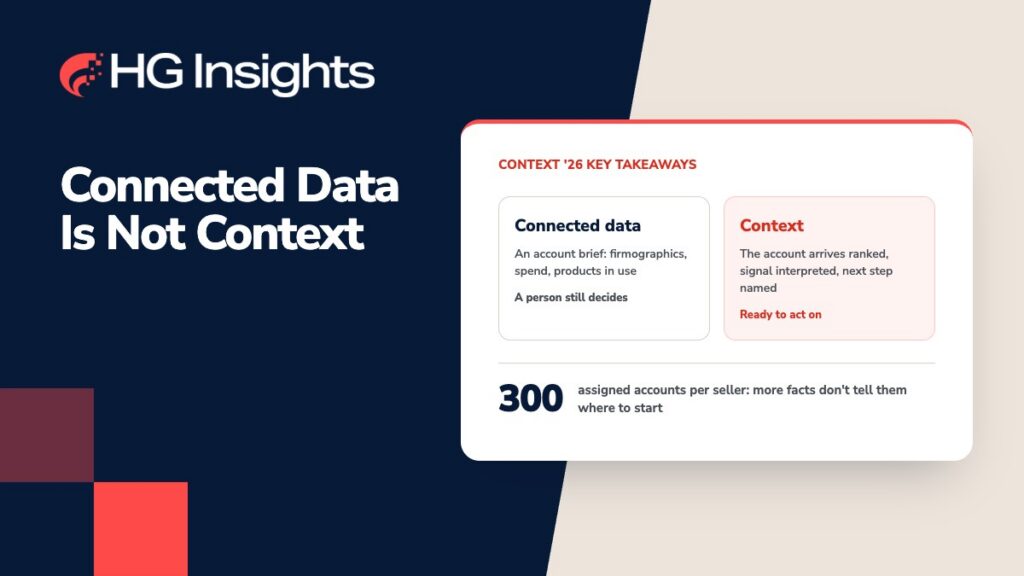
- Connected data is not context. Aggregating datasets produces an account brief, while context tells a team which account to act on and how.
- Trust is the prerequisite. Agents need data with known origin, lineage, and governance, or errors scale faster than results.
- Ownership matters. Only vendors who own and can reshape their data can derive context for a specific use case.
- Access should be flexible. HG Copilots, HG Agents, HG MCP Server, an API, and AI ecosystems draw on the same intelligence.
- Merit beats opinion. Data-driven quadrants built on billions of signals can replace partial analyst views.
Picture your most important prospect
Rohini opened up by asking the audience to picture their most important prospect, the one they have chased for months. Inside that company, a team may already be evaluating a competitor, a budget may be set aside, or a new office may be opening.
“If we were to take all this intelligence and synthesize it into context for a salesperson or a marketeer or a RevOps leader so that they can drive revenue outcomes, that is the possibility of contextual intelligence.” – Rohini Kasturi, CEO, HG Insights
That framing set up the rest of the keynote. Rohini introduced the Contextual Intelligence Platform, a new brand, and a vision for Contextual Intelligence for Agentic GTM Revenue. The Contextual Intelligence Platform includes:
The brand rests on four pillars: enterprise trust, precision, activation, and business outcomes.
The announcements were the headline. The argument behind them was the substance, and the sections below follow it. To hear it in Rohini’s own words, watch the full keynote.
What is Contextual Intelligence?
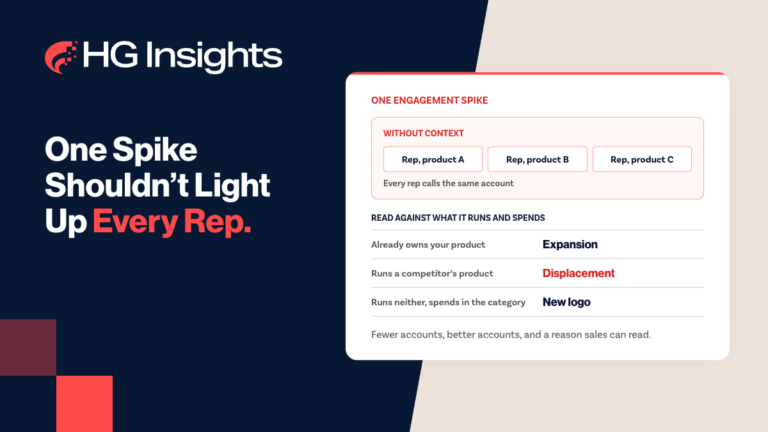
Contextual Intelligence is connected account data interpreted for a particular account, persona, and use case. Instead of handing a seller a profile of a company, it tells them which accounts to prioritize and what move to make, whether that is expansion, displacement, complementary, or white space.
Rohini used a hypothetical to demonstrate. Imagine a large healthcare company that uses a firewall from Vendor A and then starts deploying a firewall from Vendor B. If Vendor B’s firewall goes into the same location, say New York, Vendor A is being displaced. If it goes into a new location, say London, Vendor A has lost an expansion opportunity there, and Vendor B gains a new opportunity in both cities. The underlying fact is the same: a competitor’s firewall is now installed. What it means depends on the account, the location, and who is looking.
Why connected data is not the same as context
The sharpest moment of the keynote was a warning about the market’s vocabulary.
“Many of the vendors out there are confusing the market, confusing connected data with context.” – Rohini Kasturi, CEO, HG Insights
Connecting datasets gets a team an account brief: Firmographics, a spend profile, and the products in use. That doesn’t help a seller with 300 assigned accounts, or a marketer prospecting 10,000, decide where to start. If the output still needs a person to decide which account matters and why, it’s connected data. If the account arrives ranked, with the signal interpreted and the next step named, it’s context.
Rohini’s point was that only vendors who own their data can reshape it for a given play. A vendor that only aggregates other companies’ feeds can’t.
Why AI agents need a trusted, governed data foundation
Ask a general chatbot which products an account runs or what it spends, and the answer sounds sure of itself even if it is wrong. Rohini’s warning was about reputation: a confident wrong answer means bad prospecting and a damaged name. The risk grows as agents scale. An error in one seller’s notes is a nuisance. The same error repeated across thousands of autonomous actions is a pipeline of problems. The fix is a foundation where the origin of every data point is know about fifteen years of curated data, a global signaling network and verified customer reviews
He named two compounding problems:
- Data is fragmented across systems and departments, so teams cannot say who supplied it, who governs it, or whether to trust it.
- Signals also arrive late, which breaks the link between intelligence and revenue outcomes.
The answer is a trusted, governed foundation where the origin and lineage of each data point are known, and HG Insights is trusted by a majority of Fortune 1000 B2B technology companies.
The risk grows as agents scale. Rohini described a near future where agents talk to agents and to data. An error in one seller’s notes is a nuisance. The same error repeated across thousands of autonomous actions is a pipeline problem.
The three proprietary datasets behind HG Insights’ Contextual Intelligence
Rohini walked through the foundation from the bottom up.
- The first dataset is roughly fifteen years of curated intelligence, including Firmographics and Tech Installs, with known lineage.
- The second is a global signaling network with 150 network endpoints, which captures usage intensity and supports spend that is modeled from observed usage.
- The third comes from Customer Voice, where every review is verified and long form.
Together these form HG Fabric, the data and intelligence foundation. On top of it sit a domain specific language model, an agent verification layer, and a contextual intelligence engine that derives context by persona, account, and use case.
How teams and agents access it
Delivery is equally important to data. Rohini listed ready-made HG Copilots, a library of more than 100 HG Agents, HG Superagent in Slack and Teams, HG MCP Server, an API, and Customer Voice.
In partner ecosystems such as Amazon Quick, OpenAI, and Microsoft Copilot, the intelligence appears as HG Insights Connect, powered by HG MCP Server.
Rohini also touched on pricing. The model runs on Intelligence Credits with estimators for planning the year.
“Unlike other AI platforms, we are not gonna charge you every time you access the same account intelligence, though we are refreshing it every week.” – Rohini Kasturi, CEO, HG Insights
A team using one account’s intelligence 52 times a year, or an agent doing the same, does not pay 52 times, and credits can move between direct access, HG MCP Server, HG Copilots, and HG Agents as a go-to-market motion changes.
From analyst quadrants to data-driven quadrants
Rohini closed the argument with a challenge to a familiar format. Analyst quadrants and wave reports draw on customer surveys and vendor briefings. Is that enough input for autonomous agents?
“Most likely not, because what’s gonna happen is this small amount of data will be scaled by various autonomous agents and (it’s) gonna lead to a lot of bad outcomes and decisions.” – Rohini Kasturi, CEO, HG Insights
His alternative is a merit-based, data-driven quadrant built from billions of signals: Tech Installs, modeled spend, buyer reviews, and buyer intent. Positioning would come from what buyers do and buy, not from who briefed an analyst.
Closing Thoughts
Rohini’s closing claim was that agent performance and revenue outcomes depend on the quality of the context behind them.
“Agentic GTM is finally here. Contextual intelligence has arrived where agents talk to agents and agents talk to data.” – Rohini Kasturi, CEO, HG Insights
The advantage was never the agent.
Watch the keynote and see it in action
Want the full story? Watch the Context keynote on demand. To go deeper on contextual intelligence, explore the CI Platform, or see how HG Copilots put it to work for planning and prioritization. When you’re ready, request a demo.
Frequently Asked Questions
What is Contextual Intelligence in B2B go-to-market?
Contextual Intelligence in B2B go-to-market is connected account data interpreted for a specific account, persona, and use case. Rather than listing facts about a company, it tells sellers, marketers, and RevOps teams which accounts deserve action now and what the right move is, whether that is expansion, displacement, complementary, or white space.
What is the difference between connected data and context?
Connected data combines datasets such as Firmographics, spend, and installed products into one view, like an account brief. Context interprets that view for a persona and use case. A seller with 300 accounts does not need more facts. They need to know which account to work first and how to approach it.
Why do AI agents give wrong answers about accounts?
General-purpose chatbots draw on fragmented data with unclear origin and governance, so they can answer confidently and still be wrong about the products or spend inside an account. Acting on those answers risks a seller’s credibility. The fix is a trusted, governed data foundation with known origin and lineage.
What is agentic GTM?
Agentic GTM is a go-to-market model where AI agents research, prioritize, and act alongside revenue teams, with agents talking to other agents and to data. HG Insights CEO Rohini Kasturi describes it as GTM effectiveness tied directly to revenue outcomes such as growth, retention, and operational efficiency.
Where does HG Insights' data come from?
HG Insights’ Contextual Intelligence draws on three proprietary datasets: fifteen years of curated data with known lineage, a global signaling network, and verified long-form buyer reviews from Customer Voice. Together they feed a domain specific language model and an ontology that derives context by persona, account, and use case.
Author
-

Nik Koutsoukos brings over 25 years of product and marketing executive leadership to his role as VP of Product Marketing at HG Insights. He drives product GTM, customer and partner-marketing, and sales enablement to increase awareness, reach, adoption, and growth.
Prior to HG Insights, Nik held senior positions including VP of Product Marketing at SolarWinds, Chief Marketing Officer at Catchpoint, and VP of Product Marketing at Riverbed Technology, where he helped scale adoption of enterprise performance and observability solutions. Nik brings deep expertise in translating complex technology into compelling market value and partner-aligned growth. He holds a BSEE from Leeds Beckett University.