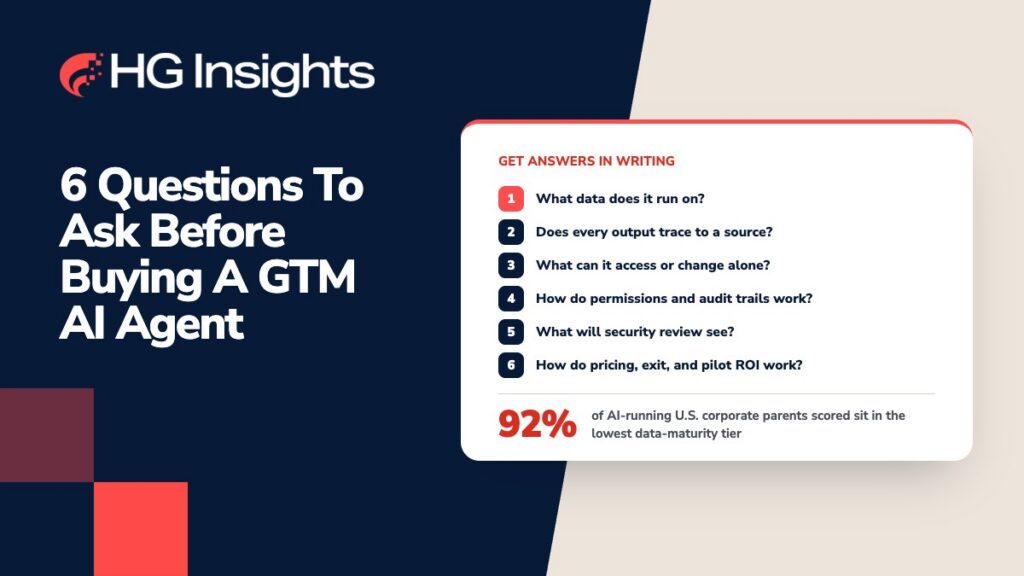
AI agent procurement breaks the usual software buying playbook, because an agent does more than store data or display a dashboard. It reads records, chains tool calls, and produces outputs that people act on. The data underneath is rarely ready: about 98% of US corporate parents with 1,000 or more employees run an AI product, yet 92% of those scored for data maturity sit in the lowest tier (HG Insights, November 2026). RevOps and GTM leaders who own the purchase now need answers that procurement and security will accept. This post covers evaluation questions only. For the definition and architecture, start with Agentic GTM Explained.
Quick Answer: Procurement should ask six things before approving a GTM AI agent: what data it runs on, whether every output traces to a source, what it can access or change on its own, how permissions and audit trails work, what security and compliance reviews will see, and how pricing, exit rights, and pilot ROI are defined.
What should procurement ask before buying a GTM AI agent?
Ask the vendor to prove what the agent knows, what it can do, and how anyone can check it. A sound evaluation covers data provenance, source citation, access scope, human approval, audit trails, security review, contract terms, and a measurable pilot. Vendors who answer each point in writing, with documentation, have done this work before.
The rest of this post turns each point into questions a buying committee can drop into an RFP or security questionnaire. In short form, the list looks like this:
- Where does the agent’s data come from, and how current is it?
- Can each output be traced to a source?
- What can the agent read, write, or send without a human?
- Who approves actions, and where is the log?
- How does it connect to the CRM and the rest of the AI stack?
- What will security and privacy reviewers see?
- What do pricing, term, and exit look like?
- What does a pilot have to prove before scale?
Agreeing on these eight before the first demo keeps RevOps, security, and procurement from judging the same vendor against different standards.
Why AI agent procurement needs a different checklist than software purchases
Standard software review starts from a stable product. The vendor describes what it stores, the security team checks who can log in, and legal reviews the term. An agent changes the picture. It queries data, reasons over it, and produces an output or an action, and the result can differ from one run to the next. A wrong answer also scales: one bad assumption repeats across every account the agent touches.
Public frameworks give procurement and security a shared vocabulary for this. The NIST AI Risk Management Framework (AI RMF 1.0) organizes AI risk work into four functions: Govern, Map, Measure, and Manage. The OWASP GenAI Security Project released its Top 10 for Agentic Applications in December 2025, and its LLM Top 10 lists excessive agency as LLM06:2025. Neither is a purchasing checklist. Asking a vendor how its controls map to them is still a fast way to separate documented practice from sales language.
What data does the agent run on, and can you verify it?
Start with the inputs. An agent is only as reliable as the account data under it, and many teams build the agent first and the data foundation second. HG Insights counted 13,557 US corporate parents with 1,000 or more employees running at least one AI product in November 2026. Of the 10,935 scored for data maturity, 821 reached medium maturity and 19 reached high (HG Insights, November 2026). That gap between AI adoption and data readiness is where confident wrong answers begin. The data foundation every GTM agent needs is worth reading before the first vendor call.
Ask for named sources and refresh windows
Procurement should request a list of datasets by name, with coverage figures and a refresh cadence for each. “Proprietary data” is not an answer. For comparison, HG Agents runs on nine sources delivered through HG Fabric: firmographics, technographics, IT and cloud spend, buyer intent, functional area intelligence, corporate hierarchy, install history, verified contacts, and SEC filings.
Test entity resolution before accuracy claims
Ask how the agent decides that two records are the same company, and where a subsidiary’s spend lands. Without corporate hierarchy, an agent can count one buyer twice or credit a parent’s budget to the wrong account. The gap is large: among US companies with 1,000 or more employees running an AI product, counting every entity record instead of corporate parents inflates the total by 61%, with 21,815 records against 13,557 parents (HG Insights, November 2026). Hand the vendor ten messy accounts from the CRM, including a few with subsidiaries, and check the results by hand.
Can every output be traced to a source?
A traceable output has a source attached to each claim, not a bibliography at the bottom. The test is simple. Take any figure or recommendation from a sample output and ask the vendor to show the underlying record, its date, and where it came from. If that takes a support ticket, the audit will not hold up in a pipeline review either.
Traceability matters most to the people who have to defend the output. RevOps and GTM leaders are asked to stand behind numbers they cannot trace, and teams that cannot check an AI answer either re-verify everything by hand or quietly stop using the tool. HG Agents cites the HG Insights data signal behind every material claim, so a score or a brief can be questioned and answered. See how HG Agents cites sources on every output.
What can the agent access, change, or send on its own?
Autonomy is where agent risk concentrates. Procurement should ask for a plain list of what the agent can read, what it can write, and what it can send, per integration and per role. The answer should separate drafting from sending, and recommending from updating a record.
Vendors describe capability in its best light, so request the permission matrix in writing, along with the default setting for each permission. An agent that can email prospects or edit CRM fields on day one needs a different approval path than one that returns a report.
For reference, the pre-built HG Agents return deliverables on request: account briefs, stakeholder maps, scored account lists, contact tables, and email sequences, delivered into Slack, Microsoft Teams, or the HG MCP App. HG Insights lists recurring autonomous agents as coming soon in its GTM Marketplace, so this question will matter more as that category matures.
How are permissions, human approval, and audit trails handled?
Permissions and approval gates
Ask who configures the agent, who can change its scope, and which actions require a human to approve them. Role-based access, single sign-on, and admin controls should be standard on an enterprise plan. On HG Agents, SSO and admin controls are included on Enterprise plans, and the account admin configures each HG Superagent instance, including its available skills.
Audit trails a reviewer can follow
An audit trail should let a security reviewer reconstruct a run: who asked, which data calls the agent made, what it returned, and what happened next. Ask for a sample log and have the security team read it cold. HG Insights states that every HG Agents run creates an audit trail. Combined with per-claim source citation, that gives a reviewer both the path and the evidence.
How does the agent connect to your CRM and existing AI stack?
Most GTM agents sit between the CRM, the data layer, and whatever AI tools a team already uses. Procurement should ask how the agent authenticates, which systems it writes to, what data leaves the customer environment, and whether it supports an open standard such as the Model Context Protocol (MCP), the open protocol that lets AI clients call external tools. Open standards lower the cost of switching vendors later.
HG MCP Server exposes more than 40 data primitives that run inside AI clients such as Claude, ChatGPT, Cursor, Salesforce Agentforce, and Microsoft Copilot, with setup through an API key and no warehouse build. Individual HG agents can also be called from a customer-built agent through the same server. RevOps teams weighing who should own which agent can read the framework for sharing GTM AI agents across sales, marketing, and RevOps.
What do security, privacy, and compliance reviews need to see?
Documents to request
Reviewers should receive the package they would expect from any vendor that touches company data: a current SOC 2 Type II report, a data processing agreement, a subprocessor list, a retention and deletion policy, and incident response terms. Agents add a second layer. Ask how the vendor handles prompt injection, redacts sensitive data, and tests its own defenses.
Controls worth testing
HG Insights states that SOC 2 Type II, GDPR, and CCPA apply to HG Agents, that endpoints are authenticated, logged, and monitored, that inputs are screened for prompt injection, that sensitive data is redacted before storage, and that a 700-scenario adversarial test program runs quarterly. Security guardrails and governance documentation are published at phoenix.hginsights.com/docs. Use any vendor’s equivalent claims the same way: ask where each one is documented, and ask to see the most recent test results.
How are pricing, contract terms, and exit rights structured?
Pricing questions
Agents are usually priced by usage, so the budget depends on volume. Ask for the unit cost of every agent, how credits are consumed, whether unused credits expire, and what happens at overage. HG Agents runs on Intelligence Credits, and each run consumes credits. An Account Research Brief in quick mode costs about 15 credits (HG Insights pricing, September 2026), and current pricing is published at phoenix.hginsights.com/pricing. HG Superagent is included in the HG Agents Enterprise plan and individual agents are not sold separately, so buyers should size the plan against the full workflow.
Exit rights
Contract review should settle term length, termination for convenience, data return and deletion, ownership of outputs and custom agents, and notice when the vendor changes an underlying model or subprocessor. Exit is easier when outputs live in the customer’s own CRM and tools, and when the agent connects through an open standard.
How do you prove ROI in a pilot before you scale?
A pilot should answer one question: does the agent beat the current way of doing the work, on evidence a skeptical reviewer would accept. Set the baseline first. Measure how long account research takes today, how many accounts per rep get real research, and how often AI-generated claims get challenged. Then write the pass criteria down.
Accuracy needs its own audit. Pull a sample of outputs, trace each claim to its source, and record the error rate. Vendor figures belong in the hypothesis, not the result. HG Insights states that an Account Research Brief draws on 30 or more data points in roughly 90 seconds, which is a number to time during the pilot, not to assume.
Keep the scope narrow: one workflow, one team, a fixed window. Wide pilots produce anecdotes, and anecdotes do not survive a budget review.
Which red flags should end the evaluation early?
Some answers should stop the process. A vendor that shows any of the following has not finished the work procurement is asking about:
- Outputs cannot be traced to a source record, claim by claim.
- Data sources are described as “proprietary” with no names, coverage, or refresh cadence.
- The agent has write or send access by default, with no approval step.
- No per-run audit log exists, or the vendor cannot show a sample.
- Security documentation is available only after signature.
One of these is a reason to pause. Two together is a reason to stop.
Where to go next
Teams that want the definition and architecture first can read Agentic GTM Explained. Teams ready to see source citation and audit trails in practice can explore HG Agents, and RevOps and security reviewers can book a technical walkthrough of HG Agents or HG MCP Server to put these questions to HG Insights directly.
Frequently Asked Questions
What is AI agent procurement?
AI agent procurement is the process of evaluating, contracting, and approving software agents that take actions or produce decisions on a company’s behalf. It extends standard software buying with questions about data provenance, autonomy, permissions, auditability, and ongoing usage costs, and it usually involves procurement, security, legal, and the business owner together.
What should procurement ask an AI agent vendor about data?
Ask which named datasets the agent uses, how often each refreshes, how company identities and subsidiaries are resolved, and whether every output cites the source record behind each claim. A vendor should answer with documentation, not a summary. Unverifiable data turns a fast agent into a fast source of wrong answers.
How is buying an AI agent different from buying SaaS?
SaaS review asks what a product stores and who can log in. Agent review adds what the product can do: which systems it can read and write, what it can send without approval, how its outputs vary between runs, and what it costs per run. Usage-based pricing and autonomy make the contract and the controls harder to define upfront.
What security documents should an AI agent vendor provide?
Request the vendor’s current SOC 2 Type II report, data processing agreement, subprocessor list, data retention and deletion policy, and a description of controls for prompt injection, sensitive data redaction, and adversarial testing. Also ask for a sample per-run audit log, so the security team can see what a real investigation would look like.
How long should an AI agent pilot run?
A pilot should run long enough to cover a full cycle of the workflow being tested, such as a complete territory review or campaign. Agree on the baseline, the success metrics, and the accuracy audit method in writing before day one, so the scale decision rests on measured results and not on demo impressions.
Author
-

Nik Koutsoukos brings over 25 years of product and marketing executive leadership to his role as VP of Product Marketing at HG Insights. He drives product GTM, customer and partner-marketing, and sales enablement to increase awareness, reach, adoption, and growth.
Prior to HG Insights, Nik held senior positions including VP of Product Marketing at SolarWinds, Chief Marketing Officer at Catchpoint, and VP of Product Marketing at Riverbed Technology, where he helped scale adoption of enterprise performance and observability solutions. Nik brings deep expertise in translating complex technology into compelling market value and partner-aligned growth. He holds a BSEE from Leeds Beckett University.