Data freshness decides whether an ideal customer profile (ICP) still describes the buyers who actually convert. Once AI agents score accounts, build lists, and trigger outreach from that profile, a stale ICP stops being a planning flaw and becomes an execution error that runs at machine speed. This guide lays out a data freshness framework for agentic GTM: which ICP inputs refresh continuously, which refresh quarterly, and what should force an off-cycle update.
Quick Answer: Data freshness for an ICP is how recently each input behind the profile (firmographic, technographic, intent, and conversion data) was verified, measured against the maximum age your scoring and agents can tolerate. Fast-changing signals need continuous refresh. Scoring weights need quarterly recalibration. The ICP definition itself needs an annual rebuild or an event trigger.
How often should agentic ICPs refresh?
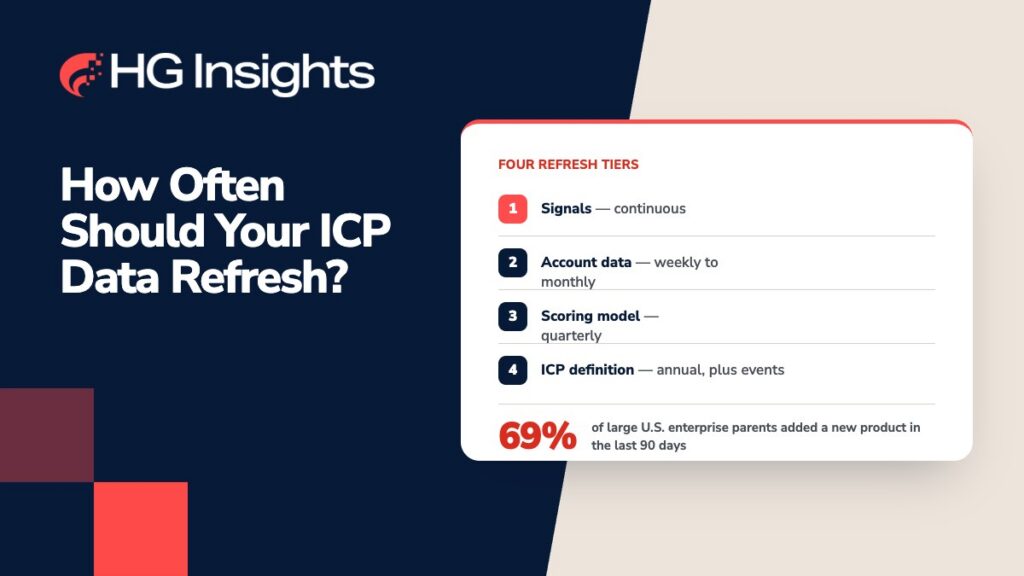
Agentic ICPs should refresh on tiers, not on one schedule. Re-score continuously as new signals arrive, sync target account lists weekly, recalibrate scoring weights quarterly, and rebuild the ICP definition annually or whenever win rates drop. Add event-triggered updates after product, pricing, or packaging changes. This is a recommended operating model, not an HG benchmark.
Published guidance lands in roughly the same place. Apollo recommends a scheduled baseline cadence layered with event-triggered refreshes for high-impact moments such as job changes and intent spikes. The Starr Conspiracy’s Fit-Intent-Capacity scoring framework refreshes scoring monthly and recalibrates weights quarterly. That consensus is useful, and it is also where the generic answers stop.
What they leave open is the mapping. Which tier applies to which kind of data? Why does a job change need a different clock than a pricing change? The rest of this guide fills that gap, starting with why the question got harder once agents entered the stack.
Why agentic ICPs go stale faster than static ones
A static ICP lives in a slide or a spreadsheet, and a person reads it before acting on it. That person notices when a segment looks wrong, when a “perfect fit” account just announced layoffs, or when the list still includes a company that was acquired last quarter. An agentic ICP has no such checkpoint. The agent reads the field, applies the rule, and acts.
Agents remove the human checkpoint
Every ICP has errors. The difference is where they get caught. In a manual workflow, a rep or an analyst absorbs most of them informally. In an agentic workflow, the error moves downstream untouched, into scores, sequences, and ad audiences, and it stays there until someone audits the output.
Errors scale with automation
A confident wrong answer scales with the automation. A model with no account context cannot tell that two records are the same company, that a subsidiary’s spend belongs to its parent, or that an account showing intent already owns the product. It answers anyway, fluently, across the whole market.
Data maturity lags agent adoption
The data underneath often trails the agents built on top of it. HG Insights data, also reported in Agentic GTM Explained, shows that 98 percent of US corporate parents with 1,000 or more employees (13,286 of 13,530) run at least one AI product. Of the 10,679 of those scored for data maturity, 93 percent rate low. Only 757 reach medium and just 16 reach high. Teams are building agents faster than they are building the account intelligence beneath them.
The market also moves under the profile. HG Insights’ August 2026 Insight Report on market intelligence refresh found that technology adoption, IT spend allocation, and competitive positioning shift monthly, while most market research still ships annually or twice a year. An ICP built on last year’s picture of those inputs is already describing a market that moved.
The movement shows up in install data too. In a sample of 457 large US enterprise parents with 5,000 or more employees, 69 percent had at least one new product first detected in the last 90 days, and 81 percent in the last 180 days (HG Insights install data).
What data freshness means for an ICP
Data engineers treat freshness as how recently the data in a final asset was updated, measured against how often it is consumed (Monte Carlo). The ICP version has the same shape, with one twist: an ICP is not one dataset. It is a stack of inputs that each age at a different speed. A company’s industry code barely moves. Its tech stack, headcount, and buying signals move constantly. Its conversion history grows with every closed deal.
Freshness needs a threshold per input
“Fresh” means nothing without a limit. For each input, set the maximum age your scoring and agents can tolerate before the output stops being trustworthy. Intent signals might tolerate hours. Firmographic attributes might tolerate a month. Conversion data used to train a scoring model might be reviewed once a quarter. That threshold is the freshness requirement, and everything else in the framework hangs off it.
Freshness is not accuracy
A record can be updated yesterday and still be wrong. Freshness tells you how recent the data is. It does not tell you whether it is correct. Vendors know the difference, which is why Apollo’s own guidance warns that a vendor can truthfully answer “monthly” while re-verifying only a small share of records that month. Ask what share of records is actually re-checked, field by field.
The data freshness framework: match refresh cadence to signal type
The framework rests on one idea: refresh cadence should follow how fast the underlying fact changes and how costly it is to be wrong, not the planning calendar. Four tiers cover most agentic ICP setups.
The signal tier: continuous
Signals are events: intent spikes, job changes, funding rounds, new technology installs, and engagement with your content. They decay in days, and Apollo notes that intent signals expire within days. Ingest them as they arrive and re-score accounts on arrival, because a signal acted on next quarter is not a signal anymore.
The account tier: weekly to monthly
Account attributes, such as firmographics and technographics, change more slowly. They still change. Across 72,174 company-product pairs at 453 large US parents, only 21 percent showed flat usage momentum, while 37 percent were accelerating and 42 percent were declining (HG Insights install intensity data). A technographic snapshot starts aging the day it is pulled. Refresh them on a weekly or monthly clock, and match your target account list against the CRM weekly so agents never work a list that includes closed-won customers or disqualified accounts.
The model tier: quarterly
The scoring model is where the ICP turns into numbers. Recalibrate weights and thresholds every quarter against closed-won and closed-lost outcomes. Scoring set once and left alone drifts further from reality each quarter it goes untouched, which is the drift problem Data Studio is built to address.
The definition tier: annual, plus events
The ICP definition itself covers segments, personas, and the criteria that make an account a fit. Rebuild it annually. Rebuild it sooner when something changes the business underneath it, which the events section below covers.
Which ICP inputs refresh continuously and which refresh quarterly?
The table below maps common ICP inputs to a recommended tier. Treat the cadences as starting points to test against your own conversion data, not as fixed rules.
ICP input | Rate of change | Recommended refresh | Tier |
|---|---|---|---|
Intent and behavioral signals | Hours to days | Continuous, re-score on arrival | Signal |
Job changes, funding, hiring spikes | Days to weeks | Continuous | Signal |
Technology installs and removals | Weeks to months | Weekly to monthly | Account |
Firmographics (headcount, revenue, location) | Months | Monthly | Account |
Target account list match against CRM | Weekly | Weekly | Account |
Scoring weights and thresholds | Quarters | Quarterly recalibration | Model |
Win and loss analysis | Quarters | Quarterly review | Model |
Segment and persona definitions | Years | Annual rebuild | Definition |
One pattern deserves attention. The inputs that change fastest are usually the ones your agents act on most directly. The inputs that change slowest are the ones that define everything else. That asymmetry is why a single refresh date for the whole ICP either wastes money on stable data or lets volatile data rot.
What events should trigger an off-cycle ICP refresh?
Calendars miss the moments that matter most. These events should pull the ICP forward regardless of where you are in the cycle:
- A product, pricing, or packaging change. Your best-fit customer may now be a different company, and the old profile will keep sending agents after the old buyer.
- A drop in win rate. A sustained decline in conversion on top-tier accounts means the scoring model no longer predicts outcomes.
- A move into a new segment or region. The existing ICP was trained on a market you are leaving or adding to.
- A significant share of closed-won deals outside the top tier. If accounts the model ranked low keep converting, the model is missing a pattern.
- A merger, acquisition, or large customer churn event. Account hierarchies and your own conversion history both change when a major account does.
- A competitor launch or a shift in category spend. The reasons buyers pick you shift when the alternatives do.
Any one of these justifies a targeted recalibration. Two at once justify rebuilding the definition.
How to tell when your ICP data is stale
Most teams discover staleness after the pipeline review, not before it. Build checks that surface it earlier. The Starr Conspiracy, in its catalog of ICP frameworks for B2B GTM, argues that most ICP work fails because teams treat it as slideware: built once a year, parked in a deck, and never run as a system.
Watch for these signs of staleness:
- Score and outcome divergence. Top-scored accounts convert at a rate close to mid-scored accounts.
- Rising out-of-ICP wins. Closed-won deals increasingly come from accounts the model ranked as poor fits.
- Record age beyond the limit. Fields feeding the agents are older than the threshold you set.
- Conflicting records. The same company appears in two segments, or a subsidiary is scored separately from its parent.
- Agent outputs nobody can trace. When a seller asks why an account was flagged and no one can show the signal and its date, freshness is unmeasured, which is the same as unmanaged.
The last sign matters most for leaders. RevOps and GTM leaders feel the traceability pain most, because they are the ones asked to defend a score in a pipeline review. A freshness timestamp on every input is the cheapest defense available.
Who owns ICP refresh: RevOps, marketing ops, or the agent?
Ownership splits along the tiers. RevOps and sales operations should own the cadence itself: the thresholds, the quarterly recalibration, and the decision to rebuild the definition. They build and depend on the scores, so they carry the accountability when a ranking drifts.
Marketing operations should own the inputs that sit in its systems: engagement data, campaign and content signals, and the lead routing rules that consume the score. When engagement data is split across web analytics, the marketing automation platform, and content tools, nobody sees account-level movement, and that gap is theirs to close.
The agent owns execution within guardrails. It can ingest signals, re-score accounts, and flag records that breach a freshness limit. It should not redefine the ICP on its own. Changes to the definition, the weights, and the thresholds need a human decision, preferably with a preview of how many accounts would change tier before the change goes live.
How to set up a refresh cadence for your team
Start small and make it measurable. A workable first pass takes a few weeks.
- Inventory every input behind the ICP. List each field and signal your scoring model and agents read, and note the source and the last update date for each.
- Set a maximum age per input. Decide how old each input can be before it stops being trustworthy, working backward from the decisions it drives.
- Assign each input to a tier. Use the table above as a starting map and adjust it to your market’s actual rate of change.
- Write down your event triggers. Pick three to five from the list above and name who can call an off-cycle refresh.
- Monitor freshness as a metric. Track the share of records inside their age limit, the lag on signal ingestion, and sync errors between systems.
- Review quarterly against outcomes. Compare scores to closed-won and closed-lost, then change the cadence where the data says it is wrong.
Cadence is a hypothesis. Quarterly might be too slow for a fast-moving category and too fast for a long enterprise sales cycle. The review in step six is how you find out.
Where HG Insights fits
Keeping a scoring model fresh takes more than a calendar reminder. It takes account data that updates on its own clock and a model trained on what actually converted. HG Insights Data Studio builds Customer Fit models trained on a company’s own CRM conversion history, using HG firmographic and technographic data, and previews the effect of a model change before it deploys. See how Data Studio helps RevOps teams keep scoring current.
Next steps
For the operating model behind the agents, read Agentic GTM Explained. To go deeper on building and maintaining the scoring model your ICP feeds, use the Account Scoring Guide. If you are still defining the profile itself, start with how to create an ideal customer profile.
Frequently Asked Questions
What is data freshness?
Data freshness is how recently data was updated or verified compared with how current it needs to be. In GTM, it covers the age of firmographic, technographic, intent, and conversion data behind an ICP or score. Freshness is measured against a threshold you set for each input, and it is separate from accuracy.
How often should an ICP be updated?
Update an ICP on tiers. Refresh signals continuously, account attributes weekly to monthly, scoring weights quarterly, and the full definition annually. Trigger an off-cycle update after product, pricing, or packaging changes, or when win rates drop. These cadences are a recommended starting point to test against your own conversion data.
What is data staleness and how do you spot it?
Data staleness is the point where data is too old to support the decision it feeds. Spot it by watching for scores that no longer predict conversion, closed-won deals from low-ranked accounts, fields older than your age limit, and agent outputs nobody can trace to a dated source.
How do you monitor data freshness and accuracy?
Track freshness as a metric: the share of records within their age limit, signal ingestion lag, and sync failures between systems. Monitor accuracy separately by comparing scores to closed-won and closed-lost outcomes each quarter. A record can be recent and still wrong, so both checks are needed.
How fast does B2B data decay?
Estimates vary widely by source. Research compiled by Landbase, and repeated in Apollo’s decay guidance, puts annual B2B contact decay between 22.5 percent and 70.3 percent. Because those are vendor figures, measure decay in your own database by sampling records and checking them against current sources.
Why do AI agents make data freshness more important?
AI agents act on data without a human reviewing each decision, so stale inputs flow straight into scores, lists, and outreach at scale. A person might catch an outdated account. An agent usually will not. That removes the informal checkpoint that manual workflows rely on and makes explicit freshness thresholds necessary.
Author
-

Nik Koutsoukos brings over 25 years of product and marketing executive leadership to his role as VP of Product Marketing at HG Insights. He drives product GTM, customer and partner-marketing, and sales enablement to increase awareness, reach, adoption, and growth.
Prior to HG Insights, Nik held senior positions including VP of Product Marketing at SolarWinds, Chief Marketing Officer at Catchpoint, and VP of Product Marketing at Riverbed Technology, where he helped scale adoption of enterprise performance and observability solutions. Nik brings deep expertise in translating complex technology into compelling market value and partner-aligned growth. He holds a BSEE from Leeds Beckett University.