Many teams find the problem the hard way: three agents email the same VP in the same week. AI agent orchestration is what keeps your sales, marketing, and RevOps agents from reaching the same buyer at the same time. This guide explains what orchestration does, how to choose an approach, and who should own it.
Quick Answer: AI agent orchestration is the control layer that decides which AI agent acts on which account or contact, in what order, and under what rules. In a go-to-market stack, it stops sales, marketing, and RevOps agents from duplicating outreach by giving every action one owner and a record.
What is agent orchestration in a go-to-market stack?
In a go-to-market stack, agent orchestration is the coordination of multiple AI agents across sales, marketing, and RevOps so they act on shared accounts without conflict. An orchestration layer assigns work, sequences actions, sets contact limits, and logs every step, which turns separate agents into one system a team can govern.
GTM is different because every outreach agent ends up in a real person’s inbox. A repeated or mistimed message costs more than a wasted task. It costs a buyer’s attention, and sometimes the account.
Agents also act at machine speed. A gap that once produced one awkward email can now produce several in a week, to the same CFO. That makes orchestration a question of arbitration: when two agents want the same contact, who wins?
Why do overlapping GTM agents create duplicate outreach?
Overlapping agents create duplicate outreach because each one is built by a different team, fires on a different trigger, and holds its own view of the account. No agent asks whether another already acted. Each sees a valid reason to reach out, and each is right in isolation.
Enterprise companies already use a large number of separate sales and marketing software products (an average of 8.6 per enterprise across HG Insights’ tracked data), creating a crowded and fragmented tech stack. Introducing autonomous AI agents on top of this existing infrastructure without a control or orchestration layer leads to uncoordinated actions, such as multiple agents contacting the same buyer simultaneously.
One signal, three agents
An intent spike on a target account shows how it happens. The sales agent starts a sequence. The marketing agent enrolls the account in a nurture track. A RevOps agent reassigns the lead. All three act within minutes, and none records that it did.
Records that disagree about the buyer
Duplicates also happen because of poor data organization. If a subsidiary isn’t linked to its parent company, an agent will mistakenly treat them as different accounts and message the same buyer twice. Most organizations aren’t prepared for this: according to HG Insights’ analysis of AI agent infrastructure, only 0.2% of large U.S. companies have high data maturity, while 64% have low data maturity. Fixing these corporate hierarchies must happen before setting any rules for account ownership.
Agents act with equal confidence on the wrong record. Resolving corporate hierarchy, so subsidiaries roll up to the right parent, has to come before any rule about who owns an account.
What is the difference between sharing context and orchestrating agents?
Sharing context means agents read the same data and use the same definitions. Orchestrating agents means their actions are sequenced and arbitrated. Shared context keeps agents from disagreeing about facts. It does not stop them from acting at the same time.
Two reps can read the same CRM record and agree on the account, the contact, and the last activity. If both decide to call at 9:00 a.m., the shared record does not stop them. A manager or a rule does.
HG Insights covers the first half in its framework for sharing GTM AI agents across sales, marketing, and RevOps. Orchestration picks up where that framework stops: once agents share data, what decides who acts first?
What does an orchestration layer decide?
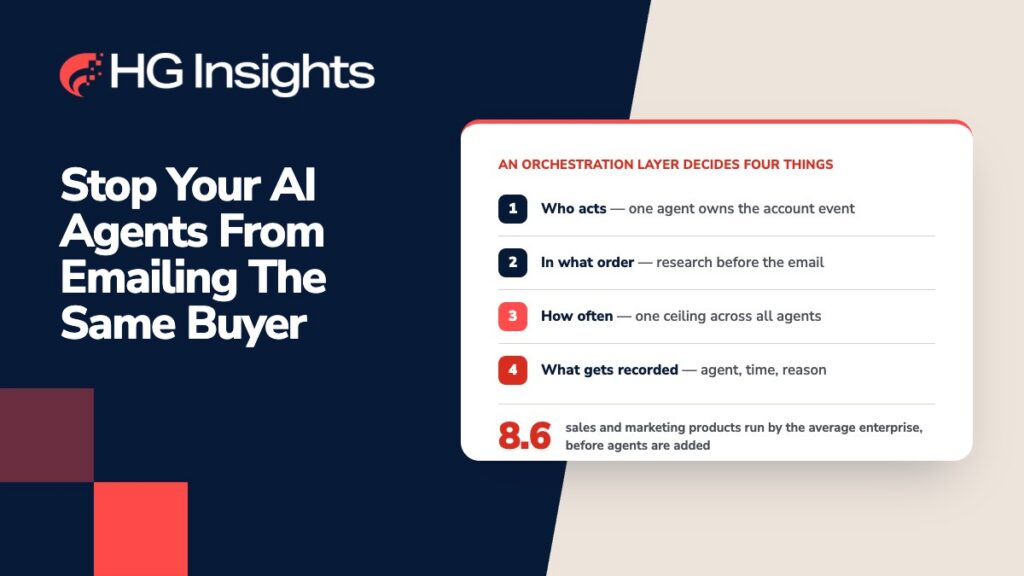
An orchestration layer decides four things: who acts, in what order, how often a buyer is contacted, and what gets recorded. Dashboards and drag-and-drop canvases in vendor demos are just interfaces onto those four decisions.
Who acts
For any account event, one agent is designated as the primary actor. The others stand down or simply share their insights with the primary agent without reaching out to the buyer directly. Without this rule, agents compete by default, and the fastest one wins.
In what order
A new-logo prospect might get a research agent first, then a personalization agent, then a sequence agent. The layer holds each agent until the one before it finishes, so the email agent never drafts from an incomplete brief.
How often
A buyer needs a ceiling on total touches, no matter how many agents are working the account. Three agents each sending one “reasonable” email is still three emails.
What gets recorded
Every action needs an agent name, a timestamp, the contact, and the reason it fired. If a team cannot answer “which agent touched this contact last, and why?” it has a router, not a control layer.
Which orchestration approach fits your stack?
Most GTM stacks choose between a central orchestrator that directs every agent, peer handoffs where agents pass work to each other, and CRM rules where the system of record decides what is allowed. The right fit depends on how many agents you run and how often they overlap on the same contacts.
Central orchestrator
One layer receives each request, picks the right agents, and runs them in order. It gives the strongest control and the cleanest audit trail. It also needs an owner who understands every agent beneath it.
HG Agents uses this approach for its own specialist agents. HG Superagent sits on top of the pre-built agents, including Account Research Brief, Buying Committee Mapper, and Outreach Drafter. It interprets a request, selects and coordinates the right specialist agents, and returns the result through one conversational interface, so the person asking does not need to know which agent is running. Superagent is included in the HG Agents Enterprise plan with no separate SKU. See how HG Agents coordinates specialist agents under one layer.
Peer handoffs
An agent finishes its job and passes the account to the next one. This is simple and works for linear workflows, like research to drafting to sequencing. It breaks down when two chains reach the same contact, because no neutral party sees both.
CRM rules
The CRM enforces ownership and contact limits, and every agent checks it before acting. This needs the least new infrastructure and works across vendors. It assumes one record to enforce against, which is often untrue: 73% of U.S. enterprise headquarters running a CRM run two or more CRM products, according to HG Insights install data.
For most teams, CRM rules come first because they work with agents already running. A central orchestrator becomes worth adding as the agent count grows and sequencing starts to matter more than contact limits.
Who owns agent orchestration on a GTM team?
RevOps should own the orchestration rules and the layer that enforces them. Sales, marketing, and customer success leaders own their own agents. When functions disagree on priority, the CRO or equivalent revenue leader settles it.
This mirrors how territory and lead routing already work. The function that owns an agent decides what it does. RevOps decides when it is allowed to do it.
Register new agents with RevOps before launch to prevent uncoordinated outreach collisions.
How do you know orchestration is working?
Watch one number: the share of contacted buyers who heard from more than one agent in the same week. A rising rate means a new agent shipped without coordination or a rule stopped working. A falling rate means the rules are holding.
Read a sample of the actual messages too. Two emails from two agents can each look fine in a report and still read like a team that does not talk to itself. Every HG Agents run has a full audit trail, and every claim in its output is cited to the data source that produced it, so a reviewer can see why an agent acted. The same test applies to any agent: if the reason for an action cannot be reconstructed, the action cannot be audited.
Build orchestration on verified account data
Orchestration only works when every agent reads the same account, the same contact, and the same hierarchy. HG Insights provides that foundation for multi-agent stacks. Scope the data and infrastructure layer for your agents, or, for technical evaluators, connect agents to verified account data through the HG MCP Server.
Frequently Asked Questions
What does agent orchestration mean?
Agent orchestration means coordinating multiple AI agents so they work as one system instead of acting independently. An orchestration layer assigns tasks, sets the order of actions, enforces rules, and records what each agent did. In go-to-market work, it also decides which agent may contact a given buyer.
How do you stop multiple AI agents from contacting the same buyer?
Give every account event one owning agent, apply a single contact limit across all agents, and log each touch with the agent’s name. A written priority order resolves conflicts the same way every time, and the log shows where collisions still happen so they can be fixed.
Is agent orchestration difficult to implement?
Agent orchestration is manageable when it starts with rules in the CRM instead of a new platform. Ownership and contact limits cover most early collisions. Difficulty rises as agent count grows and sequencing between agents matters, which is when a central orchestrator becomes worth adding.
Which AI agent orchestrator is best for GTM teams?
No single orchestrator is best for every team. Choose one by what it can read and enforce: account ownership, cross-agent contact limits, and a full audit log. A GTM orchestrator that cannot see which agent touched a contact last is a task router, not a control layer.
Who owns agent orchestration on a GTM team?
RevOps should own the orchestration rules and the layer that enforces them. Sales, marketing, and customer success leaders own their own agents and what those agents do. A revenue leader, usually the CRO, settles priority disputes. One named owner for the rules keeps each function from writing separate exceptions.
Author
-

Nik Koutsoukos brings over 25 years of product and marketing executive leadership to his role as VP of Product Marketing at HG Insights. He drives product GTM, customer and partner-marketing, and sales enablement to increase awareness, reach, adoption, and growth.
Prior to HG Insights, Nik held senior positions including VP of Product Marketing at SolarWinds, Chief Marketing Officer at Catchpoint, and VP of Product Marketing at Riverbed Technology, where he helped scale adoption of enterprise performance and observability solutions. Nik brings deep expertise in translating complex technology into compelling market value and partner-aligned growth. He holds a BSEE from Leeds Beckett University.