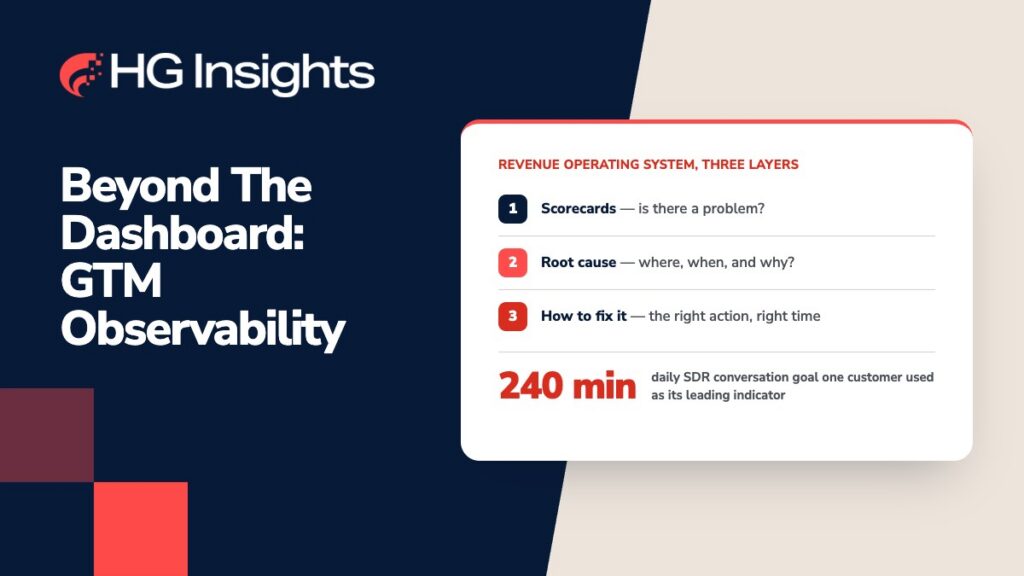
A revenue operating system maps a go-to-market (GTM) organization as a system, then measures it, so teams can see where it breaks and why. At Context26, HG Insights VP of Client Transformation Barry Magee and VP of AI Strategy Francis Brero described the system HG Insights is building internally, then turned to the harder problem: acting on a diagnosis with the right context. This recap covers their breakout session.
Quick Answer: A revenue operating system is next-generation observability for go-to-market. Instead of siloed dashboards, it maps the whole GTM mechanism as a system, measures handoffs, dwell times, and conversion rates, and explains where bottlenecks sit. It works in three layers: scorecards that show whether there is a problem, root cause analysis, and a path to fix it.
Key takeaways
- Observability beyond dashboards. A revenue operating system maps GTM as a system and measures it, so teams can see where and why it breaks.
- Three layers. Scorecards, root cause, and how to fix it.
- Diagnosis is not intervention. Teams still need the right action at the right time, not more automation.
- The moat is moving to execution. Institutionalizing top-seller workflows raises the floor for everyone.
- Start with a leading indicator. Pick one, automate the workflows behind it, and never skip the context.
What Barry and Francis covered at Context26
Francis opened the breakout by splitting the topic in two. Barry would cover how HG Insights uses context to inform strategy, through the revenue operating system he is building. Francis would cover how context improves execution, and how to raise the bar for everyone on a team.
Barry brought a practitioner’s background. He is a former HG Insights customer, twice over, who spent twenty years at IBM and Citrix in operations, strategy, and analytics roles. For the last several years he has led HG Insights’ client advisory function, working with customers on how to use data to solve business problems. His role now centers on building HG Insights’ internal intelligence systems. To hear the full conversation, watch the Context26 recording.
What is a revenue operating system?
Barry’s starting point was a pattern from client advisory work. The assumption had always been that customers knew which problems they wanted to solve. In practice, he said, many were playing whack-a-mole: they saw symptoms, struggled to find the cause, and could not always see the problem in the first place. That led to a hunch that a diagnostic capability could be useful to customers as well as to HG Insights itself.
His answer is the revenue operating system, which he called the next generation of observability for go-to-market. Instead of standard dashboards and standard BI, HG Insights built a semantic structure that looks at the entire mechanics of a GTM organization. It breaks the organization into its components, workflows, and processes, then watches them work to find bottlenecks.
It does that in three steps. It maps the entire GTM mechanism as a system, including handoffs, time taken, dwell times, and conversion rates. It measures everything through telemetry. And it supports explainability: when something is off, whether in the ecosystem, marketing engagement, or sales discovery, a team can drill down to the level underneath because observability runs at multiple layers.
The slide Barry presented was an internal one from only 48 hours earlier.
“We’re moving from the traditional BI stack, or Power BI or Tableau into an AI native environment.” – Barry Magee, VP of Client Transformation, HG Insights
Three layers: scorecards, root cause, and how to fix it
Barry described the system as working in three layers, and said he thinks of it almost as a product in its own right.
The first layer is scorecards. They answer the first question: is there a problem, and is the team on target? The second layer is root cause. It asks why there is a problem, where and when it occurs, who is affected, and when it is not a problem, which also surfaces the accelerators already working. The third layer is the fix, and it is the one where HG Insights has traditionally played.
Barry gave two examples of the third layer. If only half of the sales reps are hitting quota, HG Insights datasets can help optimize territory design. If top of funnel is underperforming because the wrong persona is getting the wrong content, HG Insights has a solution for that too. The first two layers, he said, are the part that is new even to HG Insights: a better diagnostic capability for knowing where to intervene.
Barry was clear about where this stands. It began as an internal build, and he described it as a hunch that the same diagnostic capability could prove useful to customers.
Why a good diagnosis still leaves an intervention gap
Having a strong diagnostic does not close the loop, and Barry was candid about where he is stuck. The system can diagnose very effectively, but an organization still has to respond.
“Even though you might have a very advanced diagnostic capability, we still are all people just doing our jobs.” – Barry Magee, VP of Client Transformation, HG Insights
The usual response is more dashboards, a weekly cadence, and reviews, because not everyone interprets data the same way and teams need coaching to read it. People are also busy and juggling many things. Getting a coherent, responsive reaction to a diagnosis is the next challenge.
AI adds to it. There is so much noise now, and AI can produce so much content, that the real question is what the right thing to do is. If an SDR has a hundred or a thousand prospect accounts, which one is right? Barry’s point was that teams should become context aware, delivering the right intervention at the right time, instead of trying to automate everything in front of them. The same question applies to a top of funnel marketer, a volume rep, an enterprise rep, or a renewals team: how do you layer automation, AI, and Contextual Intelligence, not just data, to bridge awareness and action?
Why the GTM moat is moving from product features to execution
Francis picked up the execution side with a view on the market. Companies can now ship product faster and replicate features, he said, even just from a marketing perspective. In his words, competitors can ship imitation features within weeks, which erodes a moat that once rested on being the only company that could do something.
“The moat is now flipping away from the pure technology component in most cases towards the go to market component.” – Francis Brero, VP of AI Strategy, HG Insights
He called that an opportunity for GTM practitioners. The ability to institutionalize a company’s best workflows, and to go to market in a differentiated way, is what will decide who wins. Features may help sellers win fewer deals than their ability to position against the competition, and positioning depends on context: the company’s own GTM approach, its positioning, and how it displaces one vendor or another.
How to turn top-seller expertise into a shared workflow
Historically, Francis said, a top rep’s strength was also a liability. One seller was great at pre-call research, another at objection handling, and when either left, the superpower left too. AI lets companies bake that expertise into processes and redistribute it.
“We’re not just raising the bar, [we’re] raising the floor.” – Francis Brero, VP of AI Strategy, HG Insights
Everyone can then operate at the level of top performers, as long as the workflows are institutional assets. That includes the revenue operating system itself. Francis noted that what Barry is baking into it is, in effect, parts of his own analytical judgment, so the system does not depend on one person to extract insight from reports.
He shared a story from HG Insights’ own team, anonymized. HG Insights built an internal agent for sellers to prepare for meetings, and watching how the best sellers used it was instructive. One seller generated an account brief, then asked the agent to act as the CFO of the target customer and tear the brief apart. The result was a stronger second version. The seller then looked at the compensation plan of the target company’s CEO to understand which top-level metrics the board cares about, which led to a third version that drew strong feedback from the customer. HG Insights turned that sequence into a standard play every rep can run.
Francis offered two lessons. One is to learn from top sellers. The other is to meet people where they work. RevOps teams tend to push workflows onto sellers, he said, but adoption rises when the system is easy to reach: queried in natural language, pinged through Claude, delivered by email, or available as account briefs in Slack or Teams. He also encouraged teams to let the field modify the workflows, because people closest to the work are usually best at it.
One agent as the front door to specialized agents
The next idea was how people reach all of those workflows. Francis said teams should not make sellers decide which agent or which copilot to use. They should give them a single entry point, an agent that takes in any request and routes it to the right specialized agents, each with the subject matter expertise and context to solve the problem. Francis pointed to HG Superagent, HG Insights’ version, which routes requests to specialized GTM workflows and runs in Slack, Microsoft Teams, and the HG Insights web app.
He compared it to how an organization already works. A team’s best experts get pinged by everyone because everyone knows they are the right people to ask. A single front-door agent emulates that, with specialized agents behind it. Francis called it the architecture of the future from an interaction perspective, and recommended that teams build one or consider buying one.
Pick a leading indicator first: the 240-minute SDR example
Francis closed with a customer story, anonymous, about proving AI’s return. AI takes time to show results, he said, and there is no perfect answer on how to pick what to work on, but there is a right process.
The customer focused on its SDRs and chose a leading indicator it could influence: how much time per day SDRs spend talking to customers. They set a goal of 240 minutes of conversations per day. They then listed everything SDRs did that was not a conversation, identified the workflows behind those tasks, and automated them using HG Insights, some of their own agents, and some of their own proprietary data. SDRs received account research ahead of time instead of researching before each call. A few months later, productivity metrics and pipeline per SDR had increased.
What stood out to Francis was the order. The team did not chase pipeline per SDR first. It chased an efficiency metric, the time spent on the core value of the work, and automated the rest. He encouraged listeners to pick a leading indicator they could move in the coming weeks and feed heavy workflows into an automation layer with the right context. The one thing a team cannot shortcut, he said, is that context.
“Build the automation without the context, that’s gonna be disastrous.” – Francis Brero, VP of AI Strategy, HG Insights
Pick the leading indicator, build the workflow with context, and the result, in his words, is a quick win with a large effect on the business.
Watch the full session
This recap covers the Barry and Francis breakout. Watch the full Context26 recording to hear their examples in full. For more on RevOps plays that streamline GTM execution, read the RevOps plays post, or visit the Contextual Intelligence Platform page to see how HG Insights puts context into execution.
Frequently Asked Questions
What is a revenue operating system?
A revenue operating system is next-generation observability for go-to-market. It maps the whole GTM mechanism as a system, adds telemetry across handoffs, dwell times, and conversion rates, and explains where bottlenecks occur through multiple layers of drill-down.
How is a revenue operating system different from BI dashboards?
Dashboards show metrics. A revenue operating system also carries the context of why a metric matters and how to analyze it, and works in three layers: scorecards that show whether there is a problem, root cause analysis, and a path to fix it. It embeds expert analysis in the system, so insight does not depend on one person.
How do you prove ROI from AI in go-to-market?
Start with a leading indicator instead of waiting for pipeline. In the example shared by Francis Brero, VP of AI Strategy at HG Insights, a customer set a goal of 240 minutes per day for SDRs in conversations, automated the workflows that crowded those conversations out, and later saw productivity and pipeline per SDR increase.
What is a super agent for sales teams?
A super agent is a single entry point that takes any request and routes it to specialized agents, mirroring how people go to a team’s top experts today. HG Superagent is HG Insights’ version. It spares sellers from deciding which agent or copilot to use, so they can ask for what they need.
Why do GTM automations fail without context?
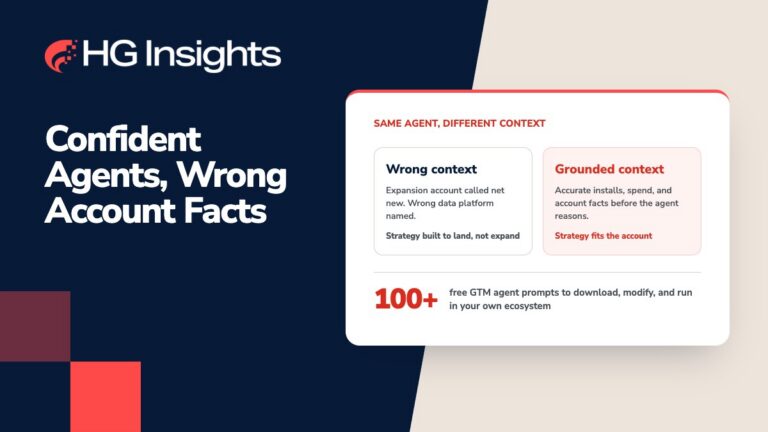
Automation without the right context produces confident but wrong output at scale. Francis Brero, VP of AI Strategy at HG Insights, said there is no shortcut on context. Workflows need the right information in the right place, and the right intervention at the right time, or the result can be disastrous instead of helpful.
Author
-

Nik Koutsoukos brings over 25 years of product and marketing executive leadership to his role as VP of Product Marketing at HG Insights. He drives product GTM, customer and partner-marketing, and sales enablement to increase awareness, reach, adoption, and growth.
Prior to HG Insights, Nik held senior positions including VP of Product Marketing at SolarWinds, Chief Marketing Officer at Catchpoint, and VP of Product Marketing at Riverbed Technology, where he helped scale adoption of enterprise performance and observability solutions. Nik brings deep expertise in translating complex technology into compelling market value and partner-aligned growth. He holds a BSEE from Leeds Beckett University.