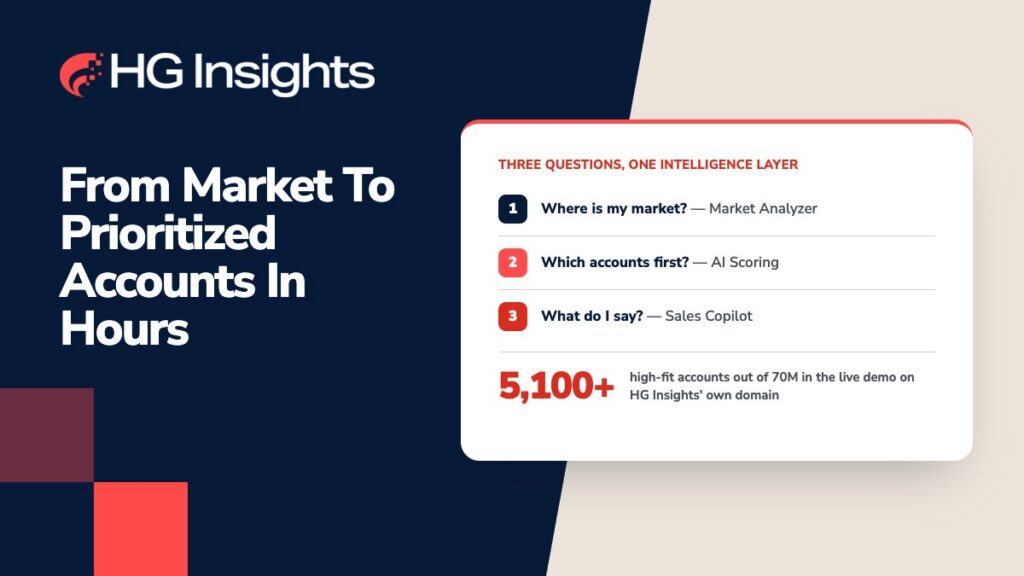
Account scoring tends to break down when each team works from its own stack and its own data, hoping the outputs line up by themselves. At Context26, HG Insights VP of Product Yuan Fang showed a different approach: size the market, build a propensity model, prioritize accounts, and arm sellers with what to say, all on one intelligence layer. This recap walks through his session, including the live demo and what he covered on AI search and Customer Voice.
Quick Answer: Account scoring ranks accounts by how well they fit an ideal customer profile, how much need they show, and how strong their intent is. With AI Scoring in HG Copilots, a team supplies a company domain, reviews the Fit, Need, and Intent models it generates, tunes them, and publishes a prioritized account list.
Key takeaways
- One intelligence layer beats separate stacks. Strategy, ABM, sales, and customer success work from the same Fabric.
- Three questions organize the work. Where is my market, which accounts first, and what do I say.
- Scoring can start from a domain. In the demo, AI Scoring generated displacement, expansion, and new logo models from one input.
- Speed is the point. Yuan said teams can reach business outcomes within hours, and the demo took minutes to build a model, though it was a demo and not a benchmark.
- AI search is now part of the journey. Buyers lean on AI answers, so presence in them matters.
What Yuan shared at Context26
Yuan followed the session on HG MCP Server and HG Agents by turning to HG Copilots and Customer Voice. His goal was to leave the audience with one takeaway.
“The contextual intelligence platform not only is powerful, but it can get your team’s time to value and business outcome within hours, not days, not weeks.” – Yuan Fang, VP of Product, HG Insights
He supported it with a few slides and two demos. To see the full session, watch the Context26 recording.
Why GTM teams need one intelligence layer instead of separate stacks
Yuan framed the session around the end of the year. As teams finish 2026 and plan 2027, every GTM function has to work together: strategic planning, territory design and account prioritization, ABM and demand generation, sales prospecting and plays, and customer success expansion and retention. That collaboration needs one data foundation and one intelligence layer, not each team building its own stack and hoping the results agree.
Under the hood is Fabric, which Yuan described as the result of fifteen years of innovation and accumulated domain knowledge. It includes account intelligence with hierarchy, technology footprint, IT Spend, Cloud Spend, AI Spend, context tied to the buying center, and HG Contextual Buyer Intent. The Contextual Intelligence Platform adds the interpretation layer Satish covered earlier in the day.
From there, each team reaches the same intelligence in the way that fits its work. Data and analytics teams use an API or a data warehouse. Marketing, operations, and sales teams use HG Copilots for market sizing, account partitioning, and account research. Deployment engineering teams use HG MCP Server and HG Agents to build their own automation. Brand and demand generation marketers use Customer Voice for buyer reviews and intent. A single pool of Intelligence Credits covers direct access, copilots, and agents, so a team can shift usage as its work changes.
Where is my market? Building an account-level view with Market Analyzer
Yuan organized the walkthrough around questions he said GTM leaders ask at this point in the year.
“There are three questions every GTM leader is asking at this time of the year.” – Yuan Fang, VP of Product, HG Insights
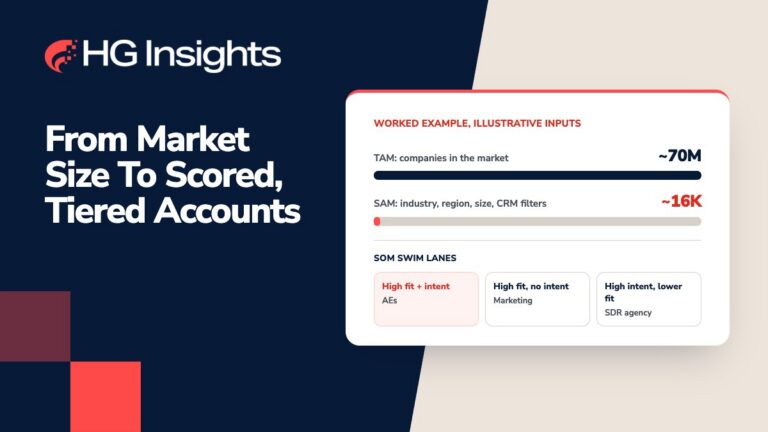
The first is “where is my market?” By that, he said, leaders are not asking for a number or the name of a country. They want a list of accounts they can actually go after. Market Analyzer gives a bottom-up, account-level view of the market that fits a team’s ICP, which is the starting point for everything after it.
Which accounts first? Building a propensity model in AI Scoring
Once a team has a list, the second question is which accounts to work first given its budget and bandwidth. That means understanding the Fit, Need, and Intent of each account and prioritizing from there. AI Scoring in HG Copilots handles that step.
Yuan demonstrated it live. To create a new propensity model, he supplied one input.
“All I have to supply is the company domain.” – Yuan Fang, VP of Product, HG Insights
In the demo he used HG Insights’ own domain. A team can add an offering and guardrails to narrow the model, and he selected Fabric as the data foundation. Building a model takes a few minutes, so he opened one he had built earlier in the day.
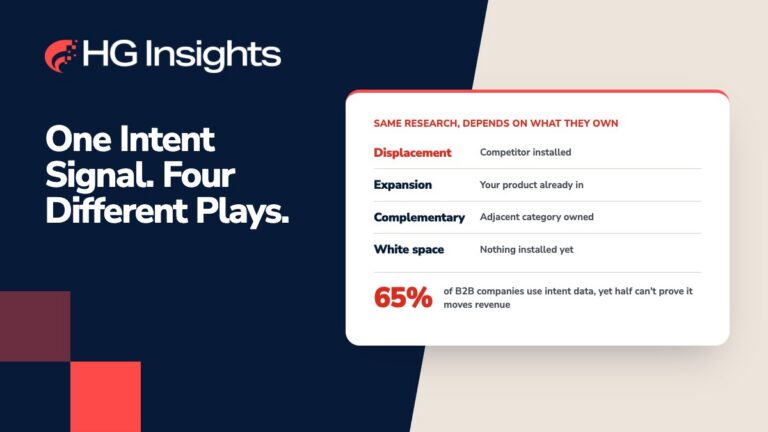
The result was three models: one for displacement, one for expansion, and one for new logo (white space). For each, he could review the model statistics, see how the score is made up, and look at the details behind Fit, Need, and Intent. A scoring agent helped refine the model, and the ranking weights could be tuned. Once satisfied, he published the model live.
The published model flowed into Market Analyzer. The numbers below come from a demo on HG Insights’ own domain, not from a customer.
“Out of the 70,000,000 accounts, there’s 5,100 plus accounts that I deem as a high fit.” – Yuan Fang, VP of Product, HG Insights
From there, filters such as geography narrow the list further. Having already built the propensity model, he said he trusted the list and moved on to the next step.
What do I say? Arming sellers in Sales Copilot
The third question is what to say. When sales has a list of accounts in a territory, sellers need to know the business problem a prospect or existing customer is likely to have and how the solution helps. Yuan said Sales Copilot arms sellers before any customer engagement.
He added the high-fit list to Sales Copilot, which shows each account with its intent topics, competitors, and complementary technologies. Selecting an account opens its signals, recommends the offering that best fits, and suggests what to do next. An account agent inside Sales Copilot can then build a battle card or draft an outreach email.
Yuan said HG Insights teams use this flow every day to generate outcomes, and that the breakout sessions from Rachel and Spencer would go deeper on it.
How AI search changes where buyers do their research
Yuan then turned from finding buyers to how buyers find vendors. Buyers do their research with AI assistants, he said, and many of them rely on it and trust the answers they get.
AI crawlers scan hundreds of places looking for the most authentic, authoritative third-party answers to the specific question a buyer asked, which is why buyers find those answers relevant. According to Yuan, buyers referred to TrustRadius through AI research are likely to convert six times more than buyers from Google organic search.
“If your solution does not appear a part of the AI answers, you risk becoming irrelevant in those buyers’ journey.” – Yuan Fang, VP of Product, HG Insights
In his framing, the risk is relevance. Buyers are researching with AI, so a vendor missing from those answers drops out of that research.
Customer Voice and GEO monitoring: what they track
Yuan gave two reasons Customer Voice, powered by TrustRadius, helps with influence on the buyer’s journey. The first is review quality: he said reviews average 400 words, and large language models look for the best, most relevant answer, not the most data. The second is context. HG Insights Contextual Intelligence now appears on product pages on TrustRadius, answering where a reviewer came from, in which vertical, market segment, and geography, so buyers can judge whether a solution is right for someone like them.
Customer Voice customers already have the GEO dashboard, part of GEO monitoring, included. According to Yuan, over two thirds of customers have turned it on, and CSMs can enable it for the rest. Beyond monitoring, he listed three execution levers:
- Targeted reviews: sourcing reviews that answer the questions buyers are asking.
- FAQ pages: building them from review insights and aimed at the prompts a team believes matter most.
- GEO-optimized blocks and content: which he said third-party sourcing makes more objective and trustworthy than content on a vendor’s own site.
In the demo, the dashboard showed dimensions, citations, sentiment, and coverage over time, plus the specific prompts where a product is mentioned and cited. The same view works at the category level. A separate crawler dashboard shows which crawlers visit TrustRadius sites, for a team’s products and for competitors’, which page types they read, which large language model they come from, and whether each is a grounding crawler answering a buyer’s question or a training crawler. HG Insights has webinars and coffee chats on this topic coming up this month and next.
Watch the full session
This recap covers Yuan’s session. Watch the full Context26 recording to see the scoring and Sales Copilot demos in action. For a deeper look at account scoring, read the account scoring benchmarks post. To see how it all connects, visit the Contextual Intelligence Platform page, or book a demo of AI Scoring.
Frequently Asked Questions
How do you score accounts with AI?
With AI Scoring in HG Copilots, a team supplies a company domain and, optionally, an offering and guardrails. The system generates models for displacement, expansion, and new logo, each built on Fit, Need, and Intent. Teams review the model statistics, tune the rankings, and publish the model to produce a prioritized account list.
How long does it take to build a propensity model?
In the Context26 demo, building a model took a few minutes, and Yuan Fang said teams can reach business outcomes within hours, not days or weeks. That was a live demonstration on one company’s domain, not a benchmark, so timing will vary with the scope, guardrails, and tuning a team applies.
Should market size affect account scores?
Market sizing and scoring work best together. In the Context26 walkthrough, Market Analyzer provides the account-level view of the market, an AI Scoring model ranks those accounts by Fit, Need, and Intent, and the high-fit accounts move into Sales Copilot for outreach.
What is a sales copilot?
Sales Copilot is an HG Copilots product that gives sellers a view of scored accounts, including intent topics, competitors, and complementary technologies. Selecting an account shows its signals, the best-suited offering, and a recommended next step, and an account agent inside Sales Copilot can draft a battle card or an outreach email.
How does AI search affect B2B buyer research?
According to HG Insights, many buyers now rely on AI research and trust the answers they get. AI crawlers look for authentic, authoritative third-party answers, so reviews and other third-party content can shape which vendors appear. Vendors absent from AI answers risk dropping out of the buyer’s journey.
Author
-

Nik Koutsoukos brings over 25 years of product and marketing executive leadership to his role as VP of Product Marketing at HG Insights. He drives product GTM, customer and partner-marketing, and sales enablement to increase awareness, reach, adoption, and growth.
Prior to HG Insights, Nik held senior positions including VP of Product Marketing at SolarWinds, Chief Marketing Officer at Catchpoint, and VP of Product Marketing at Riverbed Technology, where he helped scale adoption of enterprise performance and observability solutions. Nik brings deep expertise in translating complex technology into compelling market value and partner-aligned growth. He holds a BSEE from Leeds Beckett University.