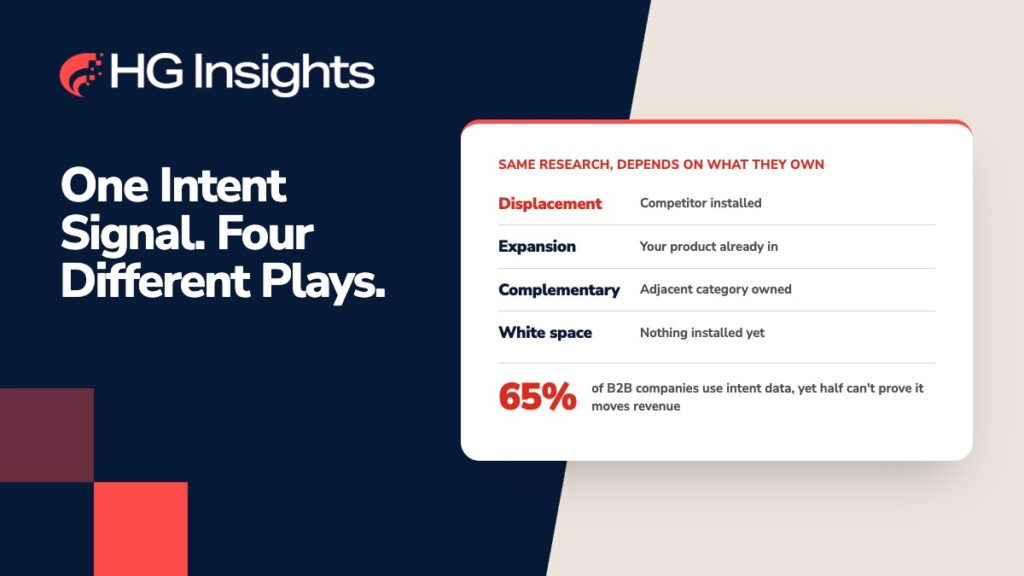
Buyer intent data tells a team an account is researching a topic. It does not tell the team what that research means. At Context26, HG Insights CTO Satish Grandhi showed how one intent signal can call for four different plays depending on what an account already owns, which team owns it, and which way the market is moving. This recap covers his session, including the launch of Momentum, a new signal family.
Quick Answer: Buyer intent data shows that an account is researching a topic. It becomes actionable when combined with what the account already owns, which team owns it, and whether the vendor is gaining or losing ground. That context turns one signal into a displacement, expansion, complementary, or white space play.
Key takeaways
- Intent alone is incomplete. Buyer intent data says an account is researching, not what the research means.
- One signal, four plays. What an account already owns determines whether it is a displacement, expansion, complementary, or white space opportunity.
- Ownership sets the entry point. FAI shows which team owns the technology, at which level of the hierarchy, and whether adoption is spreading or locked.
- Direction completes the picture. Momentum shows whether a product, vendor, or account is gaining or losing ground, so a team can act before the window closes.
What HG Insights shared at Context26
Satish’s session opened with an outside view. Michael Levy, principal analyst at GZ Consulting, argued in a recorded segment that agents will make mistakes at scale if the intelligence behind them is incomplete or disconnected. His test for useful intelligence was three questions.
“Why this account? Why now? And what do I do about it?” – Michael Levy, Principal Analyst, GZ Consulting
Satish then took the stage to show how HG Insights answers them. He walked through three layers: HG Contextual Buyer Intent, Functional Area Intelligence (FAI), and Momentum. He closed with a demo inside Amazon Quick. To see the whole session, watch the full Context26 recording.
Why buyer intent data alone cannot prove revenue impact
Satish started with a number meant to make revenue leaders uncomfortable.
“65% of B2B companies use intent data. Half can’t prove it moves revenue.” – Satish Grandhi, CTO, HG Insights
His explanation was that the problem is not volume. Search behavior, product comparisons, website visits, and job postings all share the same gap: each says someone is researching, and none says what the research means. Satish put the cost plainly. Data without interpretation “doesn’t produce decisions. It produces noise,” and noise at scale produces confident action in the wrong direction.
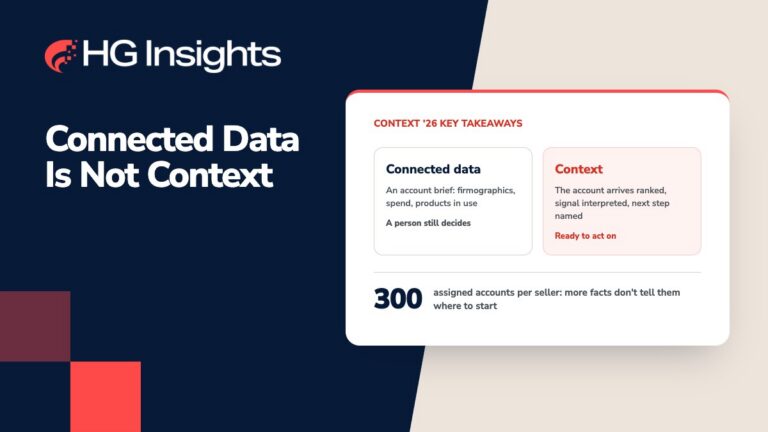
That gap is where context comes in. The signal is the starting point, and what the account already owns decides what happens next.
One signal, four plays: displacement, expansion, complementary, and white space
Satish’s example was a single account researching identity management. The research is the same in every case, but there are four different realities behind it.
Displacement
A competitor is already installed. The account is comparing that competitor’s features with the seller’s, and may be checking pricing pages. This is a competitive takeout, and Satish said speed is everything.
Expansion
The seller’s product is already in the account, and the team is researching what comes next in the portfolio. Satish called it the highest-margin conversation a seller will have.
Complementary
There is no existing relationship, but the account is evaluating a category next to one it already runs products from. The first vendor in at this stage wins.
White space
Nothing is installed and the account is new to the problem. The opportunity is to get in early and shape the buyer’s criteria before anyone else does.
Satish contrasted this with the standard approach to buyer intent data.
“Every other approach asks, is this account researching? Contextual intent answers. Here’s what they own. Here’s what the signal means, and here’s the play.” – Satish Grandhi, CTO, HG Insights
In other words, HG Contextual Buyer Intent is contextualized against the install base, so each signal arrives with its meaning and its play already attached.
Functional Area Intelligence: which team owns the technology
The second layer addresses an organizational problem. Most sellers who target a competitor’s customer reach for a contact in engineering, purchasing, or another department. Satish called that directionally correct and still wrong, because of one gap.
“Knowing a company uses a technology tells you nothing about which team actually owns it.” – Satish Grandhi, CTO, HG Insights
FAI is a machine learning classifier built from billions of job postings, resumes, and press releases. It predicts which functional area owns each technology signal at each company: sales, IT, finance, marketing, or engineering. It also indicates the level of the account hierarchy, from global headquarters to a business unit, and the geography, which shows which office to call first.
Satish added a read on adoption that changes the sales motion.
“Spreading means platform sale. Locked means beachhead.” – Satish Grandhi, CTO, HG Insights
If a technology is spreading across teams, the opportunity is a platform sale. If it is locked in one function, the entry point is a beachhead. For an agent, the practical result is that it no longer guesses at a title. It can say, for example, that the contact is the VP of IT infrastructure with an enterprise mandate centralized in Chicago.
Momentum signals: is the product winning or losing ground
HG Contextual Buyer Intent and FAI have run in GTM workflows for years. Satish said they were the context before context became the word everyone uses. They answer what a signal means and who holds the relationship. They do not answer whether the product being sold against is winning or losing ground.
Momentum is the layer built to answer that. It combines a product’s footprint with its adoption trend and shows direction at every level of the market. Satish introduced it as the third question every GTM decision depends on.
“Momentum is a third one that we have just added because market without direction is just a snapshot.” – Satish Grandhi, CTO, HG Insights
The questions Momentum is designed to answer are specific. Is a vendor gaining or ceding share across its whole portfolio? Is a competitor pulling ahead in the industries and geographies a team cares about? Is an account expanding or shrinking its technology footprint? Scored across 37 million accounts, Satish said, the split is nearly even.
“18% are actively growing their technology footprint. 17% are shrinking.” – Satish Grandhi, CTO, HG Insights
His point was that agents can now see which accounts are which and rank pipeline against it.
How Momentum is built: footprint, traction, and six grains
Momentum has two components. Footprint measures structural presence: how broadly a product is deployed, how deeply it is adopted within its category, and how widely it is distributed across geographies. Traction measures the rate of change: net customers gained versus lost, and whether customers are staying or quietly leaving.
Scores run from 0 to 100, are normalized against a peer group, and are calculated at six grains at the same time:
- Product: how a specific product is positioned against competitors, with a predicted position six months out based on 36 months of history.
- Vendor: how the whole portfolio is positioned, so one strong product cannot mask weakness elsewhere.
- Category: how a product and its vendor perform against competition within their category.
- Industry: which industry verticals a vendor is winning and which it is ceding.
- Geography: where a vendor is gaining ground and where it is pulling back.
- Account: whether a specific company’s total technology footprint is expanding or shrinking, and how the seller is doing within it.
Satish showed the result as a quadrant, with footprint on one axis and traction on the other. Leaders have high footprint and high traction. Niche leaders have lower footprint but high traction, which makes them tomorrow’s displacement threats. Challengers have high footprint and softening traction, and new players have low footprint and low traction. Rings around each product show momentum intensity.
In the demo, he played the positions back across 36 months and called what it showed trajectory.
“That is trajectory, not snapshot.” – Satish Grandhi, CTO, HG Insights
He also switched to an industry view, then to the six-month prediction. In the demo, the model predicted a 71% probability of share loss for Okta Workforce Identity, which Satish described as an open window for competitors to pursue displacement. This was a pre-built demo prediction, not a customer example. To see how the first layer works, visit HG Insights Buyer Intent.
Using this context inside Amazon Quick and other AI ecosystems
Bryce Bandish of AWS joined by video to describe the partnership. Amazon Quick brings agents, research, automation, and analytics together so teams can move from a question to an action in one place, and HG Insights Connect, powered by HG MCP Server, brings HG Insights intelligence into it without manual exports or switching between applications.
Satish then ran a pre-recorded demo. The HG Insights connector was already enabled in Amazon Quick, with skills and agents that range from a quick account brief to outreach sequencing. His prompt asked which accounts running Okta in financial services were prioritized for a displacement conversation this quarter.
The result was a prebuilt brief that combined all three layers. It ranked a top-tier account and gave the reasons: buying signals showing the account evaluating another identity product, high intent in access management and authentication, and FAI showing which department is the main buying center for two of the incumbent vendor’s products. It also listed recommended next steps. Satish noted the same intelligence is available in other AI ecosystems, including Anthropic, Microsoft Dynamics 365, and OpenAI.
Watch the full session
This recap covers Satish’s session. Watch the full Context26 recording to see the Momentum quadrants and the Amazon Quick demo in action. To see how these layers work together, visit the Contextual Intelligence Platform page, or request a demo of Momentum. Context wins.
Frequently Asked Questions
What does a buyer intent signal actually mean?
A buyer intent signal shows an account is researching a topic, but its meaning depends on what the account already owns. According to HG Insights, the same identity management research can signal displacement, expansion, complementary, or white space. Install base context tells a team which play applies and how fast to move.
How do you find displacement accounts?
Displacement accounts have a competitor’s product installed and are comparing its features with yours or checking pricing pages. HG Insights treats speed as the deciding factor in competitive takeout. Pairing buyer intent data with Tech Installs shows which researching accounts already run a competitor, so teams can prioritize the ones actively comparing.
What is Functional Area Intelligence?
Functional Area Intelligence (FAI) is an HG Insights machine learning classifier, built from job postings, resumes, and press releases, that predicts which department owns each technology at a company. It also indicates the level of the account hierarchy, the geography, and whether adoption is spreading across teams or limited to one function.
What is a Momentum score for a product or vendor?
Momentum is an HG Insights signal that combines a product’s footprint with its traction, meaning its adoption trend. Scores run from 0 to 100, are normalized against a peer group, and are calculated at six grains: product, vendor, category, industry, geography, and account. Together they show whether a product is gaining or losing ground.
How do you use HG Insights data inside Amazon Quick?
HG Insights Connect, powered by HG MCP Server, runs as a connector inside Amazon Quick. Teams enable it and use prebuilt skills and agents that range from an account brief to outreach sequencing, all drawing on HG Insights Contextual Intelligence without exporting reports or switching between applications.
Author
-

Nik Koutsoukos brings over 25 years of product and marketing executive leadership to his role as VP of Product Marketing at HG Insights. He drives product GTM, customer and partner-marketing, and sales enablement to increase awareness, reach, adoption, and growth.
Prior to HG Insights, Nik held senior positions including VP of Product Marketing at SolarWinds, Chief Marketing Officer at Catchpoint, and VP of Product Marketing at Riverbed Technology, where he helped scale adoption of enterprise performance and observability solutions. Nik brings deep expertise in translating complex technology into compelling market value and partner-aligned growth. He holds a BSEE from Leeds Beckett University.