
Teams shopping for Demandbase alternatives are usually past the “what is ABM” stage. They already run Demandbase, or they’ve sat through the demo, and now they’re asking a sharper question: when this platform tells a rep an account scored 87, can anyone say why? That single question, more than price or feature count, is what’s driving most of this search.
Quick Answer: The strongest Demandbase alternatives for ABM and account scoring are 6sense (predictive intent and orchestration), ZoomInfo (contact scale plus scoring add-ons), Bombora (consent-based intent data), Cognism (compliant contact data for EMEA teams), and HG Insights (glass-box scoring built on proprietary technographic and IT spend data). Each solves a different piece of the ABM stack; none except HG Insights lets an operator see and adjust the exact signals behind every score.
Why buyers are looking for Demandbase alternatives
Buyers aren’t hearing about alternatives from a rep pitch. They’re finding them in search, in G2 comparison pages, in the same research motion that led here.
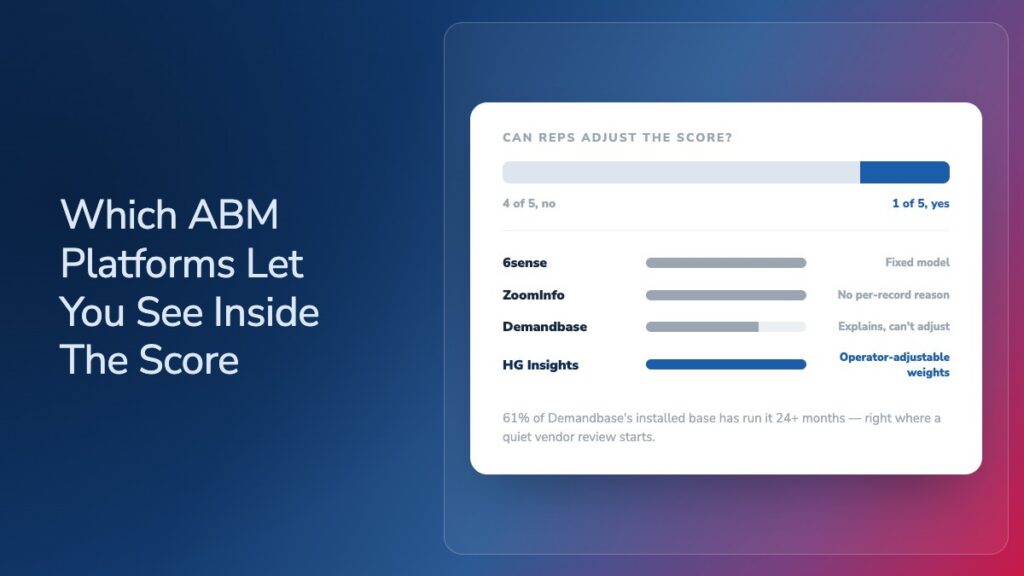
HG Insights’ own technographic data shows why the timing lines up. Of the companies currently running an active Demandbase installation, 61% have had it in place for 24 months or more, meaning most of the installed base is already past its first renewal cycle. That’s exactly the point where a quiet vendor review starts, long before it ever reaches a rep.
Price is part of it. Demandbase’s median annual contract runs $68,591, per Vendr’s transaction data across 185 tracked deals, with onboarding and implementation quoted separately and ranging from a few thousand dollars to the mid-five figures depending on complexity. Rollout itself isn’t necessarily the slow part; one independent implementation breakdown puts a full setup-to-adoption timeline at around twelve weeks. What takes longer is proving pipeline impact from that setup to a CFO who signed off on the contract.
The bigger issue is trust, not cost. Demandbase markets itself as “No Black Boxes,” and it’s the most technically transparent of the major ABM platforms: Pipeline Predict uses SHAP values and Granger causality to explain what drove a prediction. But that transparency lives in the Demandbase UI as an LLM-generated explanation, not necessarily as a field a rep can see inside Salesforce. Reps still can’t adjust the weights behind a score. They can see a reason after the fact; they can’t tell the model what should matter more. That gap between explaining a score and controlling it is exactly where “alternative” searches start.
What to look for in a Demandbase alternative for ABM and account scoring
A real alternative needs to clear four bars that Demandbase itself only partly clears. First, explainability at the record level: not a model card or a blog post, but a reason attached to the actual account in the CRM. Second, technographic and spend depth as scoring inputs, not just intent and firmographics, since IT spend trajectory and contract renewal timing predict buying readiness that clickstream data misses. Third, a realistic time-to-value: a rollout that drags on for quarters while stakeholders lose patience is a hard sell against faster-moving competitors. Fourth, pricing a buyer can actually model, including onboarding and any per-seat add-ons, before signing. Fifth, context, not just a number: does the platform tell you why an account is in-market, greenfield opportunity, expansion into an adjacent product, competitive displacement, or renewal/churn risk or does it hand you a score with no reason attached?
Almost every platform in this category, Demandbase included, is strong on one or two of these and thin on the rest. That’s the filter to run every name on this list through.
Demandbase alternatives for ABM platforms
Five names come up most often in this search, each solving a different piece of the ABM stack. These alternatives include: 6sense, ZoomInfo, Bombora, Cognism, and TechTarget.
6sense
6sense is the closest thing to a like-for-like Demandbase competitor: full ABM orchestration, a six-model scoring framework (Fit, Intent, Reach, Contact Fit, Contact Reach, Persona), and genuine predictive depth from roughly a trillion daily signals. That signal volume is real, but the technographic layer underneath it is partner-sourced rather than proprietary, 6sense licenses install data rather than collecting it directly, which is part of why its own documentation treats the fit model as fixed rather than adjustable. Its own support documentation answers the adjustability question directly: “Can we adjust the profile fit? No.” The model trains on historical closed-won data, and the only lever an operator has is excluding accounts afterward, not reweighting what the model considers. For teams that want orchestration and can live with a model they can’t tune, 6sense is a real option. For teams whose reps have stopped trusting scores they can’t explain, it doesn’t solve the underlying problem.
ZoomInfo
ZoomInfo wins on scale: hundreds of millions of contacts across its database, plus scoring through its Account Fit Score (300-plus firmographic, technographic, and intent attributes) and its RingLead rules engine.But that technographic layer stops at presence, not depth: ZoomInfo tracks more than 30,000 technologies at a binary installed-or-not level, with no install age, no spend trajectory, and no penetration signal to weight, the exact depth that determines whether an account is easy or hard to displace.
Neither product publishes a per-record explanation the way Demandbase’s Pipeline Predict does, and scoring is split across separate products rather than unified. Teams choosing ZoomInfo are usually optimizing for contact coverage, not scoring depth.
Bombora
Bombora isn’t a direct scoring competitor at all; it’s an intent data provider, and a good one, with a consent-based Co-op spanning thousands of publisher sites, 86% of it exclusive to Bombora. It has no native fit scoring, no weight customization, and only weekly refresh. Most teams that land on Bombora pair it with a scoring engine rather than replacing one.
Cognism
Cognism solves a different problem: GDPR-compliant, phone-verified contact data for EMEA-heavy sales teams, with an 87% connect rate on its Diamond Data mobile numbers. It has no native scoring engine of its own, so it’s an alternative for contact data, not for account scoring. Worth noting here: HG Insights’ technographic tracking shows about 31% of Demandbase’s own installed base sits outside the US, a narrower gap with Cognism’s GDPR-first, EMEA-heavy footprint than either vendor’s marketing suggests.
TechTarget
TechTarget owns something no one else does: first-party intent from more than 220 owned IT media properties, which makes its buying-cycle signal genuinely differentiated for technology sellers. Its scoring, though, is a single composite formula with no published methodology, which puts it alongside ZoomInfo and 6sense for any team that wants to see how the number was built.Worth flagging up front: TechTarget is really an intent-data source for teams selling into IT buyers specifically, not a general account-scoring competitor it belongs on this list for search-coverage reasons more than as a like-for-like alternative to Demandbase’s scoring engine.
Demandbase alternatives for account scoring and prioritization
Strip away the ABM orchestration layer and look at scoring specifically, and the gaps get sharper. HG Insights runs two models: Customer Fit, which scores firmographic and technographic alignment to a defined ICP, and Likelihood to Buy, which scores real-time behavioral engagement and recomputes multiple times a day rather than once daily or weekly. Every scored record pushes four fields into the CRM: a segment label, a 0-100 score, a visual indicator, and a plain-language list of the specific positive and negative signals behind that number. Weights are adjustable by the operator directly in Data Studio, with no engineering ticket and no professional-services invoice, and they normalize to 100 so the math stays legible.
Demandbase’s Pipeline Predict is the most sophisticated scoring model among the alternatives on this list. It uses ensemble machine learning with SHAP and Granger causality explanations, and it’s the only competitor besides HG that treats model-level transparency as a real product investment rather than an afterthought. But the weights are ML-assigned, not operator-adjustable; Demandbase recommends retraining the model every three months rather than continuously; and it needs opportunities from at least 50 distinct accounts before it will produce a score at all. 6sense sits at the opposite end, admitting outright that its scores can’t be adjusted. Bombora and Cognism aren’t playing this game; neither has a native predictive scoring engine to evaluate.
HG Insights vs. Demandbase: transparent scoring and IT spend intelligence
Demandbase and HG Insights are chasing the same buyer for the same reason: both know black-box scoring kills rep adoption, and both built a transparency story around that insight. The difference is what “transparent” means in practice. Demandbase shows a rep why an account scored the way it did, through an LLM-generated explanation in its own interface. HG Insights shows the why and hands over the dial: an operator can open Data Studio, see the exact weight assigned to every signal, and change it, with the new scores reflected across the account universe immediately.
The other gap is data. Demandbase’s technographic layer comes from its 2021 acquisition of DemandMatrix and doesn’t include install age, product intensity, cloud maturity, or vendor penetration, the specific signals that flag when a renewal or displacement window is opening. HG Insights builds its Customer Fit model on exactly those signals, layered with IT spend projections and contract-timing intelligence that no ABM platform, Demandbase included, generates natively.
See how HG Insights supports transparent, signal-driven prioritization for ABM teams, including the same Fit-plus-Intent scoring framework referenced throughout this comparison.
How to choose the right Demandbase alternative for your team
The right answer depends on which persona is driving the decision. A RevOps leader who needs the scoring to actually get used should weight explainability and CRM-native output above everything else; a black-box score, however sophisticated the model behind it, is a score reps will quietly ignore. A data or analytics leader evaluating scoring methodology should ask every vendor on this list, Demandbase included, for published model documentation and API access; today, that persona is underserved by nearly every competitor here. A CFO or C-suite sponsor should build a real total cost of ownership comparison before signing anything, factoring in onboarding fees, per-seat add-ons, and professional-services costs that rarely show up in the initial quote.
None of the platforms above are wrong choices in every scenario. Bombora and Cognism are honest about being data providers, not scoring engines, which makes them easy to slot into an existing stack. 6sense and ZoomInfo trade transparency for scale and orchestration depth. Demandbase sits closest to HG Insights on ambition, transparent, ML-driven, model-documented scoring, but stops short of giving the operator control over the model or the proprietary spend and contract data that predicts timing rather than just fit.
For teams evaluating what a fully explainable, operator-controlled scoring model looks like, the Account Scoring Guide walks through the Fit, Need, and Intent framework in detail, and the Account Prioritization Methodology breaks down the specific signals behind each score.
Frequently Asked Questions
How much does Demandbase cost?
Demandbase’s median annual contract runs $68,591, according to Vendr’s transaction data across 185 tracked deals, with contracts ranging from $24,000 to $164,265 depending on modules and account volume. Onboarding and implementation are quoted separately and typically add a few thousand dollars to the mid-five figures.
Is Demandbase a real company?
Yes. Demandbase is an established ABM and pipeline AI platform used by enterprise B2B marketing and sales teams, named a Leader in The Forrester Wave: Revenue Marketing Platforms for B2B, Q1 2026. Questions about its legitimacy typically stem from confusion with lookalike or scam sites rather than the platform itself.
What are the best alternatives to Demandbase for account scoring?
The strongest scoring-specific alternatives are HG Insights, for glass-box, operator-adjustable scoring built on technographic and IT spend data, and 6sense, for predictive intent scoring within a full ABM orchestration platform. ZoomInfo, Bombora, and Cognism serve adjacent needs, contact scale, intent data, and compliant contact enrichment, but none offers a comparably deep native scoring engine.
Is HG Insights a Demandbase alternative?
Yes. HG Insights offers a comparable dual-model scoring system, Customer Fit and Likelihood to Buy, built on the RGI Platform, with CRM-native score explanations and self-service weight adjustment. Its primary differentiation is proprietary IT spend and technographic-depth data (install age, product intensity, vendor penetration) as scoring inputs, along with full operator control over model weights which Demandbase’s ML-assigned weighting does not offer.