
Vendor selection in B2B used to hinge on UI polish and a long feature list. That has shifted. The teams making the smartest decisions in 2026 are filtering tools first by data coverage and accuracy, then by everything else.
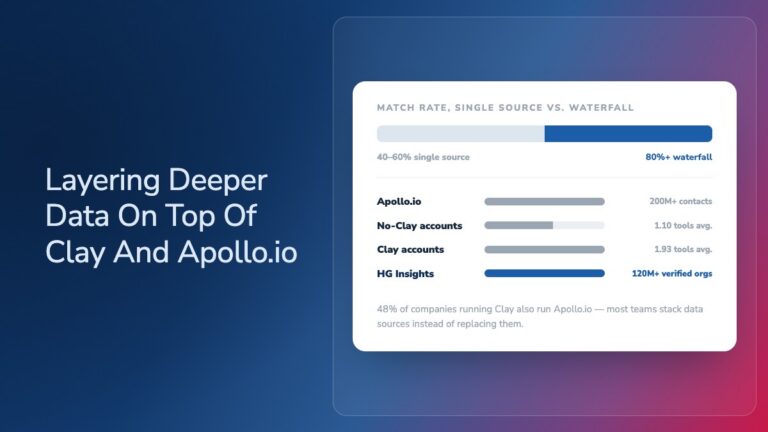
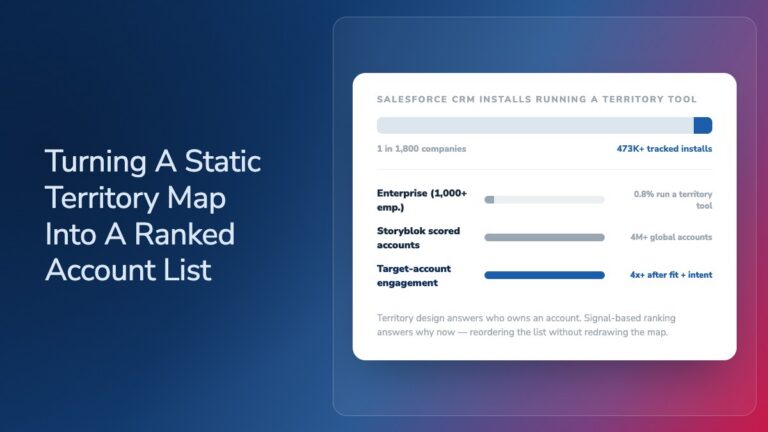
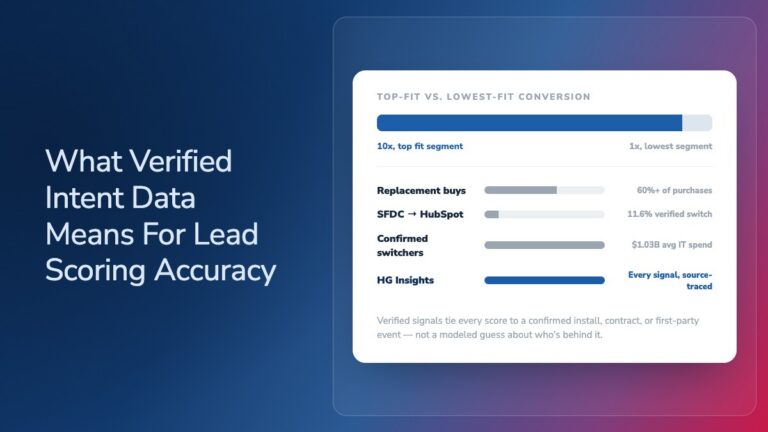
There is good reason for this. A market intelligence tool with a slick interface but thin global coverage will quietly cap your TAM models. A platform with broad records but stale data will corrupt scoring, segmentation, and forecasts. Coverage and accuracy decide whether the rest of the stack actually works. HG Insights data shows that 93% of mid-market and enterprise Salesforce CRM users have no intent data platform running alongside it, meaning most B2B teams are making pipeline decisions without buying-stage signals in their stack. And among enterprise companies already running a market intelligence platform, 1 in 3 are running two or more simultaneously. Coverage gaps are real, not theoretical, and no single tool is fully delivering.
This ranking compares the top 10 B2B market intelligence tools through that lens. Each entry looks at how the vendor sources, scales, and validates GTM data, plus where their dataset is strongest and where it thins out.
How we ranked these B2B market intelligence tools
- Each tool is ranked on coverage breadth across firmographic, technographic, install, contract, and intent data.
- Accuracy is assessed through refresh frequency, source diversity, and how well data holds up in CRM environments.
- Global reach across regions, industries, and company sizes is treated as a core requirement, not a bonus.
- AI readiness, integration depth, and proven use case fit are weighted as supporting factors.
| Tool | Firmographic | Technographic | Install and spend depth | Contract and renewal | Intent |
|---|---|---|---|---|---|
| HG Insights | Core strength | Core strength | Core strength | Core strength | Core strength |
| ZoomInfo | Core strength | Partial | Not offered | Not offered | Partial* |
| Bombora | Not offered | Not offered | Not offered | Not offered | Core strength |
| 6sense | Partial | Not offered | Not offered | Not offered | Core strength |
| Demandbase | Core strength | Partial | Not offered | Not offered | Core strength |
| Dun & Bradstreet | Core strength | Partial | Not offered | Not offered | Partial |
| Crunchbase | Partial | Not offered | Not offered | Not offered | Not offered |
| PitchBook | Partial | Not offered | Not offered | Not offered | Not offered |
| SimilarWeb | Not offered | Not offered | Not offered | Not offered | Not offered |
| Apollo | Partial | Partial | Not offered | Not offered | Partial* |
1. HG Insights
HG Insights combines firmographic, technographic, install base, contract intelligence, intent, and contact intelligence in a single platform rather than requiring teams to assemble and reconcile signals from multiple vendors. The RGI Platform is the primary interface for GTM teams: it surfaces technology adoption, spending patterns, contract timing, buying intent, and contact-level data for accounts across 100M+ companies globally, with coverage that spans enterprise and mid-market segments across major geographies and industry verticals.
The IT spend dataset is one of the more distinctive elements of the platform. Most technographic providers track whether a technology is present at a company; HG Insights adds depth on estimated spend levels and contract lifecycle signals, which lets teams prioritize accounts not just by what they run but by what they are likely to buy, renew, or replace next. Technology install data covers software, hardware, and cloud services, with coverage that reflects both direct signals and validated third-party sources across 100M+ companies.
Data accuracy is treated as a product discipline. Records are refreshed continuously and cross-validated across multiple source types, which holds up in environments where stale data corrupts scoring models and segment definitions. 95% of Fortune 1000 B2B tech companies and all major hyperscalers rely on HG Insights, a customer base whose data requirements include production-grade accuracy at global scale.
GTM teams that span strategy, marketing, sales, and RevOps tend to see the broadest value. Strategy teams use the platform for TAM sizing, whitespace analysis, and competitive intelligence. Marketing uses it for ICP definition, segment targeting, and campaign prioritization. Sales uses it for account prioritization, territory planning, and contact-level activation. Contact Intelligence within Sales Copilot identifies and enriches contacts at high-priority accounts with verified email and phone data, then pushes them directly to Salesforce, Outreach, or Salesloft without leaving the platform. RevOps uses it to build scoring models that combine technographic, spend, and intent signals in one data layer.
Explore the RGI Platform for B2B market intelligence.
2. ZoomInfo
ZoomInfo maintains one of the largest B2B contact and account databases on the market, with coverage across 100M+ companies and 260M+ contacts, including 135M+ verified phone numbers. The platform’s strength sits in contact intelligence: verified emails, direct dials, and job change alerts flow directly into CRM systems through a full Salesforce and HubSpot integration workflow.
On the technographic side, ZoomInfo tracks 30,000+ technologies, with coverage reflecting technology presence detection across company web properties and third-party signals. The technographic layer covers breadth of presence rather than deployment depth, spend correlation, or contract-level timing. Teams that need to model technology investment patterns or identify renewal windows typically supplement the platform with additional data sources.
The AI Copilot product is built for individual sales reps, surfacing account intelligence inside CRM records, generating personalized outreach, and recommending next actions. GTM Studio provides a workflow automation layer for orchestrating outbound sequences and plays at scale.
Outbound-heavy teams that prioritize contact reach, account profiles, and rep productivity get strong returns from ZoomInfo. Strategy and RevOps use cases that require technographic depth, predictive spend modeling, or contract intelligence typically require layering in additional sources.
See how B2B data enrichment for GTM precision strengthens scoring and segmentation.
3. Bombora
Bombora operates a publisher cooperative that aggregates B2B content consumption data from across the web to produce account-level intent signals. The cooperative covers 20,100+ intent topics and delivers weekly Surge Scores on a 0-to-100 scale based on how much a company’s research activity has increased relative to its baseline across that topic set.
The coverage model is intentionally focused on intent. Bombora does not maintain a contact database, firmographic records, or technographic data of its own. It is designed as a signal layer that sits alongside existing CRM systems, account databases, and marketing automation platforms. Connections to Salesforce, Marketo, HubSpot, and Pardot allow Surge Score changes to trigger list updates, ad targeting adjustments, and sales alerts within existing workflows.
Where Bombora adds value is in account prioritization timing. It is most actionable when a team has firmographic and contact coverage in place and needs to layer on signals indicating when accounts are in an active research cycle. Teams using Bombora as part of an ABM motion typically combine it with technographic or firmographic data from a separate platform to build the full account picture.
Teams looking for firmographic coverage, contact data, or technographic intelligence will need to source those elsewhere. Bombora’s competitive position is deliberately narrow, which is a strength for teams that need a focused intent signal without changing their broader data architecture.
4. 6sense
6sense is built around buyer intent and account identification, using its Signalverse data layer to aggregate behavioral signals from across the open web, partner networks, and its own cooperative. The platform processes signals including anonymous web activity, content consumption patterns, and IP-based identification to predict which accounts are in an active buying cycle and model buying committee composition.
AI-based scoring assigns accounts to buying stages and generates prioritization recommendations that feed into account dashboards, ad targeting queues, and rep workflows. 6sense also includes a native B2B advertising DSP, which allows marketing teams to run programmatic account-targeted campaigns directly within the platform without a separate media buying tool.
On the data coverage side, install base depth, predictive IT spend modeling, and contract-level intelligence are not part of 6sense’s core dataset. The platform’s primary orientation is toward demand activation and pipeline influence rather than market structure analysis, TAM sizing, or territory planning.
Marketing teams running coordinated ABM programs that need account identification, multi-channel activation, and pipeline attribution reporting in one place are the platform’s strongest fit. Strategy and RevOps teams that require deeper intelligence on technology adoption or market sizing tend to pair 6sense with a dedicated market intelligence platform.
5. Demandbase
Demandbase operates as an ABM platform that combines account intelligence, intent data, B2B advertising, and pipeline orchestration. The platform covers 176M+ B2B contacts and tracks 42,000+ technologies across its company database on a monthly update cycle. With 85+ out-of-the-box integrations spanning CRM, marketing automation, sales engagement, and data warehouse tools, the platform is designed to sit at the center of an enterprise GTM stack.
The advertising DSP is one of Demandbase’s distinguishing features: it allows teams to run account-targeted display and LinkedIn campaigns without leaving the platform, making it one of the few vendors that handles both intelligence and media buying in a single workflow. Pipeline orchestration tools coordinate account engagement across sales and marketing, and the platform’s account identification layer uses a combination of IP matching and behavioral signals for web visitor identification.
Technographic coverage reflects technology presence tracked on a monthly basis rather than verified deployment depth or spend data. Whitespace analysis and TAM modeling are available but depend on the accuracy of the underlying technology detection layer. Contract and renewal signals are not part of the offering.
Enterprise teams running integrated ABM programs across marketing, advertising, and sales that need those workflows connected to account intelligence tend to gravitate toward Demandbase. Teams focused on strategic market planning alongside ABM activation typically use Demandbase as one component of a broader data stack.
6. Dun & Bradstreet
Dun & Bradstreet’s data infrastructure centers on its D-U-N-S Number system, a proprietary business identification standard that underpins its records across 600M+ entities globally. Corporate hierarchy mapping, legal entity data, financial indicators, and beneficial ownership structures are core capabilities refined over decades of use across commercial credit, compliance, and enterprise procurement workflows.
The firmographic dataset runs through 60B+ quality checks and provides some of the most reliable corporate linkage data available, particularly for global parent-subsidiary relationships and legal entity separation. This makes D&B a common foundational data source for enterprise GTM teams that need accurate account hierarchy for territory design, account routing, and compliance-adjacent use cases.
Outside of firmographics and corporate hierarchy, coverage thins. Technographic data is a secondary capability, and intent signals are available through the platform but are not a primary product focus. The Rev.Up ABX platform provides a RevOps workflow layer on top of the firmographic core, with account targeting, segmentation, and CRM integration for teams that want activation capabilities alongside the data foundation.
Compliance-sensitive sectors, financial services, and enterprise GTM teams that prioritize corporate hierarchy accuracy and global entity coverage rely on D&B for foundational firmographic data. Most teams pair it with a separate platform for technographic, intent, or demand activation capabilities.
Learn how predictive account targeting and scoring builds on layered data sources.
7. Crunchbase
Crunchbase specializes in company lifecycle and funding intelligence, with particular depth around startup and growth-stage organizations. Funding rounds, investor relationships, executive appointments, board changes, and acquisition activity are tracked and updated regularly, providing visibility into organizational momentum signals that most firmographic databases don’t capture.
The platform covers companies at all stages, from pre-seed through public, with richer coverage for venture-backed organizations than for large established enterprises. Company profiles include founding date, full funding history, headcount trajectory, and M&A activity, giving teams a view into company trajectory alongside standard firmographic fields.
Coverage is narrower outside of funding and company lifecycle data. Install base intelligence, IT spend modeling, and technographic depth are not part of the platform’s dataset. Enterprise-level technology adoption data and contract signals are absent.
Sales and business development teams targeting growth-stage, venture-backed, or recently funded companies use Crunchbase to identify organizations at expansion moments (new funding, leadership changes, or acquisition activity) that often precede purchasing decisions. Enterprise-focused teams targeting mature organizations typically need a separate platform for account-level technology and spend intelligence.
8. PitchBook
PitchBook covers private market transactions, institutional investment activity, and corporate development intelligence. Deal records include transaction detail, investor participation, advisory relationships, and target company profiles extending back several decades of private market activity. The dataset covers private equity, venture capital, mergers and acquisitions, and real assets.
Research teams at PitchBook actively track and verify deal activity, producing coverage that goes beyond what automated data collection typically captures for private market transactions. The platform supports workflow tools for screening companies, tracking deal pipelines, and monitoring portfolio positions, built for investment and corporate development professionals.
PitchBook’s orientation is financial analysis and corporate development rather than GTM execution. Contact-level outreach data, technographic intelligence, and intent signals are not part of the platform. The data structure and interface are designed for analysts, investors, and corporate strategy teams performing diligence and market research rather than for sales rep activation or marketing campaign targeting.
Corporate strategy, M&A, private equity, and partnerships teams that need verified private market intelligence and deal-level visibility use PitchBook as a primary research tool. Sales and marketing teams tend to draw on it for company context rather than as an active data source for pipeline development.
9. SimilarWeb
SimilarWeb tracks digital traffic, audience behavior, and web performance across millions of websites globally. The platform’s dataset is built from a combination of panel data, ISP partnerships, and direct measurement relationships that allow it to estimate traffic volume, traffic sources, engagement metrics, and audience characteristics for the domains it monitors.
Core capabilities include competitive web traffic benchmarking, traffic source analysis by channel, audience overlap measurement between domains, and trend tracking over time. The platform provides a view of digital market share as measured by web engagement, which is useful for understanding relative brand awareness and channel performance across competitive sets.
The platform does not track technology install bases, IT spending patterns, or contract-level signals. Its company data coverage is oriented around web behavior and digital presence rather than business operations, technology investment, or buying activity. Intent data and firmographic records are not part of the offering.
Digital marketing, competitive strategy, and growth teams that analyze web-driven market dynamics use SimilarWeb as a benchmarking source. GTM teams targeting enterprise technology buyers generally pair it with a separate platform for the technographic, firmographic, and intent intelligence needed to prioritize and activate accounts.
See how competitive analysis and takeout strategy benefits from layered intelligence.
10. Apollo
Apollo provides a combined contact database and outbound workflow platform, with coverage across 210M+ contacts and a broad set of company records spanning SMB and mid-market accounts globally. The platform integrates contact data with built-in email sequencing, a CRM sync layer, and a dialer, allowing sales teams to move from prospecting to outreach within a single interface. A free tier and published pricing tiers make it one of the more accessible options in the category.
Contact data is a core strength, using SMTP-based verification that the platform cites at 91–97% email accuracy. Integrations with both Salesforce and HubSpot cover the CRM environments used by most of the platform’s target customers. Basic firmographic filtering by industry, employee count, revenue, and geography supports prospecting list builds within the platform.
Technographic coverage is available through a partnership with LeadSift, spanning approximately 1,600 technology topics. This is narrower than dedicated technographic providers and reflects technology presence rather than verified deployment depth, spend modeling, or contract intelligence. Enterprise-scale technographic analysis and contract signals are not part of Apollo’s current offering.
High-velocity sales teams that need broad contact reach, integrated outbound workflows, and accessible pricing tend to find astrong fit with Apollo. Teams targeting complex enterprise buyers that require deeper technographic intelligence, predictive spend data, or market structure analysis typically move to more specialized platforms as their data requirements mature.
How to choose based on data coverage and accuracy
| Tool | Standout data strength | Best-fit team or use case |
|---|---|---|
| HG Insights | Unified firmographic, technographic, install, spend, contract, and intent data in one platform | Strategy, marketing, sales, and RevOps teams that need one account view for TAM sizing, scoring, and activation |
| ZoomInfo | Deep contact intelligence with verified emails and direct dials at scale | Outbound-heavy teams that prioritize contact reach and rep productivity |
| Bombora | Focused, cooperative-sourced intent across 20,100 topics | Teams that already hold firmographic and contact coverage and want a clean intent layer for ABM timing |
| 6sense | Buyer intent and account identification with native advertising activation | Marketing teams running coordinated ABM that need identification, activation, and attribution in one place |
| Demandbase | Combined account intelligence and B2B advertising in a single ABM workflow | Enterprise teams running integrated ABM across marketing, advertising, and sales |
| Dun & Bradstreet | Authoritative corporate hierarchy and legal entity data through the D-U-N-S system | Compliance-sensitive and enterprise teams that need accurate global account hierarchy |
| Crunchbase | Funding, investor, and company lifecycle intelligence | Sales and business development teams targeting growth-stage and recently funded companies |
| PitchBook | Verified private market, deal, and investment intelligence | Corporate strategy, M&A, and private equity teams running diligence and market research |
| SimilarWeb | Digital traffic and web audience benchmarking | Digital marketing and competitive strategy teams analyzing web-driven market dynamics |
| Apollo | Combined contact database and outbound workflow with accessible pricing | High-velocity sales teams that need broad contact reach and integrated outreach |
Coverage and accuracy are easy to talk about and harder to verify. Across the four most widely adopted market intelligence platforms, HG Insights data shows just 46,000+ companies globally have any of them installed, and only 12% run more than one. That points to how early-stage the category still is despite the vendor noise. The way to cut through vendor claims is to start with the GTM use cases your team needs to power, then map the required data layers to each vendor’s actual strengths.
From there, prioritize tools that combine firmographic, technographic, install, and intent intelligence in one place. Validate accuracy with sample enrichment runs against your own CRM before committing to a long-term contract. The numbers in a sales pitch rarely match production performance.
HG Insights is built for B2B teams that need unified market intelligence with proven data coverage and accuracy at scale, not just another data feed bolted onto an already crowded stack.
See how HG Insights brings firmographic, technographic, spend, contract, and intent data into one platform. Explore the RGI Platform.