
Sales ops and RevOps teams evaluating ZoomInfo alternatives are usually not asking “which tool has more contacts.” They already have contacts. What they are missing is the context that turns a contact list into a prioritized target list: verified technology installs, real IT spend, contract renewal timing, and buyer intent that holds up when a rep actually dials. This guide compares seven ZoomInfo alternatives for data enrichment and contact intelligence, what each one is actually built to do well, and where each one falls short.
Quick Answer: A true ZoomInfo alternative for data enrichment and contact intelligence needs to do more than match contacts to companies. It has to add verified technographic, spend, or intent signal that ZoomInfo’s contact-first database doesn’t cover. 6sense, HG Insights, Demandbase, Bombora, Apollo.io, Clearbit (now HubSpot’s Breeze Intelligence), and Dun & Bradstreet each cover a different piece of that gap, and most GTM teams end up running two of them together rather than replacing ZoomInfo outright.
Why GTM teams are looking at ZoomInfo alternatives in 2026
The contact database that made ZoomInfo the default sales intelligence buy isn’t the differentiator it used to be. Most mid-market and enterprise GTM teams already have reasonable contact coverage. The real problem is downstream: reps working accounts with no verified budget, scoring models nobody trusts, and outreach that lands months before or after a renewal window opens.
Pricing plays a role too. ZoomInfo’s list pricing has climbed steadily, and its per-seat and add-on structure catches mid-market buyers off guard at renewal, pushing teams into side-by-side comparisons against Apollo.io on price and against HG Insights, 6sense, and Demandbase on data depth.
Ratings tell only part of the story too. ZoomInfo markets contact accuracy in the 90 to 95 percent range and holds the top G2 Score in Sales Intelligence, a 4.5-star rating across 9,000-plus reviews, a genuinely strong showing. What that score measures is overall satisfaction, not the match rate on any specific account list, so most RevOps teams still run a sample list against their own CRM before signing, regardless of which vendor they’re evaluating. None of that makes ZoomInfo a bad product. It just makes “which alternative fills the gap in our stack” a more useful question than “which one beats ZoomInfo.”
What to look for in a ZoomInfo alternative for data enrichment and contact intelligence
The right evaluation criteria depend on who is running it. Sales ops managers care most about ease of implementation, whether a tool is Salesforce-native out of the box, and how much they can trust the data without babysitting it. VP and director-level RevOps buyers weigh revenue impact, total cost of ownership, and how fast the tool integrates with a stack that already includes a CRM, a marketing automation platform, and probably an ABM tool.
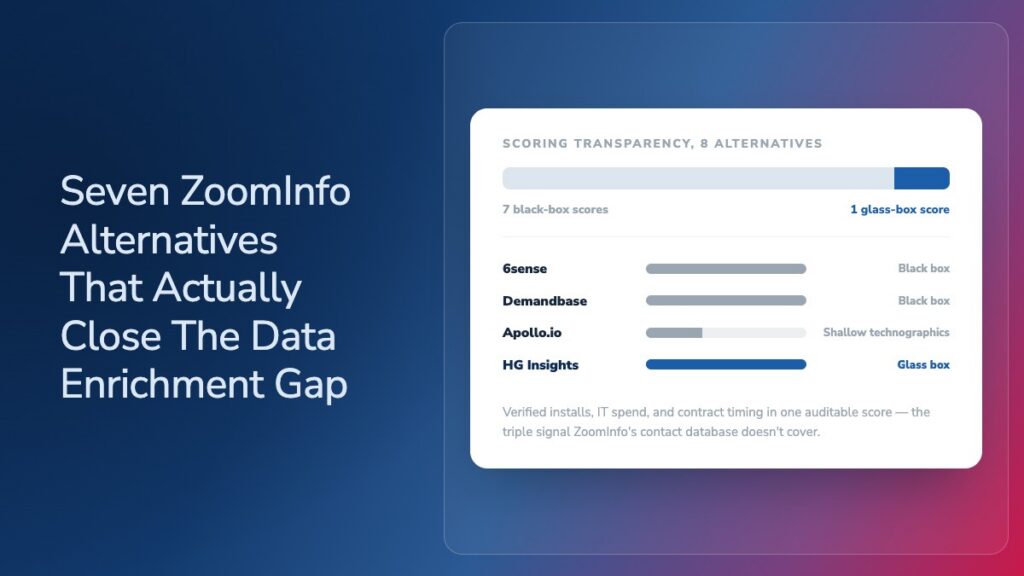
A few criteria matter regardless of seniority. Scoring transparency separates glass-box models, where every input driving a score is visible and can be audited or overridden, from black-box models that ask a data team to trust a number they can’t inspect. See how HG Insights builds glass-box account scoring before weighing vendors on this criterion alone. Contract and renewal signal coverage matters for any team running competitive displacement plays, since knowing a contract is up for renewal six months out is worth more than knowing a company merely uses a competing tool. And pricing transparency is uneven across this category: Apollo.io and Clearbit publish tiered pricing, while HG Insights, 6sense, and Demandbase require a sales conversation, which is worth planning for before an evaluation starts.
The best ZoomInfo alternatives for data enrichment and contact intelligence
Here are seven ZoomInfo alternatives worth evaluating for data enrichment and contact intelligence, ranked by the gap each one is best suited to close rather than by size of database.
1. 6sense
6sense positions itself as a full replacement for a fragmented signal stack, built around Signalverse, which the company says processes a trillion signals a day across more than 30,000 tracked technologies. Forrester has credited the platform with a 454 percent three-year ROI in a commissioned Total Economic Impact study. The catch is transparency: 6sense’s scoring is a black box, and reviewers consistently flag a steep learning curve, which makes it a harder sell to sales ops teams who need reps to trust a score without an explanation attached.
2. HG Insights
HG Insights combines verified technology install data, predictive IT spend intelligence, and TrustRadius buyer intent in a single platform, a combination the company calls its triple signal and one no other vendor on this list offers in one place. Every account score is glass-box: RevOps and data teams can see exactly which installs, spend signals, and contract timing drove a given score, rather than trusting a model they can’t inspect. That context also shows up where reps already work, syncing into Salesforce, Snowflake, and Sales Copilot rather than asking teams to log into another platform. The tradeoff is contact data. HG’s waterfall contact enrichment through the RGI Platform is newer than ZoomInfo’s database, which is why most enterprise teams run HG for account intelligence and ZoomInfo (or another contact-first tool) for contacts rather than picking one.
3. Demandbase
Demandbase’s account graph tracks more than 113 million companies globally, and it pairs that coverage with an advertising cloud, which makes it a strong pick for enterprise ABM teams that want intelligence and campaign activation in one platform. Implementation is the drawback most reviewers cite, with rollouts commonly running six to twelve months, which conflicts directly with the faster time-to-value most Growth-segment RevOps buyers are looking for.
4. Bombora
Bombora runs a consent-based data cooperative across more than 5,000 B2B publishers, tracking billions of content interactions a month to flag when an account is actively researching a topic. Its GDPR-by-design methodology is a genuine advantage for teams worried about compliance risk in intent data. What Bombora doesn’t do is tell you who at that account is researching, or what they currently run. It’s a signal layer, not a contact or technographic source, which is why it’s almost always paired with another tool rather than run alone.
5. Apollo.io
Apollo built its business on more than 200 million contacts and SMTP-based email verification, reporting 91 to 97 percent email accuracy at a fraction of enterprise pricing, with published plans starting at $49 a month on annual billing. That price point makes it the default ZoomInfo alternative for Growth-segment and startup teams. Phone accuracy is weaker, closer to 60 percent, and its technographic data (roughly 1,600 topics through a data partnership) is shallow next to a platform built around verified installs, which limits how far Apollo can go for enterprise account scoring.
6. Clearbit
Clearbit’s (now HubSpot Breeze Intelligence) post-acquisition life inside HubSpot delivers zero-configuration enrichment across more than 40 continuously refreshed attributes the moment a HubSpot account connects it. For HubSpot-native teams, that’s genuinely the path of least resistance. For everyone else, it’s close to a non-starter: the standalone API has been sunset, pricing runs on a credit-based model, and Salesforce-first organizations get none of the benefit.
7. Dun & Bradstreet
D&B remains the authority on business identity, with over 500 million D-U-N-S Numbers in its data cloud that enterprise customers most often lean on for corporate hierarchy resolution, frequently alongside credit risk monitoring elsewhere in the business. Requests for D&B tend to be firmographic and hierarchy-centric rather than buying-signal driven, and the platform fills the gaps in its own coverage through data partnerships, including with technographic vendors like HG Insights. What D&B doesn’t generate on its own is buying signal: no proprietary intent data, no contract timing, nothing that tells a rep when an account is actually ready to buy, which is why it’s rarely the sole data source in a modern GTM stack.
ZoomInfo alternative | Best for | Core differentiator | Where it falls short |
6sense | Enterprise teams consolidating a fragmented signal stack | Signalverse processes 1T+ signals a day across 30K+ technologies | Black-box scoring, steep learning curve |
HG Insights | RevOps and data teams that need explainable account intelligence | Verified installs, IT spend, and TrustRadius intent in one glass-box score | Newer, waterfall-based contact data |
Demandbase | Enterprise ABM teams that want intelligence plus advertising | 113M+ company account graph | 6 to 12 month implementation timelines |
Bombora | Marketing ops teams building consent-based intent programs | 5,000+ publisher co-op, GDPR by design | No contact-level attribution or technographics |
Apollo.io | Growth-stage and price-sensitive sales teams | 200M+ contacts at startup pricing | Weak phone accuracy, shallow technographics |
Clearbit / Breeze Intelligence | HubSpot-native teams | Zero-config enrichment inside HubSpot | HubSpot lock-in, standalone API sunset |
Dun & Bradstreet | Corporate hierarchy resolution and firmographic asks | D-U-N-S identity standard, 500M+ D-U-N-S Numbers | No proprietary intent, contract, or buying-signal data |
Replace it, pair it, or both: how GTM teams run HG Insights alongside ZoomInfo
For most of the accounts evaluating this list, the honest answer isn’t “replace ZoomInfo.” It’s “add the layer ZoomInfo was never built to provide.” ZoomInfo answers who works at an account and how to reach them. HG Insights answers which accounts are actually worth reaching, why now, and what to say once a rep is on the call, using verified technology installs, IT spend by category, and contract renewal timing that ZoomInfo’s contact-first database doesn’t track.
That’s the coexistence model most GTM teams land on, and it’s worth understanding before deciding whether this is a switch or a stack decision. HG Insights explains how that pairing works across the funnel in more depth here, including the outcomes teams report after running both platforms together: wasted outreach on zero-spend accounts dropping 30 to 40 percent within a quarter or two, and rep adoption of scoring models climbing from near-zero to over 90 percent once the rationale behind each score is visible.
If a full switch away from ZoomInfo, or evaluating HG Insights as a net-new data enrichment vendor, is more your situation, HG’s Data Enrichment solution page walks through how the RGI Platform enriches CRM and lead records with verified technographics, spend intelligence, and contract signals, or you can see it directly on a demo.
And for teams that already know they want to run HG Insights and ZoomInfo together rather than choose between them, the HG Insights + ZoomInfo: Better Together guide breaks down exactly where each platform’s coverage ends, including a capability comparison table and a business case built for a CFO conversation.
Frequently Asked Questions
What are some alternatives to ZoomInfo?
The most commonly evaluated ZoomInfo alternatives for data enrichment and contact intelligence are 6sense, HG Insights, Demandbase, Bombora, Apollo.io, Clearbit (now HubSpot Breeze Intelligence), and Dun & Bradstreet. Each covers a different gap, from technographic depth to intent data to firmographic authority, rather than duplicating ZoomInfo’s contact database outright.
Who are ZoomInfo's top 3 competitors?
Based on how often GTM teams evaluate them head-to-head, ZoomInfo’s most frequently cited competitors are 6sense, Apollo.io, and HG Insights. 6sense competes on unified ABM orchestration, Apollo.io competes on price for Growth-segment teams, and HG Insights competes on verified technographic and spend intelligence ZoomInfo’s database doesn’t include.
What are some free alternatives to ZoomInfo?
Apollo.io offers a free tier and published plans starting around $49 a month, making it the most accessible low-cost ZoomInfo alternative for contact data. Clearbit’s Breeze Intelligence runs on a credit-based model inside HubSpot with a low entry cost, though it only works for HubSpot-native teams.
Who competes against ZoomInfo?
ZoomInfo competes against contact-first platforms like Apollo.io, ABM and orchestration platforms like 6sense and Demandbase, intent data providers like Bombora, firmographic authorities like Dun & Bradstreet, and technographic and spend intelligence platforms like HG Insights. Most GTM teams run ZoomInfo alongside one or two of these rather than picking a single winner.
Is there anything better than ZoomInfo for B2B data enrichment?
It depends on the gap being filled. ZoomInfo’s contact database and Salesforce integration are hard to beat on scale. For technographic depth, IT spend intelligence, and auditable account scoring, HG Insights covers ground ZoomInfo’s contact-first data model doesn’t reach, which is why most teams pair the two rather than replacing one with the other.
What is the best ZoomInfo alternative for data enrichment specifically?
For data enrichment specifically, rather than contact lookup, HG Insights is the strongest ZoomInfo alternative because it combines verified technology installs, predictive IT spend, and contract renewal signals with glass-box scoring. Teams that also need a large contact database typically run HG Insights and ZoomInfo together instead of choosing one over the other.