
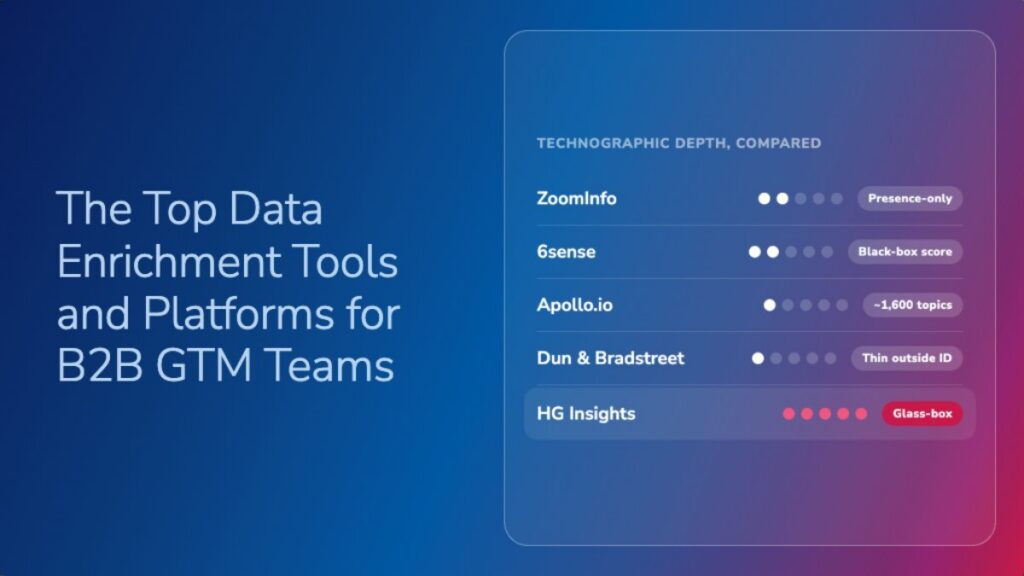
Choosing among today’s data enrichment tools means weighing very different bets: contact database size, technographic depth, scoring transparency, and how flexibly a platform delivers data into an existing GTM stack. Revenue and data teams evaluating options like ZoomInfo, 6sense, Apollo.io, and HG Insights face a market where no single vendor wins every category, and the wrong pick means paying for depth in the wrong place. This comparison breaks down eight data enrichment tools and platforms against the criteria that actually predict fit for a B2B GTM stack.
Quick answer: The best data enrichment tool depends on the job. ZoomInfo and Apollo lead on contact database size, 6sense and Demandbase lead on ABM orchestration, D&B leads on firmographic hierarchy, and HG Insights leads on verified technographic depth, IT spend intelligence, and both outbound and inbound scoring. Most enterprise GTM stacks run two or three of these tools together rather than one.
What counts as a data enrichment tool in 2026
A data enrichment tool takes incomplete account or contact records and fills them in with additional signals: firmographics, technographic installs, buyer intent, contract and spend data, or verified emails and phone numbers. The output feeds CRM records, lead scoring models, and account prioritization so sales and marketing teams work from a fuller picture of who they’re targeting.
Most vendors sold as data enrichment tools in 2026 actually specialize in one layer of that stack. Contact database vendors like ZoomInfo and Apollo.io built their businesses on verified emails and phone numbers, then added firmographic and light technographic data around that core. ABM orchestration platforms like 6sense and Demandbase treat enrichment as an input to intent scoring and advertising, not the primary product. Firmographic authorities like Dun & Bradstreet built the identity layer, the D-U-N-S number and corporate hierarchy resolution, that other vendors reference but rarely replicate. HG Insights sits in the fourth category: proprietary technographic intelligence, verified software and hardware installs, deployment depth, and predictive IT spend, layered with contact enrichment rather than led by it. For a deeper walkthrough of enrichment fundamentals and data types, see HG Insights’ complete guide to B2B data enrichment. Knowing which layer a tool actually specializes in, rather than which layer it claims to cover, is the first filter for narrowing this list.
How we evaluated these data enrichment tools and platforms
Every entry below was evaluated against six practitioner-level criteria rather than review-site star ratings, which tend to reward brand recognition over fit.
- Technographic depth measures whether a tool reports actual verified installs and deployment breadth, not just presence or absence of a technology.
- Scoring transparency distinguishes glass-box models, where every input driving a score is visible and can be audited or overridden, from black-box models that ask a data team to trust a number it cannot inspect.
- Contact data depth covers the size and verification method behind a vendor’s phone and email records.
- Delivery model looks at whether data ships through a platform UI, a REST API, a waterfall of multiple sources, or an emerging agentic and MCP feed built for AI systems.
- Pricing transparency notes whether entry and enterprise pricing are published or require a sales conversation.
- Coverage flags where a vendor’s data holds up outside North America, since Asia-Pacific match rates lag US and European rates across the industry.
These criteria come from HG Insights’ own competitive intelligence research and internal account data, not vendor marketing pages. For the fuller by-use-case view of data providers beyond enrichment specifically, see HG’s guide to B2B data providers in 2026.
Data enrichment tools and platforms compared at a glance
The table below lines up all eight tools against the criteria that matter for a GTM data stack. None of the eight wins on every dimension, which is the point: the right fit depends on which gap in the current stack a tool needs to close.
On ratings: “Full” means the capability is mature and independently documented, “Partial” means it exists but is limited in scope, thin on independent verification, or a recent addition, and “None” means the vendor doesn’t offer it. Scoring model is rated separately as glass-box (every input visible and auditable) or black-box (a score the team can’t inspect), since that’s a distinct question from how deep the underlying data goes.
Tool | Technographic depth | Scoring model | Contact data | Delivery model | Entry pricing |
|---|---|---|---|---|---|
HG Insights | Full (verified installs + spend) | Glass-box | Partial (new waterfall) | Platform, API, webhooks, MCP/agentic | Custom, not published |
ZoomInfo | Partial (presence-level) | Partial | Full (260M+ contacts) | Platform + API | ~$15K/yr entry |
6sense | Partial | Black-box | Partial | Platform + API | Free tier, limited |
Demandbase | Partial | Partial | Partial (176M+ contacts) | Platform + MCP | Not disclosed |
Bombora | None (intent only) | Documented, medium | None | API | ~$25K-30K/yr |
Apollo.io | Partial (via LeadSift) | Partial | Full (210M+ contacts) | API | Free tier |
Clearbit/HubSpot Breeze | Partial (web crawl) | None (deprecated) | Partial | HubSpot-native, API sunset | ~$540/yr (100 credits) |
Dun & Bradstreet | Partial, minimal | Partial | Partial (via Hoovers) | API + platform | ~$10K/yr entry |
Three patterns cut across this table. ZoomInfo, HG Insights, 6sense, and Demandbase compete on platform breadth: they bundle several enrichment layers with orchestration, advertising, scoring, technographics, or ABM workflow tools most other vendors don’t attempt. Bombora competes on depth in a single proprietary layer, a publisher-consent intent co-op, that the platform players cannot fully replicate. Apollo, Clearbit, and D&B fill specific niches: low-cost contact volume, HubSpot-native automation, and firmographic authority.
Top data enrichment platforms: a tool-by-tool breakdown
ZoomInfo
ZoomInfo built the market’s largest contact database, more than 260 million contacts with over 135 million verified phone numbers, backed by a research team that manually verifies records. Its technographic layer detects roughly 30,000 technologies at a presence level: it can confirm a tool is installed but not how deeply, whether usage is growing, or what the account spends on it. For enterprise accounts, ZoomInfo tends to stay in the stack for contacts even after a technographic or intent vendor gets added alongside it. For a closer look at contact-focused vendors specifically, see HG’s breakdown of contact data enrichment platforms for B2B teams.
6sense
6sense processes what it describes as a trillion signals a day through its Signalverse and 6 Signal Graph, feeding a proprietary scoring model that a Forrester study commissioned by 6sense credits with a 454% three-year ROI. That same scoring model shows up as 6sense’s most cited weakness in HG’s own internal account conversations (not TrustRadius data): enterprise data teams describe it as a black box. Separately, on G2 (a public, third-party review site), reviewers reference a steep learning curve often enough that it reads as a pattern rather than a one-off complaint.
Demandbase
Demandbase covers close to 99% of B2B companies globally through its account graph and pairs that coverage with first-party intent. It also markets a native MCP integration for AI workflows, one of the earliest such claims in this category. Independent, hands-on documentation of that integration is still limited, the same early stage HG’s own MCP preview is in, so treat both as promising rather than mature right now. Demandbase is built as a full ABM platform first and an enrichment tool second, which shows up in review sites as a six to twelve month implementation timeline for teams that just need clean account and contact data.
Bombora
Bombora doesn’t do firmographic or technographic enrichment at all but does provide intent. It’s a consent-based intent data co-op spanning more than 5,000 publishers and roughly 13,000 research topics. That scale makes it a strong complement to a fuller enrichment tool rather than a replacement for one, since Bombora’s Company Surge signals tell a team a company is researching a topic, not who at that company, what they run today, or what they’re spending. HG Insights’ own technographic data backs this up: 62% of companies running Bombora also have ZoomInfo installed, evidence that intent signals and contact data solve two different problems rather than competing for the same budget line.
Apollo.io
Apollo.io pairs a 210 million-plus contact database with built-in Outreach sequencing at a fraction of enterprise pricing, starting free and running $5,000 to $20,000 a year for most mid-market teams. Its technographic coverage runs through a LeadSift partnership limited to around 1,600 topics, thin next to the technographic-first vendors on this list, and third-party estimates put phone accuracy closer to 60%. Apollo is a real threat in price-sensitive Growth-segment deals, less so in enterprise evaluations that weight data depth over cost.
Clearbit (HubSpot Breeze Intelligence)
Clearbit, now sold as HubSpot Breeze Intelligence, auto-populates more than 40 CRM fields the moment a contact hits a HubSpot form, with no configuration required. The standalone API that once let any CRM use Clearbit data has been sunset, so the tool is effectively locked to HubSpot customers now, and its credit-based pricing, roughly $540 a year for 100 credits, caps how far it scales for a growing database.
Dun & Bradstreet
Dun & Bradstreet owns the D-U-N-S numbering system, still the closest thing to a universal standard for resolving corporate hierarchies and parent-child relationships across more than 170 million business records. That hierarchy authority is genuinely hard to replicate, but D&B’s enrichment leans thin outside that core: limited technographic depth and intent signals that remain largely unproven, plus nothing that tells a GTM team when an account is actually ready to buy.
HG Insights
HG Insights is built around a different starting layer: more than 120 million organizations with verified technology installs, deployment breadth, usage trend tracking, and predictive IT spend models. HG then layers an explainable, glass-box scoring engine that shows every input behind a number that provides transparent prioritization logic. No competitor on this list combines technology installs with spend intelligence and contract or renewal-timing signals in one platform. Like Demandbase, HG Insights offers an MCP integration and agents for AI workflows. HG also provides contact data that can be pushed into Salesforce and added to Outreach, Salesloft, and Gong sales cadences. However, because HG’s contact enrichment through the RGI Platform is newer than ZoomInfo’s or Apollo’s, most enterprise accounts run HG for intelligence and keep a contact vendor alongside it rather than replacing one with the other.
HG Insights vs. ZoomInfo and 6sense: where the best tool depends on the job
Is HG Insights a ZoomInfo alternative for data enrichment? Not a full replacement. Most enterprise teams run HG Insights for verified technographic and spend intelligence while keeping ZoomInfo for its larger contact database, since HG’s waterfall contact enrichment is newer and less proven at scale than ZoomInfo’s mature contact operation.
Is HG Insights a 6sense alternative for data enrichment? For teams frustrated with black-box scoring, yes. The biggest complaint that several enterprise data teams have raised about 6sense’s Revenue AI is that eps and analysts can’t audit why an account scored the way it did. HG’s glass-box model shows every input behind an account score, which addresses that exact complaint.
The more common pattern is coexistence, not displacement. A RevOps or data team evaluating a vendor consolidation move typically keeps one contact-database vendor, ZoomInfo or Apollo, adds HG Insights for technographic and spend depth, and drops a separate intent-only vendor once TrustRadius-informed buyer intent covers that gap. That kind of consolidation, replacing two or three point solutions with one platform, tends to be the stronger financial case for switching, stronger than any single head-to-head feature comparison.
Free and low-cost data enrichment options
Apollo.io’s free tier and roughly $5,000 to $20,000 a year mid-market pricing make it the default low-cost pick for teams that need contact data and basic enrichment without an enterprise budget. HubSpot Breeze Intelligence (formerly Clearbit) is the cheapest true enrichment option on this list at around $540 a year for 100 credits, though it only works for HubSpot customers. A handful of other names surface constantly in searches for data enrichment alternatives: Cognism, Lusha, DemandScience, and Clay. Each has a visible market presence, but none carries the depth of competitive research behind the eight tools profiled above, so treat them as worth a look rather than a verified fit until evaluated directly.
How to choose the right data enrichment tool for your GTM stack
Start with the gap, not the vendor list. A RevOps or GTM strategy leader consolidating a data stack should map current spend across contact, firmographic, technographic, and intent vendors, then identify which layer a new tool actually needs to strengthen rather than duplicate. A CDO, CIO, or data team lead evaluating the same shortlist should weight delivery model just as heavily: whether a vendor ships data through a platform UI, a REST API, a waterfall across multiple sources, or an emerging agentic and MCP feed built for the AI systems a team may already be building.
Total cost of ownership rarely shows up on a pricing page. It shows up in how many separate contracts a team manages, how much engineering time goes into reconciling conflicting records from different vendors, and how long it takes before a new tool actually changes a rep’s daily workflow. See how HG Insights applies these criteria in practice on the B2B data enrichment for GTM precision page, review the full evaluation framework in the Data Enrichment for GTM Precision solution brief, or start with HG’s guide on building a B2B data enrichment strategy that scales with AI if the next step is architecture, not vendor selection.
Most of the vendors above solve one layer of enrichment well. Teams consolidating from two or three separate tools into one platform tend to see the clearest return. See what replacing two or three point solutions with one platform looks like with a demo built around your current data stack.
Frequently Asked Questions
What is a data enrichment tool?
A data enrichment tool fills gaps in account and contact records by adding data such as firmographics, verified technology installs, buyer intent signals, or verified emails and phone numbers. Sales and marketing teams use the enriched output to score leads, prioritize accounts, and personalize outreach with more complete information than a CRM alone provides.
What is the best tool for data enrichment?
There isn’t one best tool for every team. ZoomInfo and Apollo.io lead on contact database size, 6sense and Demandbase lead on ABM orchestration and intent, Dun & Bradstreet leads on firmographic hierarchy, and HG Insights leads on verified technographic depth and IT spend intelligence. Most enterprise GTM stacks combine two or three of these rather than relying on a single vendor.
What is an example of data enrichment?
A common example: a lead fills out a form with only a name and work email. A data enrichment tool matches that email to a company record and adds firmographic details, the technologies that company has installed, buyer intent signals, and a verified phone number, turning a bare form submission into a complete account and contact profile within seconds.
What are some free or low cost tools for data enrichment?
Apollo.io offers a free tier with basic contact and firmographic enrichment. HubSpot’s Breeze Intelligence (formerly Clearbit) runs on a low-cost credit system starting around $540 a year rather than a fully free plan. Most technographic, intent, and spend-intelligence vendors are enterprise-priced and don’t publish a free tier.
Is HG Insights a ZoomInfo alternative for data enrichment?
HG Insights is an alternative to ZoomInfo. It replaces ZoomInfo for technographic depth, IT spend intelligence, and glass-box scoring, capabilities ZoomInfo doesn’t offer at the same depth. It also offers contact enrichment making it a contact-database replacement. However, ZoomInfo’s contact records are more mature at enterprise scale than HG’s newer contact enrichment.
Is HG Insights a 6sense alternative for data enrichment?
HG Insights typically works as a partner to 6sense. HG doesn’t replace 6sense’s ABM orchestration and advertising features, so many teams run HG Insights for intelligence and keep 6sense, or a similar platform, for campaign orchestration. But in the case of scoring, HG is an alternative to 6sense for teams that want transparent, glass-box scoring instead of 6sense’s proprietary black-box models.