GTM AI agents are software agents that research accounts, score leads, and draft messaging without a person running each step. As teams add them, RevOps leaders keep hitting the same agentic GTM question: should sales and marketing run the same agent, or their own? For the definition of agentic GTM itself, see Agentic GTM Explained. This framework covers what to share, what to separate, and who owns the result.
Quick Answer: Sales and marketing should share the context layer, not the execution agent. Shared account data, definitions, scoring logic, and handoff rules keep both teams working from the same facts. Separate agents handle prospecting, campaigns, and nurture, each with its own permissions, owner, and KPIs.
Should sales and marketing share the same GTM agent?
No, not as a single agent. Sales and marketing should share one data and context layer and keep separate execution agents on top of it. One agent asked to run outbound, campaigns, and lead routing ends up with competing goals and unclear ownership. Shared context gives both teams the same facts without forcing the same behavior.
Each team tends to adopt its own agents, and each agent builds its own picture of the account.
That is where trouble starts. A marketing agent scores an account as hot. A sales agent, working from a different dataset, calls the same account a poor fit. Neither is broken. They are reading different inputs, and the buyer receives mixed signals from both.
What does it mean to share a GTM agent?
There are different components of agentic GTM that can be shared. Thus, causing teams to disagree about what they mean when discussing what sharing a GTM agent should look like. The useful move is to separate the layers and decide each one on its own.
Sharing context
Context is the account record every agent reads: firmographics, technology installs, spend, contacts, and recent signals. Sharing context means every agent reads the same verified data points. This is the layer to share almost without exception.
Sharing workflows
Workflows are the steps an agent runs, such as researching an account or qualifying a lead. Some workflows are common to both teams and can be shared. Others carry team-specific goals and should stay apart.
Sharing the agent itself
A shared agent is one instance with one set of instructions, permissions, and goals, serving both teams. This is the riskiest option, because instructions that satisfy a sales rep often conflict with those that satisfy a campaign manager.
HG Insights built HG Agents around the same pattern. HG Superagent interprets a request and coordinates specialist agents, so one coordinating layer sits above many focused ones. For a vendor-by-vendor look at how agent stacks are built, see this comparison of agentic GTM stacks.
What should sales and marketing always share?
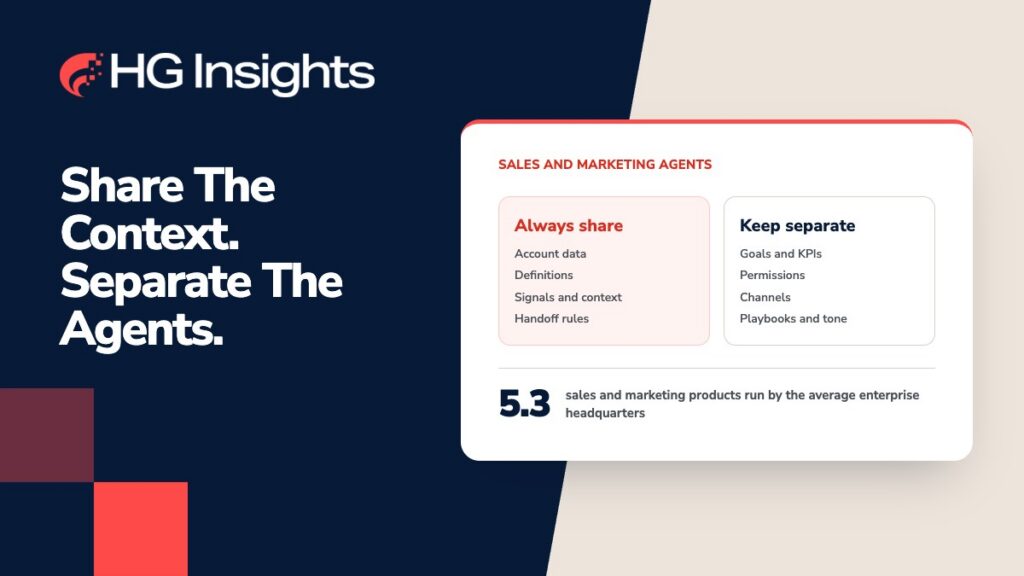
Regardless of how many agents run on top of the context and data layer, Sales and Marketing should always share account data, definitions, context, and handoff rules. Together they make up the foundation that keeps sales and marketing alignment from depending on meetings and good intentions.
Account identity and data
Every agent needs to resolve an account to the right record. HG Fabric is the data and intelligence foundation used for our Contextual Intelligence Platform and all of our tools including HG Agents. Company ID is what is used to determine an account’s identity and then match data like technology installations, spending, intent, contacts, and corporate hierarchies to that account. When agents key off one identifier, a marketing agent and a sales agent are guaranteed to be talking about the same account. That matters because identity gets harder as stacks sprawl. Nearly one in five global headquarters with 1,000+ employees run sales and marketing products from five or more vendors, according to HG Insights Tech Installs data. So ensuring your different agents are working from the same account data is important.
Definitions
A marketing-qualified lead (MQL), an ideal customer profile (ICP) match, and an “engaged” account need one written definition. Agents execute definitions literally. If marketing’s agent uses one threshold and sales’ agent uses another, the disagreement is now automated and runs all day and in every task.
Signals and context
Both teams’ agents should read the same decision-ready signals, the higher-level intelligence computed from connected data to help users and agents identify opportunities and prioritize action.
Handoff rules
The handoff is where sales and marketing alignment succeeds or fails, so the rules need to be explicit and shared. Say a marketing agent detects product-matched intent on an account with a displacement tag, meaning the account is researching a product where a competing product is installed. The rule routes that account to a sales agent with the install context attached. The tag points to a potential opportunity, not a confirmed purchase decision, and the signal attaches to the company, not to an individual researcher. If one agent doesn’t know when to pass signals off or when what signals are appropriate to accept, the handoff process breaks down.
What should stay separate between sales and marketing agents?
Execution is where the two teams legitimately differ. The shared layer answers “what is true about this account.” The execution agents answer “what should this team do about it,” and the answers diverge by design.
Goals and KPIs
A marketing agent optimizes for engagement, pipeline contribution, and campaign return. A sales agent optimizes for meetings booked and deal progression. Give each agent one scorecard. An agent chasing both sets of metrics will trade one against the other in ways nobody chose.
Permissions and channels
Marketing agents typically write to the marketing automation platform and ad audiences. Sales agents write to sequences, tasks, and opportunity records. Separate write permissions limit the damage when an instruction is wrong, and they make audits much simpler.
Playbooks and tone
Nurture copy and a first-touch email to a named buyer follow different rules on volume, personalization, and consent. Keep those playbooks apart, even when the research behind them comes from the same account context.
How do RevOps leaders decide when to share an agent?
Context is always shared, so the real decision is about individual agents. Four tests settle most cases. A task is a candidate for a shared agent only if the answer to all four is yes.
- Do both teams need the same read of the account, with no team-specific interpretation?
- Does the task write to the same records, or to none?
- Do both teams measure the output the same way?
- Can one person be accountable for the agent’s results?
Account research passes. Sales and marketing both want the same brief on a company: what it runs, what it spends, who sits in the buying center. HG Agents such as Account Research Brief or Trigger Analyst can read the shared layer and produce something both teams can use. Outreach does not pass. Sales and marketing measure it differently, write to different systems, and answer to different owners, so the HG Agents Campaign Account Scorer and Outreach Drafter belong in separate lanes.
If a task fails even one test, split the agent and keep the context shared. If an agent keeps failing tests two and three because teams edit it for their own ends, treat that as a sign it was never one agent.
What breaks when sales and marketing agents run on different data?
Mismatched data produces failures that look like execution problems but start in the inputs. Three show up most often.
The first is conflicting priorities. Two agents score the same account differently, and reps ignore both. The second is duplicate or mistimed contact. A campaign agent enrolls a contact in nurture while a sales agent drafts a cold email to the same person, because neither can see the other’s activity. The third is stale context. Enrichment records can go stale, and an agent acts on them at machine speed.
The stack is crowded, which makes mismatch likely. HG Insights data shows the average enterprise headquarters runs 5.3 distinct sales and marketing products, and 12 percent run 10 or more. Every agent inherits a different slice of that stack.
The problem is the inputs: your agents are only as good as the data they run on. Firmographic enrichment is widely available. Technology install and IT spend data adds context that enrichment alone does not, such as which products an account runs and how much IT spend is modeled for them.
Who owns a shared GTM agent, and how do you govern it?
A shared layer without an owner drifts. Governance does not need a committee, but it does need named people and a review rhythm.
Name one accountable owner
RevOps is the natural owner of the shared context layer and any agent that spans teams. The owner controls changes to definitions, scoring logic, and handoff rules. Sales and marketing leaders own their own execution agents but request changes to the shared layer instead of editing it directly.
Set permissions before launch
Decide what each agent can read and write before it runs. Read access to the shared layer can be broad. Write access should be narrow and tied to a single team’s systems. HG Agents returns source-cited outputs, which lets reviewers trace any recommendation back to the data behind it.
Review outputs on a schedule
Sample agent outputs weekly at first, then monthly. Look for disagreements between sales and marketing agents on the same account, since those point to a definition or data gap in the shared layer rather than a flaw in either agent.
How do you roll out a shared agent architecture?
Start small and build outward. Rolling out everything at once recreates the fragmentation the architecture is meant to remove. A sequence that works for most teams looks like this:
- Audit what exists. List every agent already running in sales, marketing, and ops, along with the data each one reads and the systems each one writes to.
- Pick the shared dataset. Choose one verified account record and connect every agent to it, starting with the agents that have the most overlap.
- Write the shared definitions. Agree on the MQL, ICP, and engagement definitions in writing, then encode them once in the shared layer instead of inside each agent’s prompt.
- Define the handoff rules. Specify which signals move an account from a marketing agent to a sales agent, and what context travels with it.
- Assign owners and review dates. Put a name and a calendar date against every agent and every shared rule.
Teams that scope an architecture this way can add agents later without redoing the foundation. RevOps and technical evaluators ready to scope one can start with HG Insights’ GTM Infrastructure for AI Agents.
Frequently Asked Questions
What is a GTM AI agent?
A GTM AI agent is software that completes go-to-market tasks, such as researching accounts, scoring leads, or drafting outreach, with limited human input at each step. It reads data from connected systems, applies instructions, and returns an output or takes an action inside tools like a CRM or marketing platform.
Can sales and marketing use the same AI agent?
They can for tasks where both teams need the same output, measure it the same way, and answer to one owner, such as account research. For execution tasks like outreach or campaign orchestration, separate agents work better. The recommended pattern is shared context with specialized agents on top.
What data should sales and marketing GTM agents share?
They should share account identity, technology and spend data, contact records, signal definitions, scoring logic, and handoff rules. Sharing these keeps both teams’ agents working from the same facts, so an account scored hot by one team is not scored poor by the other.
Who should own shared GTM agents?
Revenue operations should own the shared context layer and any agent that spans teams. RevOps controls definitions, scoring logic, and handoff rules. Sales and marketing leaders own their own execution agents and submit change requests for the shared layer, which prevents either team from quietly rewriting rules the other depends on.
How do shared GTM agents avoid duplicate outreach?
They avoid it by writing activity back to one shared record that every agent reads before acting. If a campaign agent enrolls a contact in nurture, the sales agent sees that status and holds its first-touch email. Clear handoff rules and separate write permissions keep each team’s actions from colliding.
Author
-

Nik Koutsoukos brings over 25 years of product and marketing executive leadership to his role as VP of Product Marketing at HG Insights. He drives product GTM, customer and partner-marketing, and sales enablement to increase awareness, reach, adoption, and growth.
Prior to HG Insights, Nik held senior positions including VP of Product Marketing at SolarWinds, Chief Marketing Officer at Catchpoint, and VP of Product Marketing at Riverbed Technology, where he helped scale adoption of enterprise performance and observability solutions. Nik brings deep expertise in translating complex technology into compelling market value and partner-aligned growth. He holds a BSEE from Leeds Beckett University.