An autonomous sales agent can research accounts, draft outreach, and update records without a rep touching each step. How much autonomy it earns depends on the risk of each action and the quality of the data behind it. Sales ops and RevOps leaders set that boundary. This post sorts agent work into three review tiers, names the guardrails that hold each tier in place, and lays out a staged rollout.
Quick Answer: An autonomous sales agent can run low-risk, reversible work without human review: account research, list building, signal monitoring, CRM hygiene, and first drafts. Actions that reach buyers, change commitments, or touch pricing keep a human approver. Autonomy expands as data quality, audit logs, and measured accuracy support it.
What is an autonomous sales agent?
An autonomous sales agent is software that pursues a sales goal on its own: it interprets a task, pulls the data it needs, takes a sequence of actions, and returns a result without a person directing each step. Typical tasks include researching an account, building a target list, monitoring buying signals, and drafting a first message.
Autonomy is a dial, not a switch. A research agent that summarizes an account for a rep sits at one end. An agent that sends messages, changes CRM fields, and books meetings on its own sits at the other. The practical question for most teams is where on that dial to set each workflow.
For a broader definition of agentic GTM, see HG Insights’ explainer on agentic GTM. The rest of this post stays on the autonomy boundary.
What can an autonomous sales agent do without human review?
An autonomous sales agent can handle account research, list building, signal monitoring, CRM updates, and first-draft content without human review. These tasks are reversible, stay inside the company, and produce outputs a person checks before anything reaches a buyer. Autonomy here saves hours and carries little commercial risk.
Research and account prioritization
Research is the strongest starting point. An agent can assemble technology installs, spend, firmographics, and buying-center contacts for an account, then rank accounts against the ideal customer profile. A wrong summary costs a rep a few minutes, and the rep catches it before acting.
Signal monitoring and routing
Agents can watch for trigger events such as funding, leadership changes, technology adoption shifts, and rising buyer intent, then route the signal to the owning rep with context. The agent flags and explains. A person decides what to do about it.
CRM updates and data hygiene
Deduplicating records, filling missing firmographic fields, and logging activity are well-bounded jobs with clear rules. Limit write access to named fields and keep a change log so any update can be reversed.
First drafts of content
Agents can draft account briefs, call prep, and email copy. The draft is the product. Sending stays behind an approval step until the next sections say otherwise.
Which actions should an autonomous sales agent route to a human for review?
Actions that reach buyers or commit the company belong with a human approver. That covers first-touch outreach to strategic accounts, pricing and discount decisions, contract language, forecast commitments, and any message that makes a claim about product capability or compliance.
Buyers expect this balance. Gartner predicts that by 2030, 75 percent of B2B buyers will prefer sales experiences that prioritize human interaction over AI (Gartner, August 2025). Speed matters early in the buying process. Judgment matters when stakes rise.
Three questions sort most actions quickly:
- Is the action reversible if the agent gets it wrong?
- Does it leave the company, such as a message to a buyer or a record in a customer-facing system?
- Does it carry financial, legal, or relationship exposure?
A yes to the second or third question points to review. A no to the first does too.
Where should the line for human review sit?
The line sits at the point where a wrong action becomes visible to a buyer or expensive to undo. A three-tier model gives RevOps a shared vocabulary for placing each workflow.
Tier | Example actions | Review model |
|---|---|---|
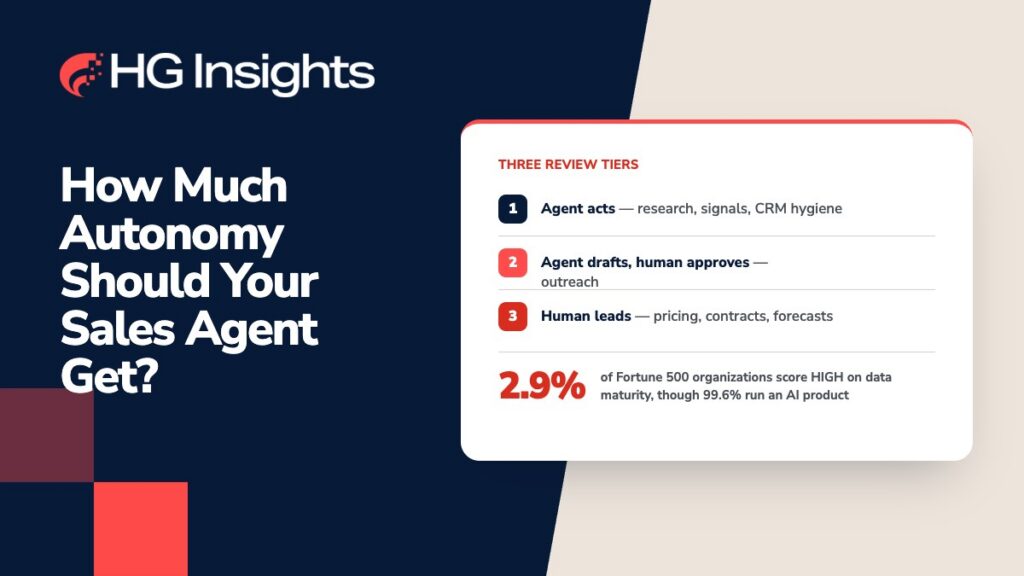
Tier 1: Agent acts | Account research, list building, signal monitoring, CRM hygiene on named fields | No pre-approval. Spot-check outputs weekly. |
Tier 2: Agent drafts, human approves | Outreach to prospects, meeting follow-ups, sequence enrollment, account plan updates | Approval queue. Rep edits or approves before anything sends. |
Tier 3: Human leads, agent assists | Pricing, contract terms, forecast commitments, executive and strategic account outreach | Person owns the decision. Agent supplies research and drafts on request. |
Placement is not permanent. A workflow moves up a tier when its record supports it: a low edit rate in the approval queue, accurate outputs under spot-check, and clean data underneath. A workflow moves down a tier after a visible miss. Treat the tier map as a living RevOps document with an owner and a review date.
What guardrails keep autonomous sales agents safe?
Guardrails turn the tier model into controls the agent cannot talk its way past. Four controls cover most deployments.
Scoped access
Give each agent the least access its workflow needs: read access to the data points it analyzes, write access to defined CRM fields, and send permissions only through an approval queue. Review access on a schedule, the same way a team reviews access for a new hire.
Approval queues for external actions
Every message that reaches a buyer passes through a queue where a rep sees the draft, the account context, and the reason the agent chose it. Approvals and edits become training signal for what the agent gets right.
Source-cited outputs and audit logs
A reviewer can only judge an output they can trace. Agents should return the data points behind each recommendation, and the system should log every action with a timestamp, the inputs used, and the person who approved it. When a result looks wrong, the log shows whether the agent reasoned badly or the data was off.
Rate limits and escalation rules
Cap how many records an agent can change and how many messages it can queue per day. Define what triggers escalation: a low-confidence result, a conflict between data points, or a contact flagged as a strategic account. Limits keep a mistake small while the team finds it.
Governance has a financial case as well. Forrester predicts that B2B companies will lose more than $10 billion in enterprise value because of ungoverned use of generative AI, through stock declines, legal settlements, and fines (Forrester, October 2025). Guardrails are the cheaper path.
Why does data quality decide how much autonomy an agent can have?
Most large enterprises have AI in place, and far fewer have the data foundation to match. HG Insights data shows that 99.6 percent of Fortune 500 organizations in its AI-maturity coverage (480 of 482) run at least one AI product, yet only 2.9 percent (14 organizations) score HIGH on HG Insights’ modeled data maturity measure. Another 42.9 percent score MEDIUM and 53.3 percent score LOW (HG Insights data, October 2026).
An agent can only be as reliable as the data it reads. The advantage was never the agent. When account records are fragmented, incomplete, or stale, an agent makes fast, confident decisions that are wrong, and revenue pays for them: wasted outreach, misdirected territory plans, and false pipeline signals that hurt new business, expansion, and retention alike.
Gartner reaches a similar conclusion. In its November 2025 research on seller productivity, it recommends prioritizing data quality before scaling agents.
How HG Insights’ Contextual Intelligence Platform closes the gap
This is the case for Contextual Intelligence, the complete, connected picture of markets, accounts, and buyers that agents and teams act on. HG Insights delivers it through the Contextual Intelligence Platform (the Platform), which includes Fabric, HG Copilots, HG Agents, and HG MCP Server. In Fabric, a shared Company ID connects technology installs, spend, buyer intent, contacts, and corporate hierarchies, so an agent works from one resolved view of an account instead of several partial ones.
Signal provenance matters too. Active research intent, powered by TrustRadius, is verified first-party intent, reported by buyers researching products on TrustRadius. Product-matched intent is modeled, contextualized against the install base. An agent that treats these as the same signal will weight them wrongly, and a reviewer cannot tell whyAI Scoring, a capability in HG Copilots, supports this with Fit, Need, and Intent models that stay transparent: precision you can trace to the technographic, spend, intent, and firmographic signals behind each priority.
Data confidence is also a practical tier-setting input. A workflow that runs on resolved, current data can move up a tier sooner than one that runs on a raw contact export.
How are autonomous sales agents different from AI copilots and AI SDRs?
A copilot assists a person who stays in control of each step. An agent carries a task through multiple steps on its own. Autonomy is the difference, which is why the review question applies to agents far more than to copilots. For a fuller comparison, read the GTM leader’s guide to AI agents vs AI copilots.
An AI SDR is a narrower product: an agent aimed at one job, prospecting and first-touch outreach. That job sits in Tier 2 in the model above, because every message reaches a buyer. Teams evaluating AI SDRs get more from the approval queue and edit-rate data than from the autonomy claims in a demo.
Volume is rising fast either way. Gartner predicts that by 2028, AI agents will outnumber sellers 10 to 1, yet fewer than 40 percent of sellers will report that agents improved their productivity (Gartner, November 2025). More agents do not produce more output on their own. Scope, data, and review decide that.
How do you roll out agent autonomy in stages?
Roll out autonomy in four stages, and move a workflow forward only when its measurements support it.
Stage 1: Shadow mode
The agent runs in parallel with the existing process and produces outputs nobody acts on. RevOps compares them to what reps and analysts actually did. This stage sets a baseline for accuracy.
Stage 2: Draft and approve
The agent’s outputs reach reps as drafts. Track approval rate, edit rate, and the reasons reps change drafts. The edits show where the agent needs better data or tighter instructions.
Stage 3: Autonomous on Tier 1 work
Workflows with a strong record in stage 2, and reversible actions, run without pre-approval. Spot-check on a schedule and keep the audit log on.
Stage 4: Expand by evidence
Each additional permission needs its own evidence. Promote a workflow when the numbers hold across a full review period, and demote it when they slip. Context wins here as everywhere: the better the data under an agent, the more autonomy it can safely hold.
Teams building governed agent workflows can explore HG MCP Server, which connects HG data and HG Agents such as Account Research Brief, Trigger Analyst, and Campaign Email Drafter to the tools reps already use, with source-cited outputs. HG Superagent interprets a request and coordinates those specialist agents. To see these agents in action, request a live demo.
Frequently Asked Questions
Can AI agents do sales?
AI agents can handle much of the preparation around selling: account research, list building, signal monitoring, record updates, and first drafts. Human sellers still lead discovery, negotiation, and relationship building. Gartner predicts that 75 percent of B2B buyers will prefer sales experiences that prioritize human interaction by 2030.
How much do AI sales agents cost?
Pricing varies by vendor and by what the agent does. Models include per-seat fees, usage-based pricing, and platform bundles. HG Insights prices the Contextual Intelligence Platform on a consumption-based model built around Intelligence Credits. Compare vendors on the cost of each completed workflow, plus the data each agent runs on.
Which AI agent is best for sales?
The best fit depends on the workflow and the data underneath it. Evaluate each agent on source-cited outputs, permission controls, approval queues, and the accuracy of the account, contact, and buying-center data it uses. For a tool-by-tool comparison, see HG Insights’ guide to AI sales tools.
Can autonomous sales agents send emails without approval?
They can, but approval-free sending suits a narrow set of cases: replies within a defined template, follow-ups to existing conversations, and internal notifications. First-touch outreach to new or strategic contacts works best through an approval queue until edit rates and accuracy show the agent is ready for more autonomy.
How should access work for GTM agents?
Grant each agent the least access its workflow needs: read access to the data points it analyzes, write access to defined CRM fields, and send permissions only inside an approval queue. Review access on a schedule, log every action, and expand permissions only when measured accuracy supports the change.
Author
-

Nik Koutsoukos brings over 25 years of product and marketing executive leadership to his role as VP of Product Marketing at HG Insights. He drives product GTM, customer and partner-marketing, and sales enablement to increase awareness, reach, adoption, and growth.
Prior to HG Insights, Nik held senior positions including VP of Product Marketing at SolarWinds, Chief Marketing Officer at Catchpoint, and VP of Product Marketing at Riverbed Technology, where he helped scale adoption of enterprise performance and observability solutions. Nik brings deep expertise in translating complex technology into compelling market value and partner-aligned growth. He holds a BSEE from Leeds Beckett University.