Good news for B2B vendors: incentivized reviews are still allowed under the FTC’s review rule. Since October 21, 2024, 16 CFR Part 465 has set one clear boundary, which is that an incentive can’t depend on what a review says. Stay on the right side of that line and your review program is on solid ground.
Quick Answer: Incentives for reviews are legal under the FTC’s Consumer Reviews and Testimonials Rule when the reward is not conditioned, expressly or by implication, on a positive or negative sentiment. Disclose incentives and invite a representative sample of customers.
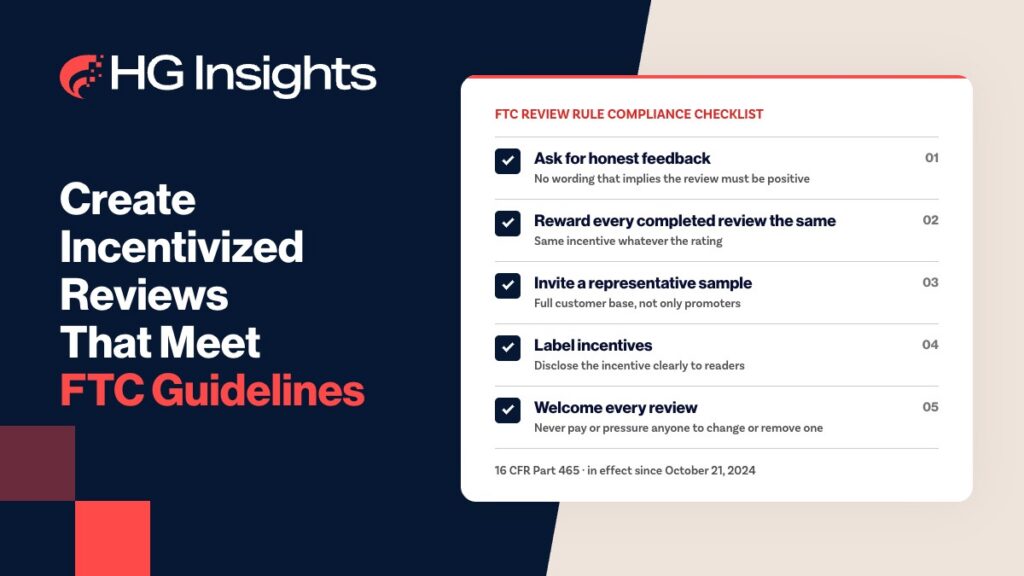
Five steps to stay within the FTC guidelines
- Ask for honest feedback. Write invitations that request an honest review. Skip phrases like “tell us how much you love us,” which can imply the review has to be positive.
- Reward every completed review the same way. Offer the same incentive to every invited user who finishes a review, whatever the rating.
- Invite a representative sample. Build invite lists from your full customer base or a random sample, not only promoters or your healthiest accounts.
- Label incentives. Make sure the incentive is clearly disclosed to readers. Review platforms like TrustRadius add an “incentivized” badge automatically.
- Welcome every review. Respond to critical reviews, and never pay or pressure anyone to change or remove one.
Most teams can put all five in place within a quarter. Marketing owns the invitation copy, customer success owns the invite list, and someone in legal or compliance owns the written policy. Include any agency partners, since the FTC says agencies and reputation management firms working on your behalf are covered by the rule too.
What the rule says, in plain terms
Section 465.4 bars paying for reviews that express a particular sentiment, whether the condition is stated or implied. The FTC’s example of an implied condition is “Tell us how much you loved your visit and get a $5 coupon.” Neutral wording such as “write a review and save 10% next time” is fine. The rule applies on third-party platforms as well as your own site, and a disclosure doesn’t cure a sentiment condition.
Two related points. Once you incentivize a review, the FTC treats it as a testimonial, so it must reflect the reviewer’s real experience. And while the rule doesn’t specifically ban inviting only happy customers, the FTC says that practice could still violate the FTC Act. A representative sample avoids the question.
Why representative sourcing wins
In B2B, few people write detailed software reviews unprompted, so unincentivized programs skew toward the most delighted and most frustrated users. A small incentive offered to everyone widens participation and produces more detailed reviews, which is what buyers want.
It also protects credibility.
Are incentivized reviews legal under FTC rules?
Yes. Incentivized reviews are legal under the FTC’s Consumer Reviews and Testimonials Rule when the incentive is not conditioned, expressly or by implication, on the review being positive or negative. Businesses should also disclose the incentive clearly, because an undisclosed incentive can violate the FTC Act separately.
The FTC guidance reviewed for this post doesn’t address B2B software reviews directly, but the standards it sets are the ones that earn buyer trust in any market. Following the rule is the smart default, and legal counsel can confirm how it applies to your program.
Put it into practice with TrustRadius
TrustRadius, an HG Insights company, built its review process around these principles before the rule existed. Every incentivized review carries a badge, reviewers confirm their incentive didn’t depend on their score or wording, and the trScore algorithm weights representative samples and recent reviews more heavily, so cherry-picking doesn’t inflate a score. The Trusted Seller program (originally called TRUE) recognizes vendors that invite all of their customers to review. Claim your TrustRadius profile to start sourcing reviews the right way.
For more detail, read TrustRadius’s breakdown of the final rule.
This post is general information and not legal advice. Talk with qualified counsel about your review program.
Frequently Asked Questions
Can companies pay for reviews under FTC rules?
Yes, with limits. The FTC’s rule does not ban incentives for reviews. It bans incentives conditioned, expressly or by implication, on a positive or negative sentiment. A company can reward honest reviews of any rating, but it cannot pay only for five-star reviews, even if it asks reviewers to disclose the payment.
Do incentivized reviews have to be disclosed?
Yes. The FTC’s staff guidance says failing to disclose incentives could violate the FTC Act, and the Endorsement Guides require disclosure of material connections between a business and a reviewer. Many B2B review platforms label incentivized reviews automatically so readers can see the incentive.
Is it illegal to ask only happy customers for reviews?
The rule does not specifically prohibit it, but the FTC says the practice could violate the FTC Act under its Endorsement Guides. The safer approach is to invite a representative sample of customers and apply the same incentive regardless of the rating.
Author
-

Grace Wells is a seasoned marketing strategist with over a decade of experience leading marketing efforts for diverse brands. She is passionate about helping clients achieve their marketing, branding, and ROI goals through thoughtful 360 degree approach to campaign execution. Grace is a tech nerd and loves nothing more than reading up on the latest marketing technology trends. She enjoys advising her clients and customers on which tools will help move the needle for their business.