
Search HGInsights

HG Insights launches GEO monitoring dashboard for AI visibility: how to track what AI engines say about your brand

Most B2B vendors know that AI is changing how buyers find software. Seventy-three percent of vendors report that AI has had a positive impact on brand discoverability, according to the 2026 B2B Buying Disconnect report. But almost none of them can measure that impact, verify what AI engines actually say about their products, or identify the prompts where their brand is completely absent.

Today, HG Insights announced the industry’s first GEO-powered software review platform, evolving TrustRadius into HG Customer Voice, a full buyer intelligence platform. It closes that gap with three things working together: a GEO Monitoring Dashboard that tracks AI crawler activity and actual AI citations across major engines, HG Insights technographic data embedded directly on TrustRadius product pages, and GEO Optimization Services for vendors who want hands-on help acting on what the dashboard shows them.

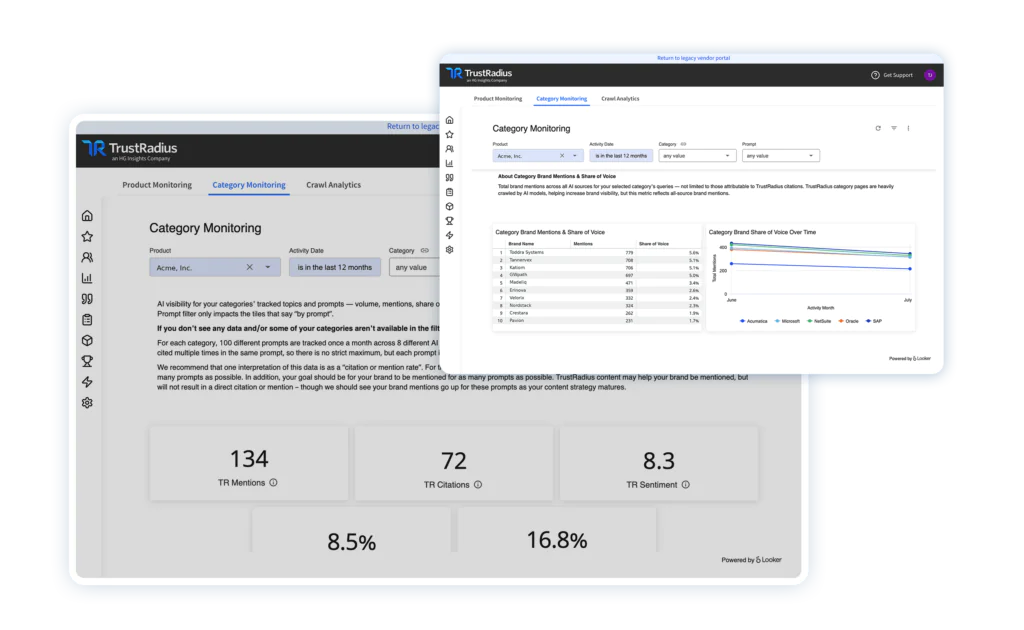
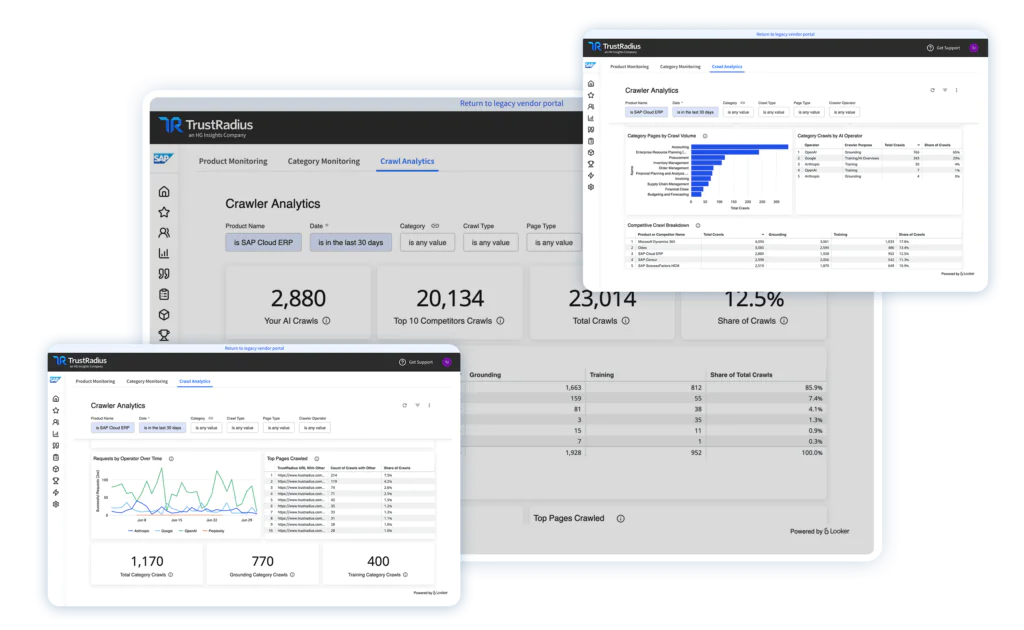
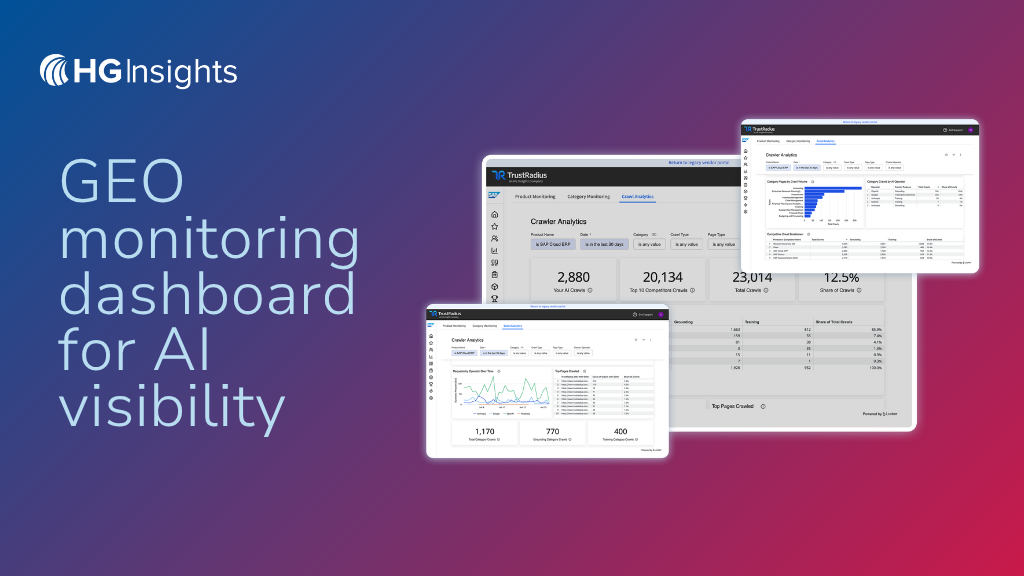
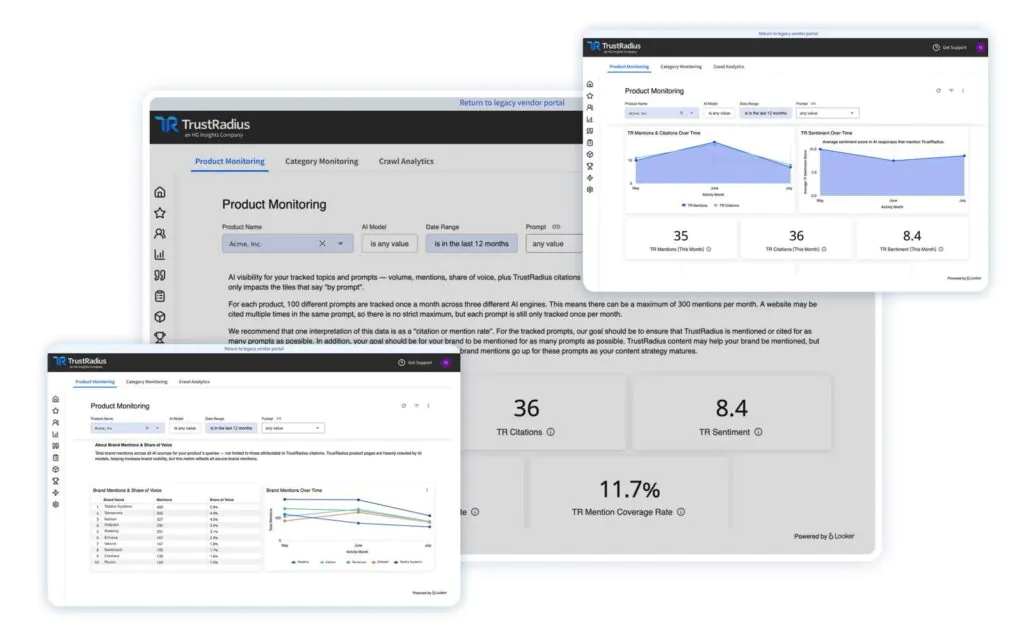
The HG Insights GEO Monitoring Dashboard, powered by TrustRadius and built in partnership with Conductor, gives every Customer Voice Package (CVP) subscriber three views: Product Monitoring (mentions, citations, and sentiment versus named competitors), Category Monitoring (brand visibility across the full buying category), and Crawler Analytics (which AI engines are reading your content, and how often). What makes the underlying content citable in the first place is HG Insights’ technographic data, embedded on every TrustRadius product page, showing real install data no other review platform has. For vendors who want a team to act on the gaps the dashboard surfaces, GEO Optimization Services are available through CVP Premium.

The AI visibility gap most vendors cannot see

Here is the uncomfortable math. Sixty-three percent of B2B buyers used AI tools during their most recent purchase, and 83 percent shortlisted three products or fewer before ever picking up the phone. AI tools and AI search are the only buyer resources growing in usage year over year, while analyst reports have dropped to 13 percent usage, a 63 percent decline since 2022. Buyers are moving. The channels where they form opinions are shifting underneath B2B marketing teams in real time.

Yet most vendors have no way to measure their AI visibility. They cannot answer basic questions: Does ChatGPT recommend our product when a buyer asks about our category? Does Google AI Overviews frame our solution positively, or mention a competitor instead? Which AI engines are even crawling our review pages in the first place?

Seventy-six percent of vendors believe their website content trains AI models, and 49 percent believe user reviews do. Those beliefs may be correct, but believing is different from knowing. Without monitoring, vendors are guessing about a channel that is rapidly replacing the ones they spent years optimizing.

The problem compounds because AI engines do not all behave the same way. ChatGPT might cite your product favorably while Perplexity omits it entirely. Google AI Overviews might surface a competitor’s positioning while Claude references your review content instead. Each engine has its own training data, its own recency bias, its own citation patterns. A single “AI strategy” that ignores these differences is flying blind across multiple cockpits at once.

Why AI engines trust TrustRadius content more than any other platform

Monitoring only matters if there is something worth monitoring. This is where being part of HG Insights changes the equation for TrustRadius.

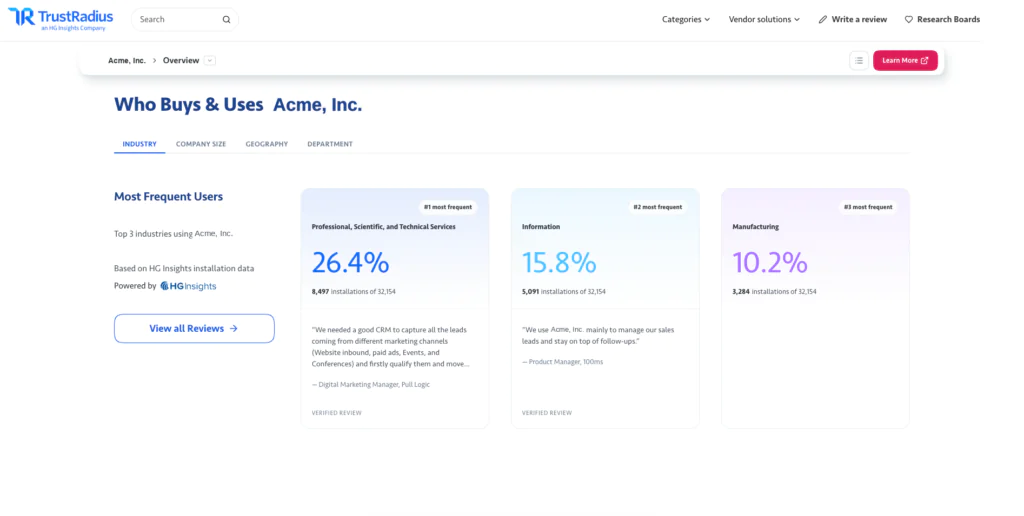
TrustRadius product pages now carry something no other review platform can offer: HG Insights’ technographic data, embedded directly where buyers and AI engines do their reading. That means real-world install data, which industries run a product, which departments use it, at what company sizes, and in which regions, drawn from HG’s coverage of millions of products across hundreds of thousands of vendors. Paired with TrustRadius reviews, which average 400 words and are 100 percent verified, it is a combination of depth and structured, proprietary data that AI engines cannot get anywhere else.
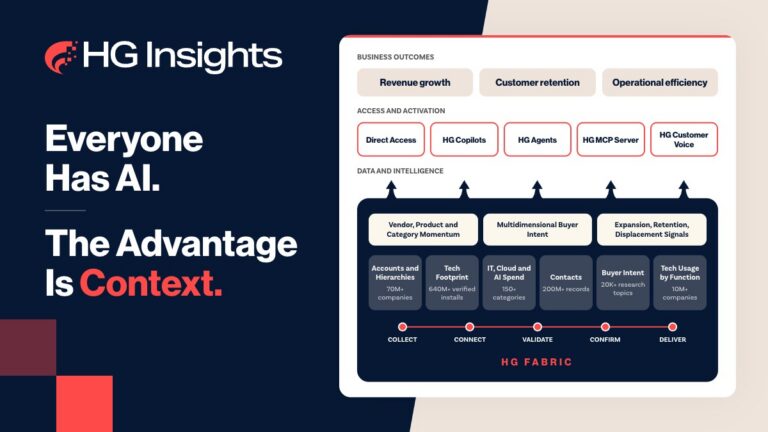
“AI has changed who answers a buyer’s first question,” said Rohini Kasturi, CEO of HG Insights. “It used to be a salesperson or a search result. Today it’s an AI engine, answering with whatever content it trusts most. Our pages now answer the question every buyer asks, ‘do companies like mine actually use this?’, with real install data no other platform has. And the integration runs both ways: TrustRadius buyer intent signals flow back into HG’s Revenue Growth Intelligence Fabric. No other company can connect what buyers research, what companies actually run, and what AI tells the market.”

The scale backs this up. TrustRadius receives approximately 60 million annualized crawls from major AI engines each year, and roughly half of those are grounding crawls, meaning an AI engine is pulling a page in real time to answer a live buyer question, not just training a model for later. That is closer to 30 million buyer questions a year where TrustRadius content has a direct shot at shaping the answer.

How GEO monitoring works in practice

Generative Engine Optimization, or GEO, is the practice of structuring content so AI answer engines surface it in their responses. Where traditional SEO optimizes for search engine rankings, GEO optimizes for AI citations. The GEO Monitoring Dashboard makes this measurable across three views, and all three are included with every Customer Voice Package subscription at no additional cost.

Product Monitoring shows how your product is discussed

Product Monitoring tracks how a vendor’s product is mentioned, cited, and characterized across AI-generated answers, with per-prompt competitive breakdowns showing exactly which buyer questions competitors are winning. It surfaces TrustRadius mentions, citations, and sentiment over time, and prompt-level data shows the specific questions buyers are asking when AI tools retrieve TrustRadius content, so nothing here is a black box. If sentiment starts slipping, this is where you see it first, before it shows up in a lost deal.

Category Monitoring widens the lens

Category Monitoring pulls back from a single product to the full buying category, surfacing emerging competitors and measuring brand visibility across the top-of-funnel AI queries buyers ask before they have narrowed down a shortlist. This is where a vendor sees not just how they are doing, but who else is entering the conversation.

Crawler Analytics shows who’s reading you, before they answer

Crawler Analytics shows which AI engines are actually reading your content, how often, and whether the activity is training crawls (building a model’s long-term knowledge) or grounding crawls (retrieving a page right now to answer a live buyer question). This matters because crawl activity is the leading indicator of AI visibility. If an engine is not crawling your review content, it cannot cite it. A drop in crawl frequency is often the first sign a brand is about to fade out of AI recommendations, often weeks before it would show up any other way.

Standard engine coverage across all three views includes Google AI Overviews, Google AI Mode, and ChatGPT. Additional coverage, including Claude, Perplexity, Microsoft Copilot, Gemini, and ChatGPT Search, is available as an add-on for vendors who want the full picture across every major engine.

GEO Optimization Services: turning visibility into action

Monitoring tells you where the gaps are. It does not close them on its own. That is what GEO Optimization Services, available through CVP Premium, are built to do.

This is hands-on work with HG’s experts to align a vendor’s review content and prompt strategies with their specific go-to-market goals, so the content AI engines crawl is tuned to both the questions buyers are actually asking and the vendor’s own priorities. Instead of guessing which review questions to add or which product pages need attention, vendors get a team helping decide, informed by what the dashboard is already showing them.

The four-step GEO cycle

Monitoring alone is not optimization. The GEO Monitoring Dashboard is designed around a repeating four-step cycle that connects data to action.

  • Align is where teams define which products, campaigns, and KPIs matter most for AI visibility. Not every product page needs the same level of GEO attention. This step forces prioritization.
  • Benchmark runs prompts across AI engines and establishes a baseline. Where does the brand appear today? Where is it absent? How does sentiment compare across engines? Without a benchmark, improvement is unmeasurable.
  • Optimize is where the work happens. TrustRadius Review Insights, HG Insights technographic data enrichment, and GEO Optimization Services feed the engines with structured, citation-worthy material. The goal is not to game AI responses. It is to give engines accurate, current, well-structured content, backed by data no one else has, that they can confidently surface.
  • Validate closes the loop. Dashboard updates show whether optimization efforts moved the needle on Share of Voice, sentiment, or gap coverage. If they did not, the cycle repeats with adjusted tactics.


This is not a one-time audit. AI engines update continuously. Competitor content changes. Buyer prompts evolve. The cycle runs indefinitely because the channel demands it.

Why GEO monitoring matters across the GTM organization

Marketing teams are the obvious beneficiaries, but the GEO Monitoring Dashboard serves multiple functions.

For demand generation leaders, the dashboard answers a question that has been unanswerable until now: how much of our pipeline originates from AI-influenced research? With 63 percent of buyers using AI in their buying process, demand gen teams need to understand whether their brand appears in the AI-mediated discovery phase or gets filtered out before a buyer ever visits a website. Category Monitoring and content gap data feed directly into content strategy, showing exactly which topics need new or updated material to earn AI citations.

Product marketing teams gain competitive intelligence at a scale manual monitoring cannot match. Sentiment analysis across engines reveals how AI positions a product against competitors, often surfacing framing problems that would take months to discover through win-loss interviews or analyst feedback. When 94 percent of buyers fact-check AI recommendations, the content those AI answers point to becomes a product marketing priority, and it is exactly the content HG’s technographic data and GEO Optimization Services are built to strengthen.

Sales enablement benefits indirectly but meaningfully. Seventy-nine percent of buyers had heard of the product they ultimately purchased before starting formal research. Brand awareness still matters, and AI engines are now a primary channel for building it. When a sales rep reaches a prospect who has already seen the product recommended by ChatGPT or Google AI Overviews, the conversation starts from a different position than when the prospect has never encountered the brand.

What is a GEO monitoring dashboard

A GEO monitoring dashboard is a measurement tool that tracks how generative AI engines represent a brand, product, or company in their responses to user prompts. It monitors AI citations, analyzes sentiment across multiple AI platforms, measures share of voice against competitors, and identifies content gaps where a brand is absent from AI-generated recommendations. It is the AI-era equivalent of rank tracking for traditional search.

The concept emerged because traditional SEO tools cannot measure AI visibility. Google Search Console shows organic rankings. Analytics platforms show website traffic. Neither one shows whether ChatGPT mentions your product when a buyer asks “What is the best CRM for mid-market companies?” GEO monitoring fills that gap by systematically querying AI engines and analyzing their responses over time.

Track and improve AI brand visibility with HG Insights

The GEO Monitoring Dashboard is available now through HG Customer Voice, and it ships with every Customer Voice Package subscription at no additional cost. Layered underneath it is technographic data no other review platform has, real install data by industry, department, company size, and region, embedded directly on TrustRadius product pages. For vendors ready to act on what the dashboard shows them, GEO Optimization Services are available through CVP Premium.

For B2B vendors operating in categories where AI-influenced buying decisions are accelerating, the question is not whether to monitor AI visibility. The question is how long a team can afford to optimize for a channel it cannot see. Review content on TrustRadius already feeds AI engines. The GEO Monitoring Dashboard shows exactly how that content is being used, where it is working, and where it is not.

Read the full press release on the HG Customer Voice launch, or request a strategy call to see how AI engines currently represent your brand today.

Frequently asked questions

What is Generative Engine Optimization (GEO)?

Generative Engine Optimization is the practice of structuring and optimizing content so AI answer engines surface it in their responses to user queries. Unlike traditional SEO, which targets search engine rankings, GEO targets AI citations. It involves creating well-structured, factually rich content that AI models can confidently reference when generating answers about a product category or vendor.

Traditional SEO tools track keyword rankings, organic traffic, and backlink profiles on search engines like Google. The GEO Monitoring Dashboard tracks AI-specific metrics: which AI engines cite your brand, how frequently they mention you versus competitors, what sentiment they attach to your product, and which buyer prompts return no mention of your brand at all. These are distinct channels with distinct optimization requirements.

Standard coverage includes Google AI Overviews, Google AI Mode, and ChatGPT, included with every Customer Voice Package subscription. Additional engine coverage, including Claude, Perplexity, Microsoft Copilot, Gemini, and ChatGPT Search, is available as an add-on for vendors who want visibility across every major engine.

Yes. Product Monitoring, Category Monitoring, and Crawler Analytics are all included with every Customer Voice Package (CVP) subscription at no additional cost. GEO Optimization Services, the hands-on layer where HG’s experts help close the gaps the dashboard surfaces, are available as part of CVP Premium.

HG Insights embeds technographic data, real install data by industry, department, company size, and region, directly on TrustRadius product pages. Combined with TrustRadius reviews, which average 400 words and are 100 percent verified, it gives AI engines the depth and specificity they need to cite a source with confidence. No other review platform pairs verified peer feedback with this kind of structured market data.

GEO Optimization Services are a CVP Premium offering where HG’s team works directly with a vendor to align review content and prompt strategies with their go-to-market goals. Rather than relying on the dashboard alone, vendors get hands-on help deciding what content to build or update so AI engines have the best possible material to cite.

Author

  • Grace Wells is a seasoned marketing strategist with over a decade of experience leading marketing efforts for diverse brands. She is passionate about helping clients achieve their marketing, branding, and ROI goals through thoughtful 360 degree approach to campaign execution. Grace is a tech nerd and loves nothing more than reading up on the latest marketing technology trends. She enjoys advising her clients and customers on which tools will help move the needle for their business.