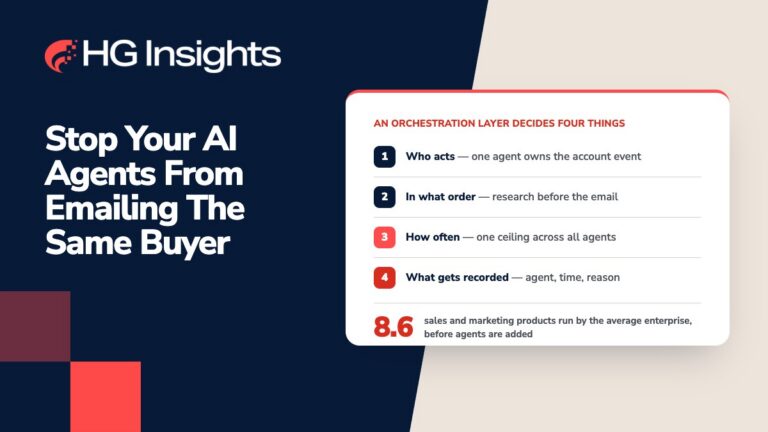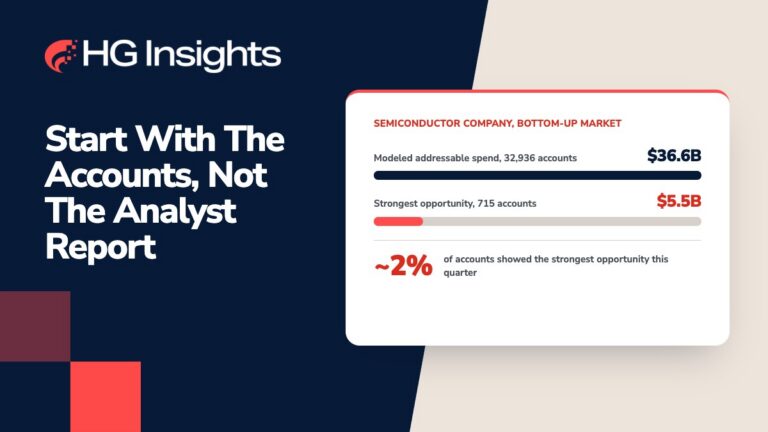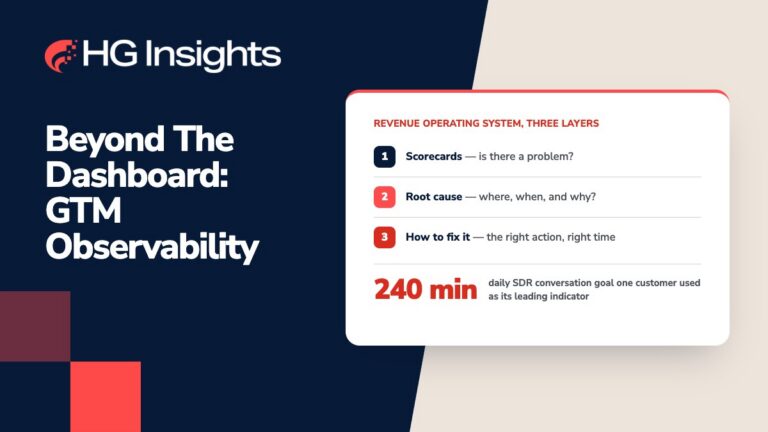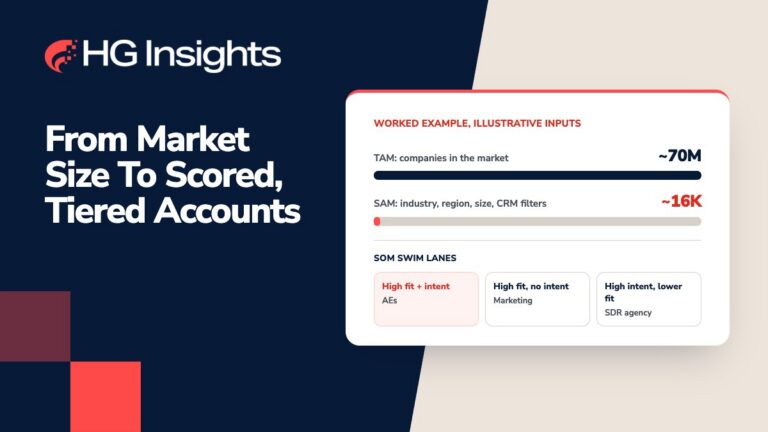
Signal-based outreach starts with a buyer event instead of a list. A competitor install nears renewal, a new revenue leader arrives, or an account’s research activity jumps, and that event decides who gets contacted, when, and with what message. The same events support winning new accounts and growing existing ones. AI agents now do much of the watching and drafting. This guide covers how the workflow runs, which signals matter, and what data the agents need to get the account right.
Quick Answer: Signal-based outreach is a B2B prospecting method that contacts accounts because of an observed buying signal, such as a new technology install, a research spike, or a hiring surge, rather than because they appear on a static list. The signal decides who gets contacted, when, and what the message says.
What is signal-based outreach?
Signal-based outreach is the execution layer of signal-based selling. Where signal-based selling decides which accounts deserve attention, outreach covers the first touch: the sequence, the message, and the timing. Every step traces to a specific, recent buyer event instead of a persona list and a template.
Where outreach fits in signal-based selling
Prioritization answers “who.” Outreach answers “who, when, and what do we say.” HG Insights covers the prioritization layer in its signal-based account prioritization use case and in 5 signal-based selling tactics that beat cold calling. This post picks up at the moment a ranked account needs a message.
What the performance data says
Cold email reply rates average 3.43 percent, according to Instantly’s 2026 Cold Email Benchmark Report, which analyzed campaigns run through December 2025. MarketBetter’s meta-analysis of more than 20 studies reports that signal-based campaigns referencing specific triggers reach 15 to 25 percent. Treat that second range as directional, since it comes from vendor and practitioner reporting, not an independent study.
A trigger alone does not make outreach good. A “congrats on the funding” message sent to every account that raised money is technically signal-based and adds no relevance. The signal earns the touch. The message still has to earn the reply.
Which signals trigger outreach: install changes, intent, hiring, and engagement
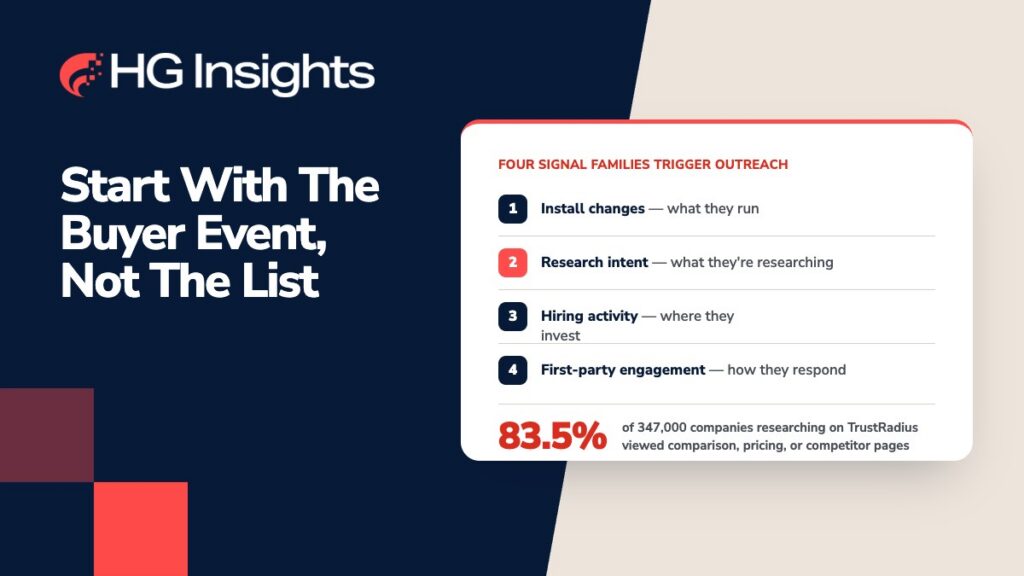
Four signal families trigger outreach: technology install changes, research intent, hiring activity, and first-party engagement. Install changes show what an account runs, intent shows what it is researching, hiring shows where it is investing, and engagement shows how it responds to your brand. Stacked together, they predict readiness better than any one alone.
Install changes show what an account runs
A new install, a dropped product, or a competitor’s product approaching renewal each suggests a different conversation. HG Insights tracks more than 648 million verified technology installs across more than 70,000 products, as described in its signal-based selling tactics guide, which is the raw material for these triggers. According to HG Insights, across the 37 million accounts scored for Momentum, 18 percent are actively growing their technology footprint and 17 percent are shrinking, so a technology-change trigger has something to act on in both directions.
Competitive displacement is the most specific use. MarketBetter’s displacement playbook sets alerts at 120, 90, and 60 days before an estimated renewal and treats the 90-day mark as the primary outreach window. It reports win rates of up to 35 percent on displacement opportunities with proper targeting, against 19 percent for net-new prospects. The same playbook treats new executive hires as a trigger, because new sales and RevOps leaders evaluate the existing stack within their first 90 days.
Intent shows what an account is researching
HG Buyer Intent covers two types, and the type changes how a rep should read the signal. Product-matched intent connects web research signals with an account’s detected product installations and deployment history, then tags the context: whitespace, expansion, displacement, or complementary. Active research intent, powered by TrustRadius, captures signals from buyer research activity on TrustRadius, attributed to the buyer’s company. Of 347,000 companies with research activity on TrustRadius in the past 90 days, 83.5 percent viewed comparison, pricing, or competitor pages, according to HG Insights data. That is evaluation-style research, attributed at the company level.
The tags cover both growth directions. Expansion means an account is researching a product from a vendor it already uses, which is a retention and growth conversation. Whitespace and displacement are new-business conversations. Either way, the tags indicate potential opportunities, not confirmed purchase decisions.
Both types are associated with companies, not individual researchers. That shapes the message. A rep can say an account appears to be evaluating a category. A rep should not write as though a named person was watched. For the provider side, see best buyer intent data providers and how to accelerate deals with technographic intent triggers.
Hiring and engagement show direction and response
A burst of DevOps postings or a new RevOps leader points to budget and priorities before any research behavior appears. First-party engagement (pricing page visits, webinar attendance, content downloads, email clicks) shows how an account already relates to you, and it fades fastest. FL0’s B2B revenue signal taxonomy treats latency as a core property of any signal: a high-intent signal that reaches sales 48 hours late is worth a small fraction of one that arrives in minutes.
How do AI agents turn signals into outreach actions?
AI agents monitor connected data daily, detect signal changes, score the accounts affected, and assemble the context a rep needs: which signal fired, why it matters, and which sequence fits. A rep reviews and decides whether to act. Agents handle the watching and drafting. People handle judgment and the conversation.
That division is the design. Fully autonomous AI SDRs have a poor record: MarketBetter’s meta-analysis of more than 20 studies reports AI SDRs converting meetings to opportunities at 15 percent versus 25 percent for human reps, with annual churn of 50 to 70 percent for the tools. The model producing revenue is the copilot model, where agents do research and first drafts and humans send.
Which HG Insights products run the workflow
The Contextual Intelligence Platform includes Sales Copilot, part of HG Copilots, and HG Agents, which are pre-built agents that automate GTM workflows and return source-cited outputs. The launch library includes Trigger Analyst, Account Research Brief, and Outreach Drafter, which map to the interpret, research, and draft steps of this workflow. HG Superagent interprets a request and coordinates the specialist agents, so a rep asks one question and gets one answer.
How Sales Copilot puts the output where reps work
Sales Copilot sends signal-triggered alerts when an account’s signals change, ties signal-based playbooks to sequences in Outreach, Salesloft, or Gong, and lets reps activate recommended contacts into Salesforce, Gong, Outreach, Salesloft, or HubSpot without leaving Sales Copilot. To see how it connects to the ranking layer, read the signal-based account prioritization use case.
Three questions sit under any outreach decision: which account first, when to reach out, and why this message. The next two sections answer them.
What does an agent-driven signal-based outreach workflow look like step by step?
An agent-driven workflow has four steps: connect CRM and engagement data, let agents rank accounts daily, have sellers act on a ranked list with the reason attached, and let admins tune signal weights. Each step has an owner, which keeps the workflow auditable and keeps humans in control of what gets sent.
Step 1: Connect your CRM and engagement data
An admin connects the CRM (Salesforce or HubSpot) to import accounts and rep ownership, then adds first-party data such as website activity, content downloads, and webinar attendance through marketing automation and analytics integrations. Accounts are enriched with firmographics, technology installs, and signals like job openings and job changes.
Step 2: Agents evaluate and rank every account daily
The platform aggregates connected data and checks each account every day for signal changes. An agent scores and ranks accounts based on multi-signal analysis, weighting each signal by how well it predicts conversion. Accounts move up or down the list as signals appear and fade.
Step 3: Sellers act on a ranked list with the why
Reps open an AI-sorted list each morning. Each account shows its reason: viewed pricing, started hiring for DevOps, installed a new technology. With that context, the rep enrolls the account in the recommended sequence, with messaging tailored to the signal, through the sales engagement tool already in use.
Step 4: Admins tune the weights
Ops and sales leadership can adjust which signals matter most and override the AI prioritization as strategy shifts. Demo requests, install changes, and hiring surges each get a weight they can change without engineering help. Rep activity and sequence results then feed back into the scoring model.
How do you rank and weight signals so reps contact the right accounts first?
Rank by combining three questions: does the account fit your ICP, does it show need, and is the signal recent? Weight signals by how well they predicted past conversions, and let them decay as they age. Fresh, stacked signals on a high-fit account outrank a single stale signal on a loose-fit account.
Combine fit, need, and recency
Those questions map to the dimensions of AI Scoring, a capability in HG Copilots: Fit, Need, and Intent. AI Scoring is a white-box model, so a rep can see why an account ranks where it does and an admin can adjust the weights. A ranking people can inspect is easier to trust and act on.
Stack signals before you prioritize
Individual signals are noisy. A competitor install nearing renewal means little by itself. Add product-matched intent on a replacement category and a new revenue leader, and the account has three independent reasons to be in conversation now. Forrester’s analyst Jessie Johnson argues that B2B teams should move beyond the marketing-qualified lead as the only indicator of propensity to buy, and Forrester’s report The Seven Signal Sets That Power B2B Customer Obsession catalogs the signal types. It works as a checklist for what to include in the weighting model, though no framework replaces tuning against your own closed deals.
Let timing and personalization follow the ranking
Timing comes from decay: contact fast on behavioral signals, and plan a longer sequence on structural ones like install changes. Personalization comes from the signal’s meaning, not its raw behavior. A message should name the business problem the signal suggests. It should not recite what an account did on a website.
Signal-based outreach vs. cold outreach: what changes for reps and RevOps
Cold outreach starts with a list and a template, then hopes timing works out. Signal-based outreach starts with an event and builds the list, the message, and the timing around it. For reps, the day starts from a ranked list with reasons. For RevOps, the work shifts to maintaining data quality and signal weights.
Dimension | Cold outreach | Signal-based outreach |
|---|---|---|
Starting point | Static list or persona | Observed buyer event |
Timing | Cadence-driven | Signal-driven |
Message | Template with merge fields | Tied to the signal’s meaning |
Rep workflow | Build and work a list | Work a ranked list with reasons |
RevOps role | Sequence hygiene | Data quality, signal weights, feedback loop |
Adoption decides whether any of this works, and SDR and BDR leadership and enablement belong in the conversation from day one. They determine whether a ranked list gets worked. In Salesforce’s 2026 State of Sales survey of 4,050 sales professionals, 51 percent of sales leaders with AI said disconnected systems were slowing their AI initiatives.
MarketBetter’s meta-analysis adds that the average SDR uses 7 to 12 tools while the best teams run 3 to 4 integrated ones. A signal program that adds another tab competes with all of them for attention.
What data foundation do agents need to act on signals reliably?
Agents need connected, current, entity-resolved data: firmographics, technology installs, spend, buying centers, intent, and verified contacts, all tied to one company identifier. Without that foundation, agents act on fragments, mismatch signals to the wrong account, and produce outreach that sounds confident and is wrong.
HG Fabric connects the data points
HG Fabric is that foundation. Its categories include Firmographics, Tech Installs, IT Spend, Cloud Spend, AI Spend, Buying Centers, Org Hierarchies, HG Buyer Intent, and Verified Contacts. Company ID is the shared identifier that connects installations, spending, intent, contacts, and corporate hierarchies, so a signal lands on the right account. Functional Area Intelligence (FAI) identifies which department owns a technology, which tells a rep who to approach.
Decision-ready signals give agents interpreted inputs
Decision-Ready Signals are computed in the HG Fabric from connected data, and they include product-matched intent and Momentum, which combines a product’s current footprint with its adoption trend. HG Fabric combines and interprets connected data to reveal decision-ready signals, so agents start from interpreted signals instead of raw rows.
HG MCP Server and delivery options
Agents reach this data through HG MCP Server, which offers MCP Tools for data, MCP Prompts for curated workflows, and MCP Resources for reference data. Teams building their own agents in MCP-compatible environments work from the same intelligence HG Agents use. Fabric can also be licensed on its own and delivered by API or Direct Feed for teams that want the data inside their warehouse or CRM first.
How do you measure whether signal-based outreach is working?
Measure by signal type, not by channel. Track time from signal to first touch, reply and meeting rates for each signal, pipeline created per signal type, and rep adoption of the ranked list. Then feed results back into the weights. Email opens say little about whether signals predict buying.
Four numbers give a useful starting view:
- Signal-to-touch time. A good signal with a slow response is wasted.
- Reply and meeting rate per signal type. Blended averages hide which signals earn their weight.
- Pipeline created and won per signal type. Count new-business and expansion pipeline separately.
- Ranked-list usage by rep. It exposes adoption problems before they show up as pipeline problems.
If install changes convert better than hiring signals in your pipeline, the weights should say so. If a signal fires often and never produces a meeting, cut it.
The same Salesforce State of Sales survey found top performers are 1.7 times more likely than underperformers to use AI agents for prospecting. Agents only help when their output is measured, so review which signals preceded closed deals and adjust.
For readers weighing how far to trust signal-driven prioritization, HG Insights’ white paper The Trust Gap in Signal-Based Selling covers what makes reps believe the ranking. When the next step is a working version, see how Sales Copilot turns signals into ranked accounts and ready-to-review outreach.
Frequently Asked Questions
What is the difference between signal-based outreach and signal-based selling?
Signal-based selling is the full motion: collecting signals, scoring accounts, prioritizing the list, and engaging buyers. Signal-based outreach is the engagement step inside it, covering the sequence, message, and timing of the first touch. Teams usually build prioritization first, then add agent-driven outreach once reps trust the ranked list.
Does signal-based outreach replace SDRs?
No. Agents handle signal monitoring, account research, and first drafts, while SDRs handle judgment, approvals, and live conversations. A 2026 MarketBetter analysis of more than 20 studies reported AI SDRs converting meetings to opportunities at 15 percent versus 25 percent for human reps, which is why human-in-the-loop models dominate.
How quickly should reps act on a buying signal?
As quickly as the signal’s shelf life allows. Behavioral signals such as pricing page visits are time-sensitive, so alerts should reach reps in Slack or email the same day. Slower-moving signals, such as install changes ahead of a renewal, support a planned sequence over weeks, with alerts at 120, 90, and 60 days before renewal.
Which signals are best for starting outreach?
No single signal wins. Stacked signals perform best, such as a competitor install nearing renewal plus product-matched intent on a replacement, or a new revenue leader plus rising research activity. Individual signals are noisy. Combinations on a high-fit account give reps a credible reason to reach out now.
Author
-

Nik Koutsoukos brings over 25 years of product and marketing executive leadership to his role as VP of Product Marketing at HG Insights. He drives product GTM, customer and partner-marketing, and sales enablement to increase awareness, reach, adoption, and growth.
Prior to HG Insights, Nik held senior positions including VP of Product Marketing at SolarWinds, Chief Marketing Officer at Catchpoint, and VP of Product Marketing at Riverbed Technology, where he helped scale adoption of enterprise performance and observability solutions. Nik brings deep expertise in translating complex technology into compelling market value and partner-aligned growth. He holds a BSEE from Leeds Beckett University.