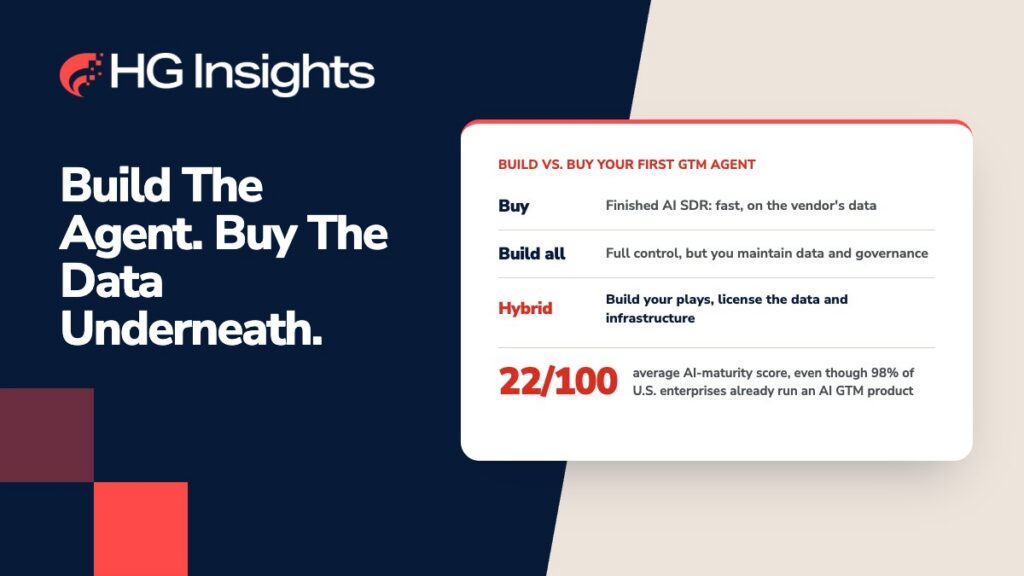
Build vs buy AI agents is the first real decision a GTM team faces once leadership asks for an AI SDR. Buying a finished tool is quick, but it locks in the vendor’s data and messaging. Building everything yourself means maintaining data, access, and governance that were never your core work. This post shows where the line sits: what to build, what to buy, and which guardrails to set before an agent contacts a prospect, so your team can win, expand, and retain accounts with its own plays.
Quick Answer: For GTM teams, the answer to build vs buy AI agents is a hybrid: build the agent that encodes your plays, routing rules, and messaging, and buy the data and infrastructure it runs on. A finished AI SDR starts faster, but it runs on the vendor’s data and defaults, which caps what it can know about your accounts.
What an AI SDR or AI BDR actually is (and what it isn’t)
An AI SDR is software that does the early work of a sales development rep: it finds prospects, researches them, drafts outreach, runs sequences, and handles first replies. An AI BDR does the same for outbound prospecting. The distinction between the two is blurry in practice, so the label matters less than what data the agent reasons over and who controls its messaging.
HG Insights data shows how common the category already is. Among U.S. enterprise companies with 1,000 or more employees, 98 percent have at least one AI-enabled product in their GTM stack, yet the average AI-maturity score is 22 out of 100. Agentic GTM Explained covers the definition of agentic GTM and the full data. Adoption arrived first. Readiness has not caught up, and that gap is where the build vs buy decision gets made.
A finished AI SDR bundles four layers
A packaged AI SDR combines a contact and enrichment layer, a model that researches and writes, a sequencing engine, and reporting. Buying one means accepting all four on the vendor’s terms. You can usually adjust tone, targeting filters, and cadence. The data underneath stays the vendor’s, and so does the logic that decides who is worth contacting.
Do AI SDRs actually work?
Sometimes. AI SDRs work for narrow, high-volume tasks such as list building, account research, and first-draft outreach. Results depend on the data and messaging the agent starts with. Gartner expects over 40 percent of agentic AI projects to be canceled by the end of 2027 because of escalating costs, unclear business value, or inadequate risk controls.
That forecast is useful for GTM teams because none of the three reasons is about model quality. Cost, value, and risk controls are scoping, data, and governance decisions, and a team controls them whether it builds or buys. BCG’s 2024 survey of 1,000 executives across 59 countries points the same way: 74 percent of companies have yet to show tangible value from AI. Owning a tool does not close that gap by itself.
What sales leaders worry about
A familiar sales objection is that AI-generated outreach sounds robotic and reps will not adopt another tool. Both concerns trace back to inputs. Outreach reads as robotic when the agent knows only a name, title, and company size. Reps adopt tools that hand them context they could not find quickly on their own.
Why a finished AI SDR struggles: generic data and generic messaging
A finished AI SDR is only as precise as the data behind it. Ask whether the enrichment behind a packaged tool is the same commodity contact and firmographic file every competitor can buy. The advantage was never the agent. It is what the agent knows.
Generic data produces generic targeting
When many teams point similar agents at similar data, they build similar account lists and fire on similar triggers. An agent that sees only firmographics cannot tell which accounts run a competitor’s product, how much they spend on that category, or whether adoption is growing. Those facts decide which accounts deserve a rep’s attention first.
The environment an agent has to read is large. HG Insights data covering 10,961 U.S. enterprise headquarters with 1,000 or more employees shows that 42 percent run 50 or more technology products and 26 percent run 100 or more, counting products verified in the last 90 days. An agent working from a narrow enrichment file sees a small fraction of that picture.
Generic messaging produces generic outreach
Personalization built on name, title, and company size produces the robotic tone sales leaders worry about. Outreach grounded in account context reads differently. An agent that knows an account runs a competitor’s product, and roughly what HG Insights models that category’s IT spend to be, can open with a specific reason to talk. That is the competitive displacement play, and it works only when the underlying technology install and spend data points stay current.
What building your own GTM AI agent really means
Building a GTM AI agent does not mean training a model. It means defining a goal, the rules the agent follows, the tools and data it can reach, and the points where a human approves its work. Most teams build on a general-purpose model and connect it to outside data through the Model Context Protocol (MCP), the open standard Anthropic introduced for connecting AI applications to external data and tools.
The parts you own
Your plays are the asset. That includes the goal and success metric, the routing rules, the tone and claims the agent may use, and the approval steps before anything reaches a prospect. A packaged AI SDR sets many of these for you. Owning them means the agent reflects how your revenue team wins, expands, and retains accounts, not how a vendor’s average customer does.
The parts you rent
The model, the tool connections, and the data are inputs, and they change faster than your plays. Treat them as replaceable. Swapping a model should not require rewriting your rules, and refreshing data should not require your team to maintain it.
Build vs buy AI agents: a decision framework for GTM teams
Approach | Best fit | Data | Messaging control | Governance |
|---|---|---|---|---|
Buy a finished AI SDR | Teams that need outbound running quickly with a standard motion | The vendor’s enrichment | Tone and cadence settings | The vendor’s controls |
Build everything | Teams with engineering capacity and an unusual motion | Whatever you assemble and maintain | Full | Fully yours, including security and audit logging |
Hybrid: build the agent, buy the data and infrastructure | RevOps teams whose plays depend on account context | Licensed from a provider that maintains it | Full | You set the rules, and the provider handles access logging and data refresh |
Read the table as a spectrum, not a ranking. Each row fits a different team, and the right choice depends on how much your plays depend on account context.
Buy a finished AI SDR when speed matters more than customization
A packaged tool suits a team that needs outbound running soon, sells with a standard motion, and can ask the vendor to show the data points behind its targeting. Ask where the data comes from, how often it refreshes, and what the agent can and cannot be told to do.
Build the agent when your plays depend on account context
If your best plays turn on the technology an account runs, what it spends on a category, or which department owns the purchase, a generic agent cannot see enough. RevOps teams in that position gain the most from writing their own rules and connecting them to richer data.
Choose the hybrid when you want control without maintaining the data layer
The hybrid is the default recommendation for most RevOps teams. You keep the plays, the rules, and the messaging. You license the data and infrastructure from a provider that maintains them, so your team spends its time on decisions rather than data upkeep.
What to buy even when you build: data, MCP access, and infrastructure
The thesis here is narrower than “build everything yourself.” Build the agent. Buy the layer underneath it. Three things belong on the buy side.
A data foundation the agent can trust
An agent decides on whatever data it can reach, so provenance matters. Label what is verified first-party, as TrustRadius Buyer Intent is, and what is modeled, as IT spend and market sizing are. HG Insights built Contextual Intelligence, its term for the complete, connected picture of markets, accounts, and buyers, tracked over time, and delivers it through the Contextual Intelligence Platform. HG Fabric is the data and intelligence foundation: firmographics, tech installs, modeled IT spend, cloud spend, AI spend, buying centers, org hierarchies, verified contacts, HG Contextual Buyer Intent, and TrustRadius Buyer Intent, connected by a shared Company ID.
Open access through MCP
HG MCP Server lets any MCP-capable agent query that data directly. According to HG Insights’ GTM infrastructure page, it works with Claude, ChatGPT, Cursor, Windsurf, and any MCP client that supports Streaming HTTP or STDIO, so the agent you build is not tied to one vendor’s interface. Teams that want a faster start can add HG Agents, pre-built agents such as Account Research Brief, Buying Committee Mapper, Trigger Analyst, and Outreach Drafter that return source-cited outputs.
Governance and logging
The server authenticates, logs, and monitors every endpoint, which gives RevOps an audit trail of what each agent requested. That record matters when a rep asks why an agent recommended an account.
Explore GTM infrastructure for AI agents to see how MCP-based data access works. For the architecture itself, read AI Agent Infrastructure: The Data Foundation GTM Agents Need.
How much does an AI SDR cost compared with building your own agent?
AI SDR pricing varies by model. One 2026 pricing guide, published by AI SDR vendor Valley, puts self-serve platforms at roughly $400 to $3,000 a month and enterprise contracts at $5,000 to $15,000 a month. Building your own agent moves cost from a subscription to model usage, data licensing, and the RevOps time to maintain it.
Compare cost per outcome, not per seat
Valley’s guide recommends comparing cost per qualified meeting across pricing models. Add what happens after the meeting: opportunities created, deals won, and revenue expanded or retained in existing accounts. A cheaper tool that books meetings with the wrong accounts costs more than its price shows.
What building adds up to
A custom agent carries four cost lines: model usage, data licensing, tooling, and the hours RevOps spends maintaining rules and reviewing output. Ask every data provider to separate data access from model usage in its pricing, so you can forecast spend as agent volume grows. HG Insights prices the Platform on a consumption model built around Intelligence Credits.
How to build your first GTM AI agent
Start small. A first agent should prove that your rules and your data work together before it touches a prospect.
Start with one workflow
Pick a low-risk task with a human reviewer, such as drafting an account research brief before outbound. Research briefs are easy to check against what your reps already know, and a wrong one costs a few minutes rather than a relationship.
Connect the data layer first
Give the agent access to account data before you write a single prompt. Prompts cannot fix an agent that has nothing specific to say about the account in front of it.
Write the rules and the approval steps
Document the goal, the accounts in scope, the claims the agent may make, and who approves output. Write these down before configuring the tool, because they are the part you own.
Run a small account set and measure
Test on a limited set of accounts. Track research accuracy, rep adoption, and the pipeline the agent influences, then expand. Involve the reps who will use the output, since adoption is the objection sales leaders raise first.
Guardrails to set before any GTM agent touches a prospect
The failure numbers deserve a direct answer. Gartner’s cancellation forecast and BCG’s value findings do not argue against building. They argue against building on weak data with no governance, which is the same failure a finished AI SDR runs into when it sits on commodity enrichment. Set these guardrails first.
Require human approval on every first-touch message until reviewers stop finding corrections. Define who the agent may contact, how often, and which suppression lists it must honor. Limit claims: the agent may cite only data points it retrieved, and it labels modeled values as modeled. Log every data request and every send, and name one owner for the agent’s outcomes. Bring in security and compliance review before the agent reaches production.
If you are weighing this decision for your team, book a demo of HG MCP Server and run it against your own accounts.
Frequently Asked Questions
Will AI replace SDRs and BDRs?
Agents are taking over research, list building, and first-draft outreach, which changes what SDR and BDR roles spend their time on. Gartner predicts at least 15 percent of day-to-day work decisions will be made autonomously through agentic AI by 2028, up from 0 percent in 2024. Teams that keep humans approving outreach manage the risk best.
What is the difference between an AI SDR and an AI BDR?
Traditionally, SDRs qualify inbound leads and BDRs prospect outbound. In AI tools, both labels describe software that researches prospects, drafts outreach, and books meetings, so the names signal little about what a tool does. Compare tools on the data they use, the controls they offer, and where a human approves output.
What is a GTM AI agent?
A GTM AI agent is software that pursues a go-to-market goal, such as researching an account or prioritizing a list, by choosing its own next steps within rules a human sets. It reasons over the data and tools it can reach, which is why the quality of its data determines the quality of its decisions.
Do I need engineers to build a GTM AI agent?
Not always. A first agent can be built in a general-purpose AI tool that connects to outside data through MCP, which RevOps teams can configure with technical support. Engineering help matters most for security review, system integrations, and monitoring. Start with one low-risk workflow, such as account research briefs, before expanding.
What should I buy even if I build my own agent?
Buy the data and infrastructure the agent depends on: a maintained data foundation, open access through MCP, and logging that shows what the agent requested. Build the plays, rules, and messaging that reflect how your team sells, expands, and retains accounts, because those are the parts that differ from every other company.
Author
-

Nik Koutsoukos brings over 25 years of product and marketing executive leadership to his role as VP of Product Marketing at HG Insights. He drives product GTM, customer and partner-marketing, and sales enablement to increase awareness, reach, adoption, and growth.
Prior to HG Insights, Nik held senior positions including VP of Product Marketing at SolarWinds, Chief Marketing Officer at Catchpoint, and VP of Product Marketing at Riverbed Technology, where he helped scale adoption of enterprise performance and observability solutions. Nik brings deep expertise in translating complex technology into compelling market value and partner-aligned growth. He holds a BSEE from Leeds Beckett University.