The renewal meeting is on the calendar. Somebody from finance wants a single slide: what did the ABM platform actually produce this year? You pull the dashboards. Engagement is up. Surging accounts are up. Then someone from sales asks how many of those accounts their reps actually worked, and the room gets quiet.
That quiet is the real problem with most ABM intent data. Marketing has plenty of signal. What it can’t show is a list sales trusted enough to act on, and renewal season (or next year’s budget review) is when that gap stops being a private frustration and becomes a line item.
ABM (Account-Based Marketing) intent data is a set of signals—typically content consumption and research activity—that suggests an account may be researching a topic related to what a company sells. Account-based marketing teams use this data to prioritize target accounts, time their outreach, and determine which accounts to hand off to sales.
Quick Answer: Sales teams stop working with ABM intent data when a list doesn’t specify which product an account is interested in, whether they already own it, or if they run a competitor’s. A single engagement spike then triggers outreach from every representative. Reading buyer intent alongside what each account already runs and spends transforms a hot list into campaigns sales will actually use.
The renewal question nobody wants to answer
Most enterprise marketing teams aren’t short on intent. Plenty of them layer two or three sources, which is exactly why “add another feed” lands like duplicate spend. The harder question at renewal is simpler and more uncomfortable: did the accounts the platform flagged turn into pipeline that sales would claim?
When the honest answer is “some of them, sometimes,” the conversation shifts. Finance asks whether the tool earns its contract. Leadership asks whether the propensity model is worth bringing to sales again. And the demand gen or ABM lead who owns the target list ends up defending a number they don’t fully believe either.
That defense is hard to make, and it’s worth looking at why before the budget gets locked.
Five symptoms of a list sales won’t work
The symptoms rarely show up as one big failure. They show up as small, repeated moments where sales quietly decides the list isn’t worth their time.
Intent topics are too broad. An account researching “cloud security” could be shopping for any of six products in a multi-product catalog, or none of them.
Alerts land on accounts nobody is working. The platform flags a surge, but the account sits outside every active territory or play, so the signal goes nowhere.
Signals don’t mean an account is looking. A spike in content consumption can be a research project, a new hire getting up to speed, or a student. It isn’t always a buying committee.
High-rated accounts convert like low-rated ones. When “hot” and “cold” produce roughly the same results, reps stop believing the rating and start working by gut.
Reps override the score. Once that habit sets in, the score becomes a report marketing reads and sales ignores. Some sales leaders go further and ask marketing for a list of a competitor’s customers instead, because at least that tells them something concrete.
None of these mean the intent was wrong. They mean it was incomplete.
One spike, every rep
Here is where multi-product companies feel it most. An enterprise software or security vendor might have separate sales teams for separate product lines, each with its own quota and its own idea of a good account.
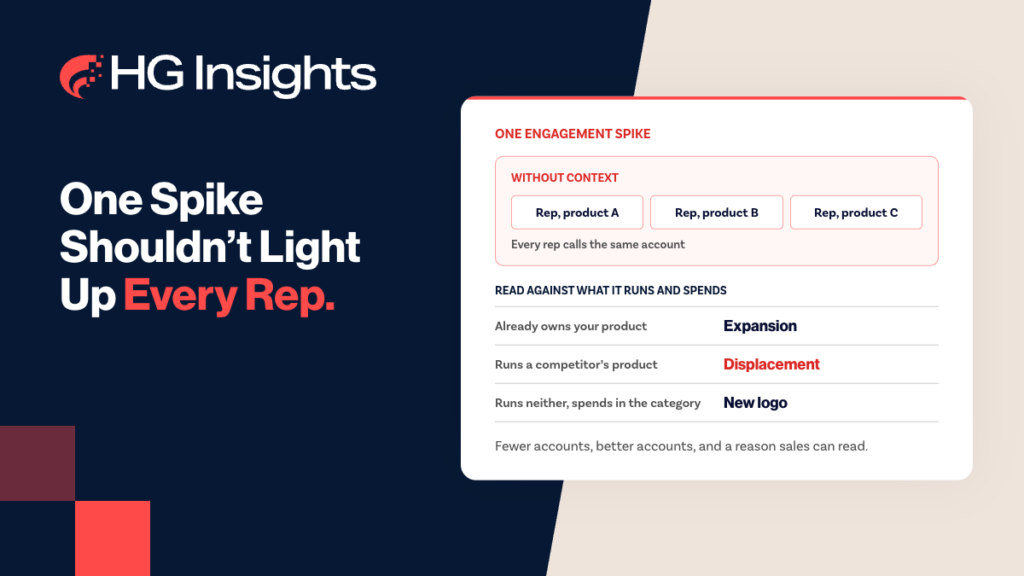
A single engagement spike doesn’t know any of that. It says an account is “in market,” so the account lands on every team’s list at once. The rep selling product A calls. So does the rep selling product B. The account already owns product A, as it turns out, and was actually reading about a competitor’s version of product C.
One holistic score can’t tell a new logo from an expansion from a competitor’s customer. It also can’t tell which product the interest is about. So the same account gets three conversations it didn’t ask for, and three reps conclude, separately, that marketing’s list is noise. Multiply that across a quarter and the target list loses its credibility one awkward call at a time.
The people cost behind the pushback
It’s tempting to frame this as a data problem. Mostly it’s a trust problem, and trust is personal.
The ABM lead built the list in good faith. The rep who wasted an afternoon on the wrong account remembers that afternoon. Marketing ops fields the question “why was this account flagged?” and can’t give a straight answer, because the score doesn’t show its work. Every unanswerable question makes the next list a little easier to ignore.
The workarounds that follow are understandable and expensive. Teams buy one-off competitor customer lists campaign by campaign. They build target lists by hand in spreadsheets. They push reps toward yet another dashboard, and reps who already juggle too many tools tune it out. Sales leadership starts asking for proof of accuracy on their own accounts before they will entertain another score. That’s a fair ask. It’s also the standard most intent lists can’t meet today.
The missing piece: what each account already runs and spends
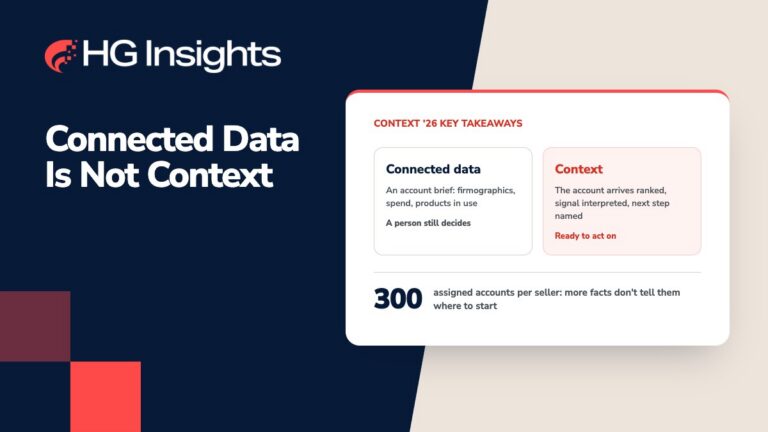
The fix isn’t more intent. It’s reading the intent you already have against two things most lists leave out: what each account already runs, and what it spends.
Once intent sits next to install and spend data, the same surging account starts to say something specific. If the account already owns your product, that’s an expansion conversation for the account team. If it runs a competitor’s product (likely approaching renewal, based on how long it’s been installed), it’s a displacement play. If it runs neither and spends meaningfully in the category, it’s a new-logo opportunity.
That one change splits a single hot list into separate, smaller campaigns, each with a visible reason behind every account. New logo goes to one team with one message. Expansion goes to another. Displacement gets its own timing and its own offer. The spike stops lighting up every rep, because now it points to the right one.
Fewer accounts, better accounts, and a reason sales can read. That’s the list reps tend to actually work.
A list with a reason attached
None of this asks marketing to rip out the ABM platform that runs its ads and orchestration. That platform still does its job. The missing layer is precision about each account, sitting beside it, so that what the platform flags can be filtered by what the account owns and spends before it ever reaches a rep.
HG Insights builds that layer. Its Contextual Intelligence Platform reads intent against more than 15 years of install history and 150+ IT spend categories, so Contextual Buyer Intent can separate new-logo, expansion, and displacement opportunities, and AI Scoring can show the signals and weights behind every ranking. Results can be exported and handed to sales as a list with the reason already written down.
The renewal meeting will still happen. The difference is walking in with a list sales already agreed to work.
Frequently Asked Questions
Why does sales ignore marketing's intent data?
Sales often ignores intent data because a single intent signal or score cannot say which product an account is interested in, whether the account already owns it, or whether it runs a competitor’s product. When high-rated accounts convert like low-rated ones, reps lose confidence in the list and return to working accounts by instinct.
What is ABM intent data?
ABM intent data is a set of signals, usually content consumption and research activity, that suggests an account may be researching a topic related to what a company sells. Account-based marketing teams use it to prioritize target accounts, time outreach, and decide which accounts to hand to sales.
How can intent data be made more useful for sales?
Intent data becomes more useful for sales when it is read against what each account already runs and spends. That context separates new-logo, expansion, and competitive-displacement opportunities, so each account goes to the right team with a clear reason attached instead of landing on every rep’s list at once.
When should a team reevaluate its ABM or intent platform?
A team should reevaluate its ABM or intent platform during contract renewal or next-year budget planning, when marketing must show what the platform produced. A short test on the team’s own target list before the budget decision gives a direct comparison of which accounts sales will actually work.